
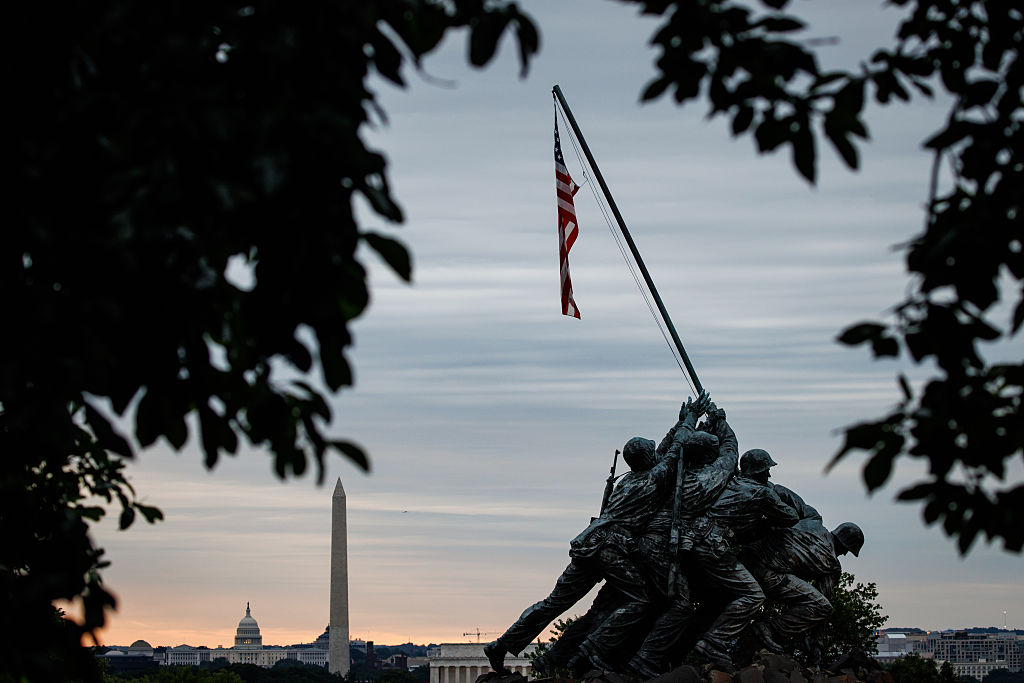
You know the photograph. You have seen it on postage stamps, on posters in VA waiting rooms, on the walls of diners and VFW halls from Bangor to Bakersfield. Six men strain against a pole on a hilltop of volcanic ash, raising the American flag over Mount Suribachi on Iwo Jima. It may be the most reproduced image in the history of warfare. It became a monument — literally — cast in 78 tons of bronze at Arlington National Cemetery.
But most Americans cannot name the men in the photograph. And almost no one knows what happened to the man on the far left.
His name was Ira Hamilton Hayes. His story reveals some uncomfortable truths about America while also revealing the exceptional bravery of individual Americans. As we approach Memorial Day, his story is well worth remembering – heroic, painful, and tragic as it may be.
Hayes was born on January 12, 1923, on the Gila River Indian Reservation in Sacaton, Arizona. He was Akimel O’odham — Pima. His father, Joseph, was a World War I veteran and a farmer. His mother, Nancy, taught Sunday school. They were quiet, faithful people.
When Ira was born, his parents were not citizens of the United States. Congress did not pass the Indian Citizenship Act until 1924. Arizona did not permit Native Americans to vote until 1948. The Hayes family knew all of this. They displayed an American flag on the wall of their home anyway.
Think about that for a moment. The Hayes family loved a country that their ancestors had lived in for thousands of years, but which had not yet decided whether to count them as its own.
In August 1942, at the age of 19, Ira Hayes enlisted in the United States Marine Corps. He volunteered for paratrooper training — one of the most punishing courses the military offered — and became the first Pima in history to earn his jump wings. His fellow Marines nicknamed him “Chief Falling Cloud.”
Ira shipped out to the Pacific and saw combat at Bougainville in the Solomon Islands, where he served as an automatic rifleman. Some of the most brutal fighting of the war took place in these unforgiving jungles. He did not talk much. Those who served alongside him said he could be in your presence for hours without speaking. But he did his job, and he did it well.
In February 1945, Hayes landed on Iwo Jima with the 28th Marines, 5th Marine Division. The battle was savagery on a scale that defies summary — 6,821 Marines killed, another 19,200 wounded, across five weeks of fighting over eight square miles of sulfuric rock. When Hayes’s company – Easy Company, 2nd Battalion, 28th Marines – landed on Iwo Jima, it was 246 men strong. Only 27 managed to escape injury or death.
On February 23, Hayes was part of a patrol sent to raise a replacement flag atop Mount Suribachi. Joe Rosenthal of the Associated Press was there with his camera. The shutter clicked. And Ira Hayes, the quiet boy from the reservation, became an icon.
He did not want to be one.
Three of the six men in the photograph — Michael Strank, Harlon Block, and Franklin Sousley — were killed in action on Iwo Jima within days of the flag-raising. The three survivors, Hayes among them, were pulled from combat and shipped home to serve as the public face of the Seventh War Bond drive. They were paraded across the country. They shook hands with the President. They spoke at rallies and dinners. They raised $26 billion in war bonds. They were, in every functional sense, celebrity props.
Hayes hated it. He said it felt like “a bad dream.” He did not believe he had done anything heroic. The heroes, he said, were the men who did not come home. He asked repeatedly to be sent back to his unit. Eventually, the Marine Corps obliged and returned him to duty in the Pacific.
There is one detail about Hayes in the aftermath of the war that I find especially revealing. In the years after the flag-raising, it came to light that one of the Marines in the photograph had been misidentified. Hayes traveled to Texas to visit the family of Harlon Block and confirm that Block, not the man the military had named, was in the photograph. He did this because the truth mattered to him — even when the fame did not, even when it cost him something to correct the record. That is character. It is the kind of character that a republic depends on and rarely rewards.
After the war, Hayes went home to the reservation. He worked menial jobs. He suffered from what we now call post-traumatic stress disorder, though in the 1940s and 1950s the country had no adequate language for it and offered no adequate treatment. He drank. He was arrested dozens of times — by some accounts, more than 50. No one intervened in any meaningful way. No institution that had used his image and his story to sell bonds and burnish the national narrative stepped forward to help the man behind the monument.
On November 10, 1954, Hayes attended the dedication of the Marine Corps War Memorial at Arlington — the massive bronze sculpture modeled on the very photograph he appeared in. He stood in front of a monument to himself. Two months later, on January 24, 1955, he was found dead near his home in Bapchule, Arizona. He was thirty-two years old. The cause of death was exposure and alcohol. He was lying in a drainage ditch. There were two inches of water in it.
He was buried at Arlington National Cemetery with full military honors.
But the harsh truth is that Ira’s country should have honored him before he was in the ground. Not with parades and made-for-TV moments, but with a commitment to healing the wounds of war and continuing to serve those who had been through hell for their country even after the war was over. Tragically, this failure was one that would be repeated too often. Ira’s story became the story of too many veterans who did not receive the support they were owed.
Nearly a decade after Hayes died, the songwriter Peter La Farge wrote a song about him. La Farge had been inspired in part by the 1961 film The Outsider, in which Tony Curtis portrayed Hayes. Johnny Cash recorded La Farge’s song in 1964 on a concept album called Bitter Tears: Ballads of the American Indian.
The song — “The Ballad of Ira Hayes” — traces the arc of Hayes’s life in plain, unsparing language: a Pima boy goes to war, becomes a hero, comes home, and is abandoned by the country that made him a symbol. It ends where Hayes ended — in the ditch.
Almost all country radio stations refused to play it. The song was too uncomfortable. It shattered too many assumptions. It made listeners feel something other than proud, and the gatekeepers of American popular music decided that was unacceptable.
Cash’s response was extraordinary. He took out a full-page advertisement in Billboard Magazine — a public letter addressed to disc jockeys, station managers, and owners. His question was blunt: “Where are your guts?” Cash understood something that the men who ran country radio did not. Honoring a man means telling his whole story, not just the chapter that flatters the audience. You do not get to wave the flag Ira Hayes raised and then look away from how he died.
Our performative culture has perfected the commodification, profiteering, and exploitation of the celebrity of the moment when it serves the national mood. And we discard them when the cameras move on. We send men and women into combat under the banner of the republic’s highest ideals, and then we greet them on the other side with bureaucratic indifference, underfunded hospitals, and a thank-you-for-your-service culture that asks nothing of the person saying it.
The flag that Hayes raised on Suribachi was not a prop. It was a covenant. It represented a promise — not merely that America would win its wars, but that the republic would be worthy of the blood spent to defend it. Every time we fail a veteran, every time we invoke sacrifice in a speech and abandon it in policy, we break that covenant. And the breaking is worse because we rarely admit it.
Scripture tells us that faith without works is dead. I would say the same of patriotism. A patriotism that celebrates the image of six men raising a flag but cannot be bothered to care for the man who helped raise it is not patriotism at all.
Johnny Cash did not sing “The Ballad of Ira Hayes” to make people feel patriotic. He sang it to make people feel accountable. There is a difference, and the difference matters. True patriotism asks hard questions, and then answers them with action.
The monument at Arlington depicts six men straining to raise a flag on a mountain of volcanic rock. One of those men was a quiet Pima boy from Arizona who loved his country before his country recognized him as a citizen. He fought for a nation that would not let his people vote. He raised a flag that became the most famous image of American resolve in the twentieth century. He deserved better than dying alone beside an abandoned hut on a cold Arizona night.
Yet Ira’s story is also part of what makes this country exceptional. His service, and Johnny Cash’s refusal to let the nation look away from his fate, remind us that America’s greatness is not found in pretending perfection but in confronting our failures and correcting them. A free people, armed with the First Amendment and a conscience, can speak for those who cannot speak for themselves. That is why veterans today receive more support than Ira ever did — and why we still have work to do.
Americans understand that we are not defined by the worst chapters of our past but by the courage with which we write the next ones. The measure of a nation is not whether it has stains, but whether it has the integrity to face them and the will to rise above them.
So, when Memorial Day arrives later this month, resist the easy ritual of polite thanks that evaporate by nightfall. Honor the fallen the way they honored us — with action. Stand with a veteran in your community. Demand accountability from leaders who forget the cost of the freedoms they invoke. Fight for policies that match the magnitude of the sacrifices made on our behalf. Live each day in a way that proves their blood was not spent on a complacent people.
American exceptionalism is not sentiment. It is resolve — the daily decision to defend what those six men raised that flag for, and to ensure that no American who served this nation ever dies forgotten.
God bless our veterans, and God bless the United States of America.
Phill Kline is a former state legislator and the former Attorney General of Kansas. He is currently a law professor.





How both sad and beautiful this article is. Thank you for the information on the man on “the left”, Ira Hamilton Hayes was a beautifully humble man who service a country that has lost it passion for true history. I only hope that there are truly no man left behind in our military. Our veterans deserve more respect and recognition then they get. Let pray that we will become the America that we love along with our military and 1st responders.
Outstanding article, thank you.
My Dad fought on Iwo Jima and was awarded a Purple Heart…he hardly spoke of any of his exploits to us, Mom was the one who would answer our questions. The only stories I heard were the ones told by my Dad and his brothers (who all served in WWII, in various branches) during family reunions. I do remember a few occasions when he spoke of Ira Hayes with a low, reverent tone. I truly believe he (and others) felt Ira’s pain and anguish but did not know how to process it (PTSD).
A personal friend of mine was on Mt. Suribachi with Ira Hayes. He knew him well and always referred to him just as “Ira” when we talked. That friend is in the original picture of the flag raising with other Marines, but was cropped out of the photo. I have a copy of that photo showing them both.
There is a film about this subject which was released in 2006. It is a good film and has been shown recently on HBO, I think. It is very touching and worth the time for sure. Thank you for the article Mr. Kline.
I wish I could take this and say it never happened again but while I served in the Army one of our duties while being in the states was to serve as funeral detail for the fallen and veterans. Our jobs were pallbearers, rifle squad, flag folding, flag presentation and we were always accompanied by a bugler. These days the amount of honor shown to you is now depending on rank, or achievement, and in most cases now there no longer is a rifle squad, and the bugler is now replaced by a tape being played by national cemetery personnel, one last poke of being “Government Issue” or “G.I.” After years of service the service can no longer be bothered to attend a soldier’s last send off. However, even then I recall a funeral for a retired Master Sergeant who had served multiple tours in Vietnam, Silver Star, multiple Bronze Stars, Purple Hearts, … It was only us, the detail, the director of the national cemetery, and the funeral home director in attendance, he had died in a state run home for old soldiers, his daughter had married and now lived in Hawaii and sent a note that she would not attend. There was no coffin, only an urn, and it took the funeral home director several minutes to find the deceased in the trunk of his car. The funeral proceeded, the pallbearers were not needed and waited on the bus the rest of us performed our duty flawlessly, the flag would have to be sent to his daughter including the 21 spent shell casings we usually handed over tucked into the triangle folded flag. On the ride home the bus was a lot more quiet than usual as we all reflected on this strange last ritual that was to be the last of many events in the life of a man who had given so much for our nation, and how honor and disrespect were displayed during the same event.
Wow.
Just wow.
So inspiring…
But SO deeply sad!
And with God’s perfect timing,
I had just watched a documentary about the Pacific Islands part of WWII a few days ago and included in the grainy black and white 16mm footage of the war?
Was that iconic moment.
Captured on film.
Not as a still pic which doesn’t really convey the “moment”…
But instead, the actual momentS of that flag raising.
I’m a boomer. Born in ’55.
And for whatever unknown reasons…
I’ve always been DEEPLY patriotic…
but also inspired as a young boy,
by Combat and Rat Patrol and yes, even by Hogan’s Hero’s (watch it again and you’ll realize that yes, it’s funny but ..
It’s also VERY serious!!! Just listen anytime Hogan is talking about a mission and how dangerous it will be…
It’s never made light of, joked about, passed off, or trivialized!
I played “war” several times a week after school with my closest friends.
We may only have been 9 or 10 or 11
… and even though it was an enjoyable activity?
we also took it seriously.
We were always bummed when our group didn’t “win” and complete our mission.
No one ever preached to us about the war,
and those shows didn’t glamorize the war either!
But even as kids,
we saw the courage and commitment of the soldiers and knew they were fighting for a worthy and just cause.
We wanted to BE LIKE THEM and fight the bad guys so they wouldn’t win!
So in my living room,
just a few days ago?
When I saw that movie clip of that iconic moment?
I sat quietly and replayed that short clip of those men raising that flag and thought of how beaten up, tired, battered and sore they must’ve been…
But also how determined,
and proud to have beaten the enemy,
and how determined and resolute to hoist our flag to “stake our claim” on the ground just taken in the previous battle…
I played it over and over. In slow motion. Pausing it here and there.
And oddly!!
For some unknown reason.
My focus was always drawn to the boy on the left.
He seemed to be leaning in farther and trying harder to help plant that flag.
And now?
To read his inspiring but SO sad story!?
I desperately wish I could have been there with him when he got home.
Been his close friend who understood.
Who helped him process and work thru all that he had been thru!
All that had come home with him!
I wished I could’ve tried my very best to help him reclaim his life and not lose himself in a lonely hole of depression and loss!
I’m also very proud of what Johnny did with that inspiring song.
He was big when I was growing up and I lived not far from Folsom prison…
But it’s only years and years later, as a man,
that I’m coming to know the real man Johnny was.
Our countries colors ran DEEP and STRONG in both those boys,
And I’m SURE that Johnny felt JUST as I do now!
I’m certain he also wished with all his heart,
that be could’ve been there to take “Falling Cloud’s” hand and say:
“I understand.
I’m wounded too!
Let’s be there for each other
and TOGETHER,
climb our way out of this dark trench to heal and celebrate the victory, in honor of those who didn’t make it back!!
After all, that’s what THEY would want us to do!”
I’m sure that’s why he was SO determined to get that song out there!!
Determined to tell Ira’s story of commitment and sacrifice!
Wow.
Just
Wow.
I’m NEVER,
EVER
going to feel the way I used to when I see that picture or that sculpture!
I hope you also were changed by Ira’s story of desire, commitment and quiet determination,
and will also go forward now with an even GREATER and DEEPER respect for the price ALL our veterans have paid!
Whether they made it home,
or not…
Wow.
Wonderful article, the one that every WOKE should be forced to read, and learn that there is a difference between the man and a meowing kitten, assuming they’d be able to comprehend Ira Hamilton Hayes was a man very few knew about ,not remember or talk about, all of us know who and what George Lloyd was, the martyr of the left. What a contrast, what a shame.
Thanks for a great article, and it shows how much different life in USA was in foities and fifties. Iwo Jima was one of the most horrific battles of WWII. I recommend reading book FLAGS OF OUR FATHERS for a good history lesson & an example of what the Greatest Generation faced in WWII and after.
I’m proud to say I knew of Ira Hayes and what happened to him. I would like to add that John Basilone was also paraded around the country to raise money after he received the MOH on Guadalcanal. He begged to be released from that service and was finally returned to his unit and died shortly after on Iwo Jima. Both of these men were great warriors and should never have been made a public spectacle. Politicians always ruin things.
phil kline you nailed it. Hayes is an american example of dedication and willingness to give and sacrifice enough he was,nt recognized as a citizen
Excellent, and sadly moving article. So many things we, personally and as a nation, in retrospect might and/or should have done differently. Article led me to google Johnny Cash’s Ballad of Ira Hayes, which I don’t remember ever hearing before. Brought tears!!
My husband came home after a tour in Viet Nam during the anti-war movement of the 1960s. He saw some of that in the airport when he came home. But thank goodness the area we lived in was in was south of DC with government buildings and military bases; so no such groups.
PTSD is real as I’m sure which plenty of AMAC members can confirm. It haunts them, especially in dreams.
I thank each and every one of you veterans. Likely most served tours in Viet Nam. God bless you all.
I heard about Ira Hayes through the Great Johnny Cash song. God Bless You, Ira. Thank you for your service to this country. R.I.P.
An exceptional story of true American heroism…not the Hollywood version, Thank You!
I had not known of Ira Hayes, nor heard the Cash song. This article brought Ira Hayes to life, and made my heart sad over his end. What a gift you have, Phill Kline. My family has always honored our family, and war veterans, who have passed by decorating their graves with flowers, real and artificial, on Memorial Day. We are keeping a promise to our Mother, and no one will carry on the tradition when we are gone.
Heard of Ira Hayes before Johnny Cash honored that HERO in The Ballad of Ira Hayes.A beautiful but condemning story and one that should have made the Arizona Government of the day weep with shame.I meet many vets these days who honor me with their friendship.Indeed my own dear son is a U S M C Vet and combat marine,Afghanistan.I myself am a Royal Air Force vet who once shared a room with a Johnny Cash fan.I still “Walk The Line”,God bless all Vets.