
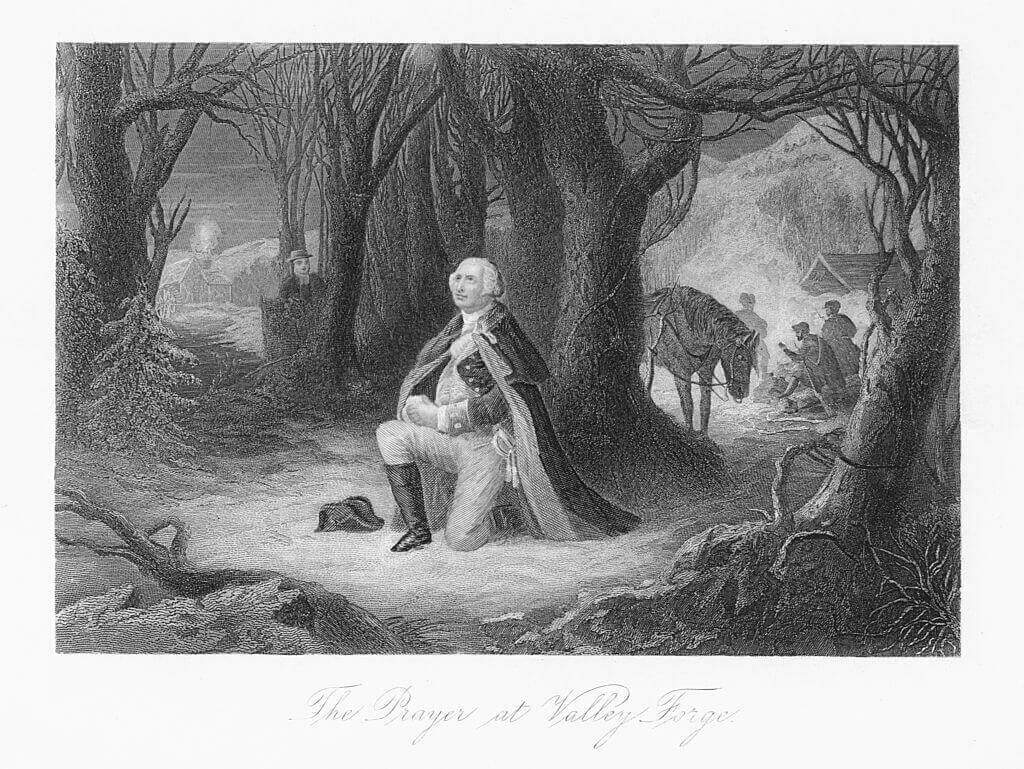
While Congress officially recognized George Washington’s birthday on Monday – a holiday observed by most as “Presidents’ Day” – Washington’s actual birthday falls this weekend, on February 22. As we honor perhaps the greatest American to ever live, especially so in this 250th year of independence for the nation he made possible, one famous image refuses to fade: a solitary commander on one knee in the snow at Valley Forge, praying for a starving army and a fragile cause.
Perhaps the most famous depiction of this scene, and the one that most Americans will immediately recognize, is Arnold Friberg’s famous 1975 painting The Prayer at Valley Forge– created for the bicentennial celebration in 1976. But the legend of Washington’s appeal to Heaven during the Revolution’s most dire hour is far older than that. While it may be more founding myth than verified fact, the courage, faith, and divine dependence it represents are rock-solid history – and they reveal why America remains exceptional.
The story begins in December 1777, after British forces seized Philadelphia. Following a string of demoralizing defeats, Washington led 12,000 Continental soldiers to the wooded hills of Valley Forge, 20 miles northwest of the city.
The winter that followed tested whether a nation conceived in liberty could survive. Supply lines collapsed. Local farmers hoarded food for British gold. Rations dwindled to fire-cakes of flour and water. Disease – typhus, dysentery, pneumonia – swept the crude log huts. Between 1,700 and 2,500 perished. Others left bloody footprints in the snow, marching without shoes.
Washington pleaded with a broke Continental Congress for food and supplies, to no avail. It seemed that the American experiment would perish in the bitter winter cold before it even began. On February 16, 1778, Washington wrote bluntly: “Naked and starving as they are, we cannot enough admire the incomparable patience and fidelity of the soldiery…”
The commander-in-chief marveled that mutiny had not already scattered his forces. Some officers whispered that Horatio Gates should replace him. Yet Washington stayed – praying, pleading, drilling, and holding the line.
Here enters the famous “Prayer at Valley Forge.” Popularized in the early 1800s by biographer Mason Locke Weems, the story tells of a Quaker named Isaac Potts stumbling upon Washington kneeling in a grove, tears on his cheeks, beseeching “the God of the Armies” for aid at this crisis “of the country, of humanity, and of the world.” Moved, the pacifist Quaker declared that God would surely bless such a leader.
The tale may be embellished – Washington’s devotions were typically private, and no 1788 eyewitness account of the alleged encounter survives. But the tale endures nonetheless because even if it is a legend, the legend reveals the man.
Washington’s letters overflow with appeals to Providence. He called the army’s survival a mark of obedience “scarce paralleled.” He ordered days of fasting and prayer and reminded his men that their cause rested “under God.”
Eight years later, with the victory won and a new nation born from the icy fires of Valley Forge, President Washington did not forget that Providence had delivered the cause of liberty from seemingly certain destruction. During his Farewell Address in 1796, his retirement from public life, he declared religion and morality “indispensable supports” of republican government.
“Of all the dispositions and habits which lead to political prosperity,” he wrote, “religion and morality are indispensable supports.” Valley Forge proved it – not through theatrical display, but through quiet, steadfast reliance on a higher power when human resources failed.
Out of that hellish winter at Valley Forge came renewal. Baron von Steuben arrived on February 23, 1778, to drill the troops in professional tactics. Supplies improved. Morale hardened. By June, the army marched out transformed – ready to fight the British to a standstill at Monmouth and ultimately prevail at Yorktown.
Valley Forge was more than a winter encampment; it was a national formation. In those frozen huts, a disparate collection of colonies began to see themselves as one people bound by a common destiny. Hardship forged unity. Suffering clarified purpose. The army that emerged in June was not only better trained – it was spiritually steeled. They had learned that liberty is preserved not by comfort, but by sacrifice; not by ease, but by endurance.
In that sense, Valley Forge became the moral furnace in which the American character was defined.
No other revolution had such a crucible. France had its guillotine, Russia its gulags. But Valley Forge was something different – citizen-soldiers enduring not for plunder or power but for the self-evident truth that rights come from the Creator. The general leading the American Revolution was not a self-exalting leader with his eye on a throne, but a man humbled by experience who came to know leadership is submission of self to a higher cause that is modeled in obedience to God.
Washington at Valley Forge showed that American Exceptionalism is not arrogance but covenant – accountability to God, fidelity in suffering, courage when all seems lost. The image of Washington quietly pleading for divine intervention further shows that exceptionalism is not a boast, but a burden – a people answerable to the Author of their liberty – almighty God.
In our own day of division and doubt, Valley Forge whispers the same question Washington faced: Will we trust in ourselves alone, or in the Providence that carried barefoot patriots through the snow to meet the enemy? The answer that saved the Revolution can still save the Republic.
As Ronald Reagan once reminded us, the Father of our Country sought divine guidance in the cold gloom of winter. May we do the same. For if those few thousand endured that long winter of privation and suffering through faith alone, what right have we to be of little faith?
As we approach 250 years of independence, Valley Forge calls us not to nostalgia, but to renewal. It summons us to reclaim the faith that looks upward in crisis, the courage to stand firm amid hardship, and the humility that acknowledges every blessing as a gift from above.
Let us rise from our own winters – personal, national, cultural – with the same resolve: to pray earnestly, to persevere faithfully, and to build a future worthy of those who bled in the snow, and the One who bled on the cross. For in trusting Providence as they did, we honor our forefathers best – and secure the promise of liberty for generations yet unborn.
Phill Kline is a former state legislator and the former Attorney General of Kansas. He is currently a law professor.
[adrotate banner=”1223″]



All Christians should be adhering to the last paragraph of this article. The legal government should be supported. Vote out all who are spewing out that there is no True God. They will meet their fate at the last Judgement. The fate of the nation now rests with the upcoming midterm election. Our nation needs to continue to show our undying support of the freedoms that the Founding Fathers granted to us and those who have died defending these freedoms since the American Revolution and thereafter. Sempre Fidelis.
Good spirit in this article ,the importance of remembering the work it took to have Liberty prevail in the American revolution.. Have visited Valley Forge five times during my 75 years; grew up in Philadelphia. The last sentence of the Declaration comes to mind reading this article – “And for support of this Declaration , with firm reliance on the protection of Divine Providence,we mutually pledge to each other our lives, our fortunes,our sacred Honor.” There is much to think about in the Valley Forge part of of American history.I do believe it could be said the experience established a standard in many ways – something that involves a reverence for Liberty..
What a story, moves one to tears. This should be branded on the brains of every democrat and the young idiots who protest not having any idea against what. If not that it should hang in every classroom and public office, like a prayer , picture from Normandy landing and flag raising on Iwo Jima would not hurt Everyone must remember what America is, no one can change that fact not even democrats and their minions.
This is the story of our birth excruciatingly painful and beyond endurance. Longest birthing ever . That birth certificate should hang in every public office and classroom, so the life long politicians would not forget nor would young ones not knoing how good they have it.
A magnificent chapel now sits on the Valley Forge National Park site where General Washington knelt and prayed that fateful winter. My wife and I were married in that chapel in April 1966.
The overwhelming hardships this great man and his followers had to endure is beyond supernatural. We whine about it’s too cold or it’s too hard. We wouldn’t have stood a chance with our mindset. I pray that their sacrifice wasn’t wasted on our entitled attitudes but history isn’t taught in schools and these great lessons are forgotten, no excluded.
I did not say that and you know it.