
As the nation digs out from a ferocious winter storm that swept across the heartland and Mid-Atlantic over the weekend, blanketing millions in snow and ice from Texas to New England, we’re reminded how nature’s fury tests character. This historic blast stretched more than 2,000 miles, bringing heavy snow, damaging ice, and life-threatening conditions that disrupted lives, closed schools, and strained power grids. In such tempests, personal character is revealed.
In the winter of 1770, cultural rather than meteorological storms were sweeping across the colonies, revealing the character of a nation in gestation and testing the resolve of its future leaders.
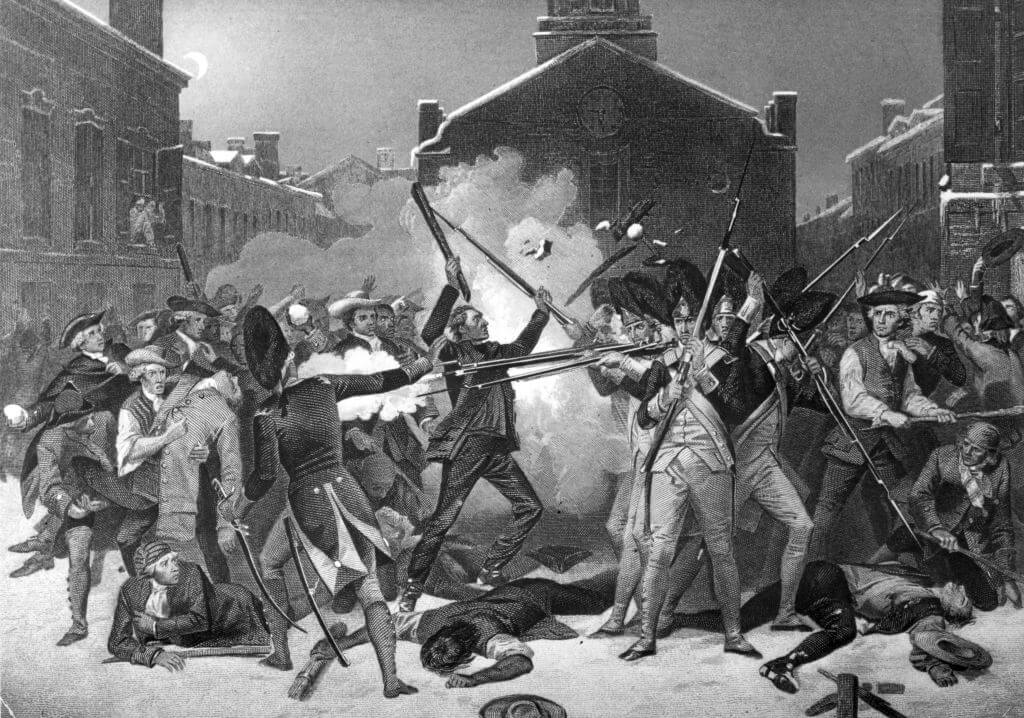
The Boston Massacre unfolded on a frigid March night, with tensions already high between colonists and British troops. A mob of Patriots taunted soldiers with snowballs, rocks, and clubs. In the chaos, the soldiers fired, killing five civilians, including Crispus Attucks – a sailor of African and Native American descent who is widely regarded as the first casualty of the American Revolution. The city erupted in fury, and the soldiers faced near-certain lynching or a biased conviction in a trial set for November 27, 1770, in the Superior Court of Judicature. (The building is still standing in Boston at 206 Washington Street.)
Enter John Adams – fervent Patriot, future president, and signer of the Declaration of Independence, and cousin to Samuel Adams. At just 35, he was already deeply committed to the cause of liberty. He was destined to be remembered as one of the most pivotal Founding Fathers and a man who poured his heart and soul into his country.
Yet when asked to defend the British captain and eight soldiers, he accepted, not for money or out of sympathy for the Crown, but out of principle. Adams believed that due process, the right to counsel, and the presumption of innocence were not trivial luxuries to be discarded when passions ran high. Rather, they were the very foundation of a free society.
Defending the “enemy” was a shocking choice. Mobs threatened Adams’ life as well as his family. But Adams pressed on, arguing that the soldiers acted in self-defense amid provocation. Six were acquitted; two were convicted of manslaughter but spared execution. And Adams, through a willingness to suffer for principle, delivered to his peers who sought independence one of the most profound lessons on a core truth that was to shape the future nation’s government structure and purpose – the moral truth that every person, even an adversary, bears the image of God and deserves dignity and fairness.
It is easy for philosophers and politicians to muse in quiet parlors and peaceful gardens about the presumption of innocence and the right to a fair trial. But the true test of how committed one is to those principles comes in moments like the one Adams faced 256 years ago, when there are real consequences for doing what is right and just over what is popular. If Adams had caved here, he would have betrayed his own argument for independence and corrupted the American experiment before it even began.
Adams’ courageous stand was not relativism, where truth bends to popularity or power. It was fidelity to absolute moral law. Adams’ courage preserved the rule of law amid rage and prevented a show trial that could have ignited a premature conflict. He embodied the radical American middle – neither surrendering to mob passions nor retreating into fear, but pursuing truth with the humility to understand that he stands on level ground in that search for truth.
Contrast Adams’ decision with today’s cultural storm. Today, many in the American legal profession – which publicly claims fidelity to the truth which animated Adams – attempt to punish dissent and allow ideological winds to supersede a higher commitment to justice.
This became glaringly obvious in the wake of the 2020 election, as lawyers who represented Donald Trump faced disbarment, fines, and professional ruin for probing serious concerns about election integrity. An entire organization, “The 65 Project,” emerged with the express purpose of disbarring and discrediting Trump-affiliated lawyers, wielding disciplinary rules in ways that reveal how moral relativism can reshape justice itself, echoing the very injustices Adams resisted.
The same can be said for the defendants implicated in the events of January 6, 2021, at the U.S. Capitol. Out of a desire for vengeance over justice, defendants with no criminal histories charged with non-violent crimes were denied bail and held in brutal D.C. prisons for months on end with no trial. Meanwhile, the same prosecutors and judges allowed repeat violent offenders to walk free. If only they had a modicum of the moral courage that John Adams displayed.
Adams recognized that the laws of man should all derive from a more transcendent truth – a natural law that ultimately comes from God. But modern legal institutions focus only on man-made, written law and are often unwilling to recognize a higher authority. This approach removes the moral nature of the law by vesting faith entirely in the exercise of procedure; if the law followed the recognized procedure in its formation, it is valid law.
Yet, we inherently know that procedural due process to an unjust law or unjust rule is merely organized injustice.
But unguided by moral truth, many in the legal space today see no issue targeting the lawyers of their political opponents or throwing the book at individuals with whom they disagree, because technically they are following the letter of the law – while denying the higher truth that law derives from.
Without a belief in external and knowable moral truth, legal terms like “moral turpitude” are shaped to mean whatever forwards the interests of those currently in power to enforce their subjective definition.
When a profession denies objective moral truth or is agnostic to that truth, it gains power to redefine moral categories to punish disfavored people or opinions. That is precisely the kind of power Adams stood against when he defended the reviled British soldiers.
But in our age of cancellation, where appearances dictate judgment, representing the “opposition” is treated as heresy. Adams, guided by eternal truth, saw beyond symbols and rhetoric. He saw the culprits of the Boston Massacre as human beings deserving a fair trial. This reflects the heart of Judeo-Christian identity – we are all children of God.
This is the antithesis to relativism’s storm, where truths shift with ideological winds and souls are imprisoned in divisions.
American exceptionalism shines in Adams’ choice, helping shape a nation conceived in liberty where virtue flourishes through defending freedoms even for adversaries.
Adams’ act preserved the Revolution’s moral high ground, proving that justice is not relative but rooted in God-given dignity. His choice shocks our political and legal culture because that culture and its discourse have lost that moral anchor.
Yet Adams’ choice speaks to us because that truth is written upon our hearts by God. And if we individually reclaim that which was gifted to us personally, we can begin the reformation necessary for our culture.
Phill Kline is a former state legislator and the former Attorney General of Kansas. He is currently a law professor.




Our nation owes a lot to John Adams.
Thanks for sharing this glimpse into his life.
This is a great article. It is too bad that it took alot less than 256 years to completely destroy all that John Adams stood for. True justice only matters when those that supposedly champion the ideology, i.e., christians and conservatives, are on the receiving end of the tyranny. This country flipped to guilty until proven innocent long ago. Most of the biggest supporters of this new reverse ideology are on the right. Unless morality and original ideology are restored to this country, all is lost. End note; I am not a liberal. I am an originalist conservative God fearing man that sees the truth.
Believe it or not, but HBO produced a seven part miniseries called John Adams. The event described above is depicted in the series. It’s well worth watching.