
Makes you smile…living in the Maine woods, I wandered a bit the other day, thinking of my brother, sisters, and me as kids – picking wild raspberries and blackberries from cutoffs, finding forgotten apple trees, pulling peaches from one old tree (always guarded by jealous yellowjackets). The wonder is that many everyday forests offer edibles. Searching for them takes you back in time.
Anywhere woods exist, you are likely to stumble on edible options. Only when we remember the process, thrill of finding, and sense of self-reliance, do we reconnect with just how much God provides.
On course, hunting – birds, deer, bear, or moose – offers its own thrill, but much of what surrounds us in the woods is edible, offering a chance to walk back into time, pioneer, and enjoy self-sufficiency.
In our Scouting days and years after, finding specimens in the woods was something of a game, a chance to prove to ourselves we were outdoorsmen, but it was also like hide and seek, fun.
One of my favorite finds in the woods, near lakes, ponds, bogs, walking rocky trails with rich earth, are teaberries. The berries themselves are one thing, but the leaves of this ground cover, four or five in a cluster – couple of inches off the ground – are like finding Wrigley’s Spearmint gum in the woods.
The leaf is a football-shaped thing, an inch in length, t bright green. If you pick it, fold it in two, then bite down on it, you are literally chewing on a flavor as satisfying as a candy cane, only with no sugar. Collect them in any New England state, dry them, and you can steep them in hot water for tea.
Then there is wild chamomile, or pineapple weed – little clusters of yellow that look like tiny pineapples jutting from thyme-like ground cover. They can be picked in bunches, dried, and become great tea, calming, not sharp, subtle, and relaxing flavor. It grows on gravel as easily as in rich soil.
Sometimes, mowing a moist, weedy lawn – and we had lots of that around us – we would suddenly smell a sharp, inviting, easily recognizable smell – wild mint. That can be picked, thrown in a lemonade, turned with something sweet into iced tea, or put in a room to fill it with mint aroma.
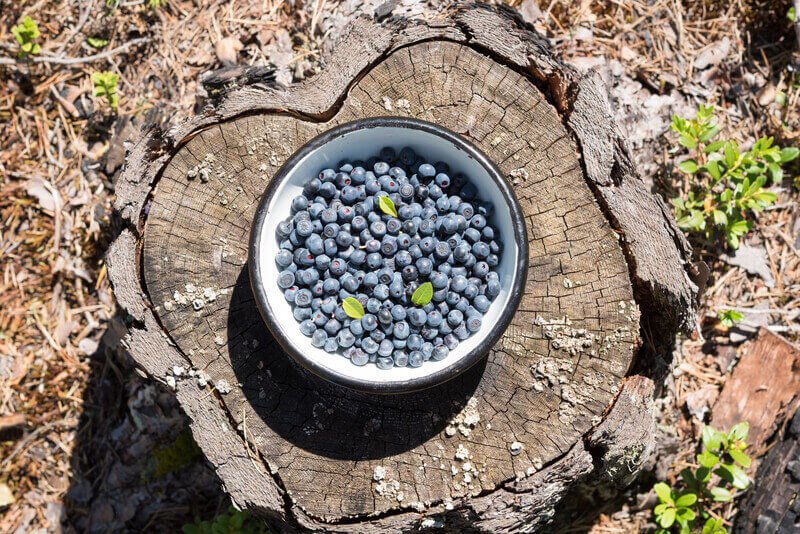
Many of the easiest and tastiest of all wild finds are wild blueberries – for centuries or longer, ringing lakes, ponds, mountain tops, encircling granite ledges, and populating roadsides, cutoffs, and high ground. As most know, they are more tart, tangy, almost citrusy, unlike domestic ones in the store.
As kids, we knew where to find them. They turned into blueberry pancakes – with Mom’s help – and when plentiful, piled up in those green cardboard boxes and got sold to summer people. The same could be said for raspberries and blackberries, which never needed planting.
Wherever there was a wood lot that was cut off, or even a clearing, the raspberries would first appear for a year or two, then get taken over by the blackberries. The wood fairies or forest elves made all this happen; no one had to plant them, none of them. They just appeared.
Of course, like it or not, the onion-like chives would dot some grassy areas, and once picked, you could smell them. Cut into little slivers, they worked in all sorts of things, a garnish with punch.
If you were really lucky, and you had to be, you might find the yellow Chanterelles, a chewy, tasty mushroom, and then dandelion leaves, when just up and tender, could be added to salad.
Finally, and this is exactly the season – late May and early June – when, without much trouble, you can find fiddleheads, the tightly curled beginning of an ostrich fern, which appears all over Maine, New England, and elsewhere. Caught before they begin to unwind, they are delicate and delicious.
Maybe the funniest edible, which never proved as edible in practice as in theory, is the inner bark of a pine tree, edible cambium, a wet, firm, boilable layer theoretically nutritious. I tried it once, as I did with “spruce gum” from an old spruce tree. Chewable, both are better left for survival school.
All said, the woods are rich in edibles around us. With a little searching, maybe a guidebook, and some modest daring, you could find your next hike enlivened by teaberry leaves, which makes you smile.
Robert Charles is a former Assistant Secretary of State under Colin Powell, former Reagan and Bush 41 White House staffer, Maine attorney, ten-year naval intelligence officer (USNR), and 25-year businessman. He wrote “Narcotics and Terrorism” (2003), “Eagles and Evergreens” (North Country Press, 2018), and “Cherish America: Stories of Courage, Character, and Kindness” (Tower Publishing, 2024). He is the National Spokesman for AMAC. Today, he is running to be Maine’s next Governor (please visit BobbyforMaine.com to learn more)!








I do remember those days of wondering in the woods near our home in Maine and finding the many great treasures. Living in west Texas now and sure do miss the woods of Maine. The best to you Bobby on your path to the governor of Maine
RBC, I waited to read your article after I had my lunch. I didn’t want an early appetite. Agree with you the amazing edibles that can be found in the woods. Just avoid the poison ivy and oak.
Have a good weekend.
WOW, just WOW! – almost wish I had grown up in Maine….. but, I grew up in West Texas where finding agates and arrowheads were our fun!
My family has been picking huckleberries in the woods above Monterey for about 140 years. I always go up for the first time in July. Coming soon!