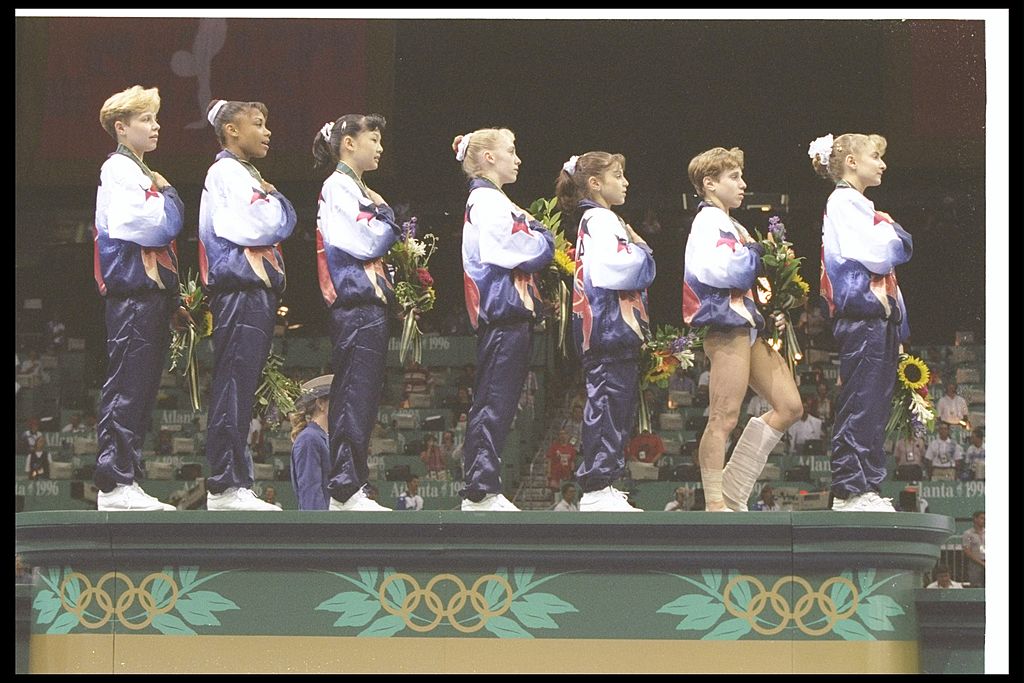
On July 23, 1996, the United States women’s gymnastics team achieved one of the most unforgettable moments in Olympic history, capturing its first-ever Olympic team gold medal at the Summer Games in Atlanta, Georgia. Before a roaring home crowd inside the Georgia Dome, seven young athletes—later immortalized as the “Magnificent Seven”—delivered a performance of determination, resilience, and extraordinary athleticism that forever changed American gymnastics.
The team consisted of Amanda Borden, Amy Chow, Dominique Dawes, Shannon Miller, Dominique Moceanu, Jaycie Phelps, and Kerri Strug. Although the United States had fielded talented women’s gymnastics teams in previous Olympics, gold had always remained elusive. For decades, powerhouse nations such as the Soviet Union, Romania, and Russia dominated the sport. Entering the Atlanta Games, however, many believed the American squad finally had the depth and talent to challenge for the top spot.
Throughout the competition, the Americans performed with remarkable consistency under intense pressure. Veteran Shannon Miller, already one of the most decorated gymnasts in U.S. history, provided steady leadership alongside team captain Amanda Borden. Dominique Dawes dazzled with her powerful routines, Amy Chow delivered dependable performances across multiple events, and the younger gymnasts contributed critical scores that kept the United States in contention heading into the final rotation.
Everything came down to the vault. Fourteen-year-old Dominique Moceanu unexpectedly fell on both of her attempts, placing the team’s hopes squarely on 18-year-old Kerri Strug. On her first vault, Strug landed awkwardly, severely injuring her left ankle. Believing another successful vault was necessary to secure the gold medal, coach Béla Károlyi urged her to make one final attempt. Fighting through intense pain, Strug sprinted down the runway, launched into a one-and-a-half twisting Yurchenko vault, and stuck the landing before hopping on one foot and collapsing to the mat. Her courageous performance earned a score of 9.712, effectively clinching the championship for the United States. Only afterward did officials realize the Americans had already accumulated enough points to win even without the second vault.
One of the defining images of the Atlanta Olympics came moments later when Károlyi carried the injured Strug to the medal ceremony as the crowd erupted in celebration. The photograph and television footage became iconic symbols of perseverance, teamwork, and Olympic spirit. The United States finished ahead of Russia, which earned the silver medal, while Romania claimed the bronze.
The victory transformed women’s gymnastics in America. Millions of young girls were inspired to enroll in gymnastics programs, television audiences for the sport surged, and the “Magnificent Seven” became household names. Their historic triumph also helped usher in a new era of American excellence, paving the way for future Olympic champions and teams that would continue to dominate international competition.
More than three decades later, the gold medal won on July 23, 1996, remains one of the defining moments in U.S. Olympic history. It stands as a testament to preparation, courage under pressure, and the power of teamwork to achieve what had once seemed impossible.