
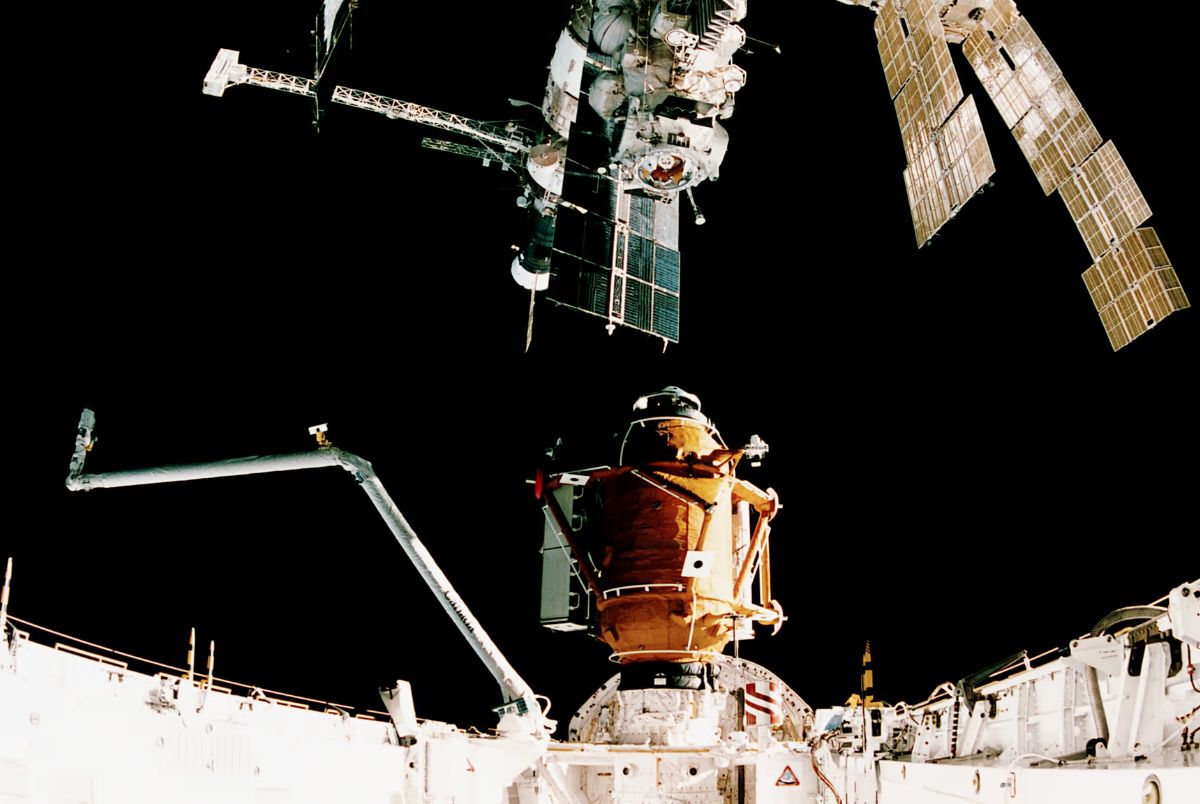
On June 29, 1995, the American space shuttle Atlantis achieved a milestone once thought unimaginable: it successfully docked with Russia’s Mir space station, marking the first docking between an American space shuttle and a Russian space station. Coming just a few years after the end of the Cold War, the mission symbolized a remarkable transformation in international relations, replacing decades of fierce competition in space with a new era of cooperation.
The docking was the centerpiece of NASA’s STS-71 mission, launched from Kennedy Space Center on June 27. Commanded by veteran astronaut Robert “Hoot” Gibson, Atlantis carried a crew of seven, including two Russian cosmonauts who would remain aboard Mir. After a carefully choreographed rendezvous 250 miles above Earth, Atlantis gently connected with Mir at approximately 9:00 a.m. Eastern Time. Together, the linked spacecraft weighed more than 220 tons, making them the largest man-made object ever to orbit the Earth at that time.
The achievement was significant for more than its engineering precision. For nearly half a century, the United States and the Soviet Union had been locked in the “Space Race,” competing to achieve milestones such as the first satellite, first human in orbit, and first moon landing. Although the 1975 Apollo-Soyuz Test Project had demonstrated limited cooperation, relations soon cooled again. By the mid-1990s, however, geopolitical realities had changed, and the Shuttle-Mir Program became an opportunity for the former rivals to work together toward common scientific goals.
During nearly five days docked together, the American astronauts and Russian cosmonauts conducted dozens of scientific experiments focused on human adaptation to long-duration spaceflight, life sciences, and microgravity research. The crews also transferred equipment, supplies, and personnel. Most notably, American astronaut Norman Thagard—who had spent more than three months living aboard Mir—returned to Earth aboard Atlantis, while Russian cosmonauts Anatoly Solovyev and Nikolai Budarin took his place on the station.
The success of STS-71 laid the groundwork for nine shuttle dockings with Mir between 1995 and 1998. Those missions allowed American astronauts to gain invaluable experience living and working in space for extended periods while strengthening operational partnerships with Russian space agencies. The lessons learned proved essential when construction began on the International Space Station (ISS), a multinational project that continues to serve as humanity’s premier laboratory in orbit.
Today, the docking of Atlantis and Mir stands as a powerful reminder that exploration can unite former adversaries in pursuit of shared knowledge. It demonstrated that scientific discovery often transcends politics, opening the door to decades of international collaboration that continue to expand humanity’s understanding of life beyond Earth.







I’ve made $84,000 so far this month working online and I’m a full time student. I’m using an online business opportunity I heard about and I’ve made such great money. It’s really user friendly and I’m just so happy that I found out about it. The potential with this is endless.
.
Here’s what I do. . . . . . JobatHome1.Com