
Taking themed vacations has soared in recent years, with travelers focused on visiting specific attractions across the country such as modern art museums, ballparks, award winning food trucks, national parks or historic monuments as examples. In this spirit of adventure, why not enjoy a road trip to explore some iconic bridges?
Structures promoting human contact
The allure of bridges is longstanding. Boasting unique designs, beauty and history, more than 623,000 bridges stretch across the USA. Travelers are intrigued by these natural or engineered structures that traverse land and water. Not only do they serve to connect people and places and make life more productive, but they also encourage freedom to explore.
Add these to your travel bucket list: Enjoy reading about three highly visitable bridges with unique stories to share.
Bridge #1, The Frankford Avenue Bridge
Per Atlas.com, the creek of Pennypack is home of the oldest surviving man-made bridge in the United States. The three-span and 73-ft long bridge stretches over the Creek of Pennypack and sits on the northern parts of Solly Avenue in Holmesburg, Philadelphia.
The famed twin-stone bridge is known by many names, including The Frankford Avenue Bridge, The King’s Highway Bridge, the Holmesburg Bridge, the Pennypack Bridge or the Pennypack Creek Bridge. It was constructed after English nobleman and founder of Philadelphia, William Penn, sought to link his home to Philadelphia.
In March of 1683, the general assembly of Philadelphia passed a bill that bridges should be built across all the creeks and rivers along the King’s highway from the southern ports of the country of Sussex (now Delaware) to Delaware Falls. It was ordered that the bridges be built 10 feet wide with railings on each side to accommodate cart and horse traffic. “The bridges were built by all the men living in the region, and anyone who failed to participate was to be fined twenty shillings.”
The bridge, built in 1697, connected Philadelphia to numerous other important northern cities like Boston, New York, and Trenton. Most people who crossed the bridge in early times did so by horseback or coach. Not only did delegates of the First or Second Continental Congresses traverse the iconic bridge, including John Adams, but President Washington also crossed the Frankford Avenue Bridge in1789 while headed to New York for his first presidential inaugural ceremony. An express rider from Boston, tasked with delivering news of the start of the American Revolution and the Lexington battle, also used the bridge in April of 1775.
Despite some confusing claims that NY state has the oldest U.S. bridge, the City of Brotherly love wins. Today, the Frankford Avenue Bridge is on the U.S. National Register of Historical Places and the Philadelphia Register of Historical places. Though some changes were made over time, and the bridge was recently rehabilitated by the Pennsylvania Department of Transportation (PennDOT), people can still drive over the bridge (on U.S. 13) as it is still a functional part of the roadway.
Bridge #2, Natural Bridge
Thomas Jefferson once owned and preserved the beautiful Natural Bridge in Rockbridge County, Virginia. The stunning limestone arched bridge formation, carved by Cedar Creek, was part of land that he acquired from King George the III of England. In Notes on the State of Virginia, Jefferson reflects on his fondness for geological beauty, describing the natural bridge as follows:
“Few men have resolution to…look over into the abyss. You involuntarily fall on your hands and feet, creep into the parapet, and peep over it. Looking down from this height about a minute gave me a violent head ach[e]. If the view from the top is painful and intolerable, that from below is delightful in an equal extreme. It is impossible for the emotions, arising from the sublime, to be felt beyond what they are here: so beautiful an arch, so elevated, so light, and springing, as it were up to heaven, the rapture of the spectator is indescribable.”
The formation is comprised of a 215-foot-high natural arch that spans 90 feet. Visitors will enjoy a trip to Natural Bridge State Park to see this iconic limestone gorge bridge carved out by Cedar Creek.
The surrounding area is beloved for its rich green forests and meadows and for the Cedar Creek Trail leading from the bridge to the dramatic Lace Falls. Note that there is a minimal park entrance fee to access the park, access the bridge, trails, gorge, canyons and more.
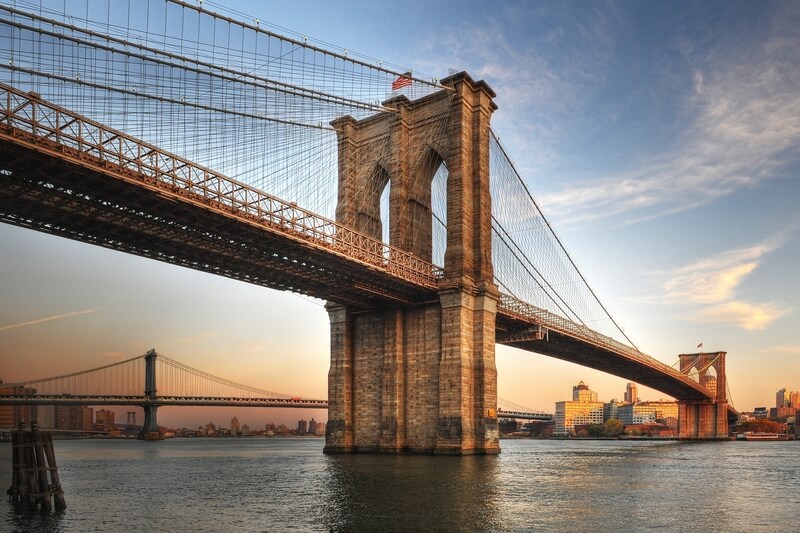
Bridge #3, New York City’s Brooklyn Bridge (informally called the East Bridge)
To this very day, the Brooklyn Bridge, spanning the East River and connecting Manhattan and Brooklyn, is an iconic symbol of New York City. The inspiring structure is considered a marvel in engineering and features the Neo-Gothic style, featuring gothic arches said to resemble cathedral windows. At the time it was built, not only was it the longest suspension bridge in the world, but it was the first to use steel cable wires as primary building material. The bridge, opened in 1883, was ahead of its time in size and design. Since its inception, it has remained a prominent historical and cultural icon of the city.
The bridge was the masterpiece of engineer and architect John Augustus Roebling. Many people are surprised to learn of the trials and tribulations that ensured during its construction period. As an experienced bridge builder, Roebling designed his own brilliant method for weaving wire cables. However, he unfortunately died at the beginning of the construction period from lockjaw caused by injury to his foot that he ultimately sustained while on the job. As a well-respected leader of the bridge building industry, his obituary, in part, reads:
“Altogether few men have lived whose history can record a series of more brilliant successes than that of Mr. Roebling. He leaves behind him monuments of his greatness, and his name will pass into history among the brightest of those who have achieved immortality, by benefiting the human race. That he has been cut off thus on the threshold of his greatest undertaking, adds to our sincere regret; but that he could not live to see its completion, will not detract from the well-won renown of its gifted and accomplished designer.”
Following in his father’s footsteps, his son, Washington Roebling, took over as his successor. However, younger Roebling faced decompression sickness after taking over as chief engineer. With the help of his wife, Emily Warren Roebling, he was able to continue directing operations, using field glasses and sending messages with her assistance. Other problems ensued, such as a compressed-air blast, and a severe fire that smoldered for weeks and caused a cable to lose anchorage on the Manhattan side and crash into the river. Costly fraud, death of approximately 20 workers, and others with decompression sickness rendered the project challenging. Yet, the will of Roebling and the workers would not cease.
The 1,595-foot bridge’s main span remained the longest in the world until 1890, until the claim was lost upon the building of the Firth of Forth cantilever bridge in Scotland. Regardless, the Brooklyn Bridge maintains special distinction as a beloved automobile and pedestrian bridge. Today, many people proudly visit and walk across the promenade, make John Roebling’s vision of a public walk of “incalculable value” a reality. To learn more, read this Trip Advisor article.
The United States is the fourth largest country of the world, covering 3.8 million square miles. Geographically speaking, in comparison, Europe is slightly larger than the U.S., at about 3.93 million square miles. Due to its size alone, building bridges across the USA to connect people and places is a marvelous feat.
Diverse landscape
Within the USA, there are innumerable small bodies of water and unique land features that necessitate bridges for passage. These marvels of architecture are built against all odds to cross deep valleys, pass over moving bodies of water, and create safe passage for travelers over steep, rocky or unstable terrain. Most bridges carry rich and dramatic history from their inception to their build and beyond. Likewise, many builders of bridges made great sacrifices to bring their masterpieces to fruition and have untold stories to share.
A worthy adventure – Touring bridges of the USA
Why not plan your road trip today to check out America’s beloved bridges? Whether you prefer to witness the quiet natural beauty of a bridge carved by a river or observe firsthand the amazing architectural handiwork of men (and women) with visions for the nation to thrive, touring bridges in the USA is an absolute worthy adventure.
Disclosure: This article is purely informational and is not intended as an historic account or guide for advice.






Nice descriptions, but photos would have added so much to this discussion!
Nice article D J .It is good to read about the Frankford Avenue -Pennypack Bridge in Philadelphia . I was born in Philadelphia in 1950 and lived about three miles from the bridge. I reckon you could say I know it well. Although it is a relatively small bridge it is impressive and it is good to view it from both sides of Pennypack Creek and both sides of Frankford Avenue . Last time I was there ( I moved from Philadelphia in 1990’s ) I remember that on one side of Frankford Avenue there were pieces of stone along the trail next to the Creek that were part of it’s construction in a way those pieces of stone ( average size about 2 to 4 feet length were not put in place on the Bridge because in the stone cutting procedure other pieces were more accurate in measure and those.were chosen to be part of the Bridge . It is nice to look at in different weather conditions, anytime of year . And walking across it is preferable to driving across it in order to appreciate that you are walking across a bridge built in 1697.
.
.
I do not want to be “Debbie Downer,” but remember what happened to the Frances Scott Key Bridge in Baltimore? That bridge had not followed the recommendations of the Safety Commission, and it collapsed. Many bridges across the county have either not had safety checks or have not followed through on recommendations for decades.
If you have a favorite bridge or route with bridges, it might add another layer of appreciation to the trip if you also research the status of that bridge. The bridge you save might be your favorite.
What about the Mighty Mac????