
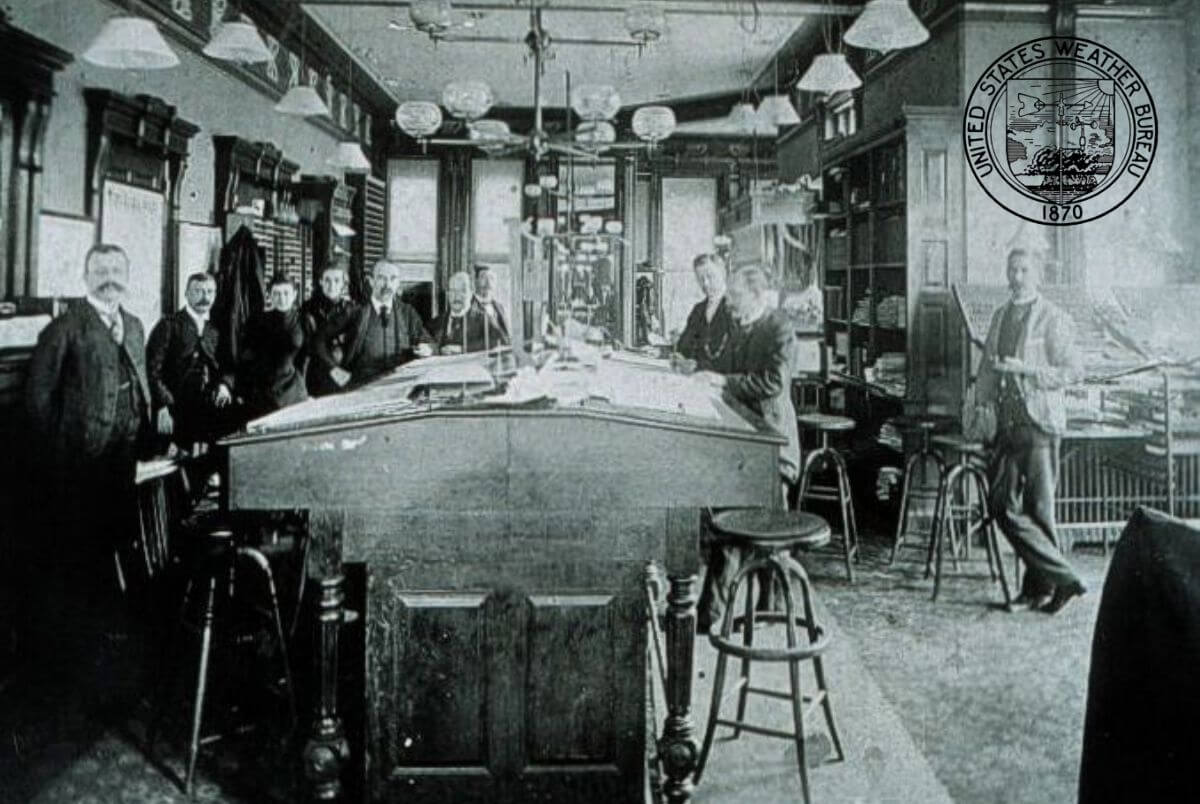
On February 9, 1870, the National Weather Service was established. President Ulysses S. Grant signed a Joint Congressional Resolution into law, creating a federal weather service — an act that laid the groundwork for modern weather forecasting and warnings that millions rely on daily.
The idea of a national weather service wasn’t born overnight. In the years after the Civil War, weather data collection in the United States was growing through spirited efforts by scientists, volunteers, and military observers. Practical weather observing networks had begun in the 1840s as telegraph technology connected individual stations, but there was still no centralized system to collect and interpret data across the nation. The need became painfully clear as sailors, farmers, and frontier communities grappled with sudden storms and dangerous conditions with no reliable advance warning.
Responding to this need, Congress passed a resolution directing the Secretary of War “to provide for taking meteorological observations at the military stations in the interior of the continent and at other points in the States and Territories… and for giving notice … of the approach and force of storms.” President Grant signed it on February 9, 1870, officially establishing the first national weather office as a part of the U.S. Army Signal Service. This new agency was originally known as the Division of Telegrams and Reports for the Benefit of Commerce — a mouthful that reflected its mission of gathering and sharing weather information for the good of the country.
Initially, the service began with 24 observation sites scattered across the country, where weather data such as temperature, pressure, and wind were recorded and transmitted via telegraph to Washington, D.C. Forecasts and storm warnings were then distributed back out to local stations, railroads, post offices, and newspapers. These early efforts marked the first time in U.S. history that weather information was systematized and shared on a nationwide basis.
Over the decades, the agency evolved and expanded. In 1891, it became a civilian bureau under the Department of Agriculture, renamed the U.S. Weather Bureau. Forecasting science advanced, new technologies like radiosondes and radar revolutionized how weather was observed and predicted, and the bureau played a critical role in aviation and agricultural weather services.
Finally, in 1970, the Weather Bureau was renamed the National Weather Service and placed under the National Oceanic and Atmospheric Administration (NOAA) within the Department of Commerce — the name and structure it holds today. Through more than a century and a half of growth, innovation, and service, the NWS has become the nation’s authoritative voice on weather, climate, and severe storm warnings, helping save lives and protect property across the United States.
[adrotate banner=”1184″]




What a great job, they never have to be right and never be accountable. Imagine any other vocation that has this level of oops. I wouldn’t want weather statistic accuracy at my bank or investment. In fairness they are getting better, but a 2 percent chance of rain actually means 98 percent it won’t. Who makes this stuff up?