
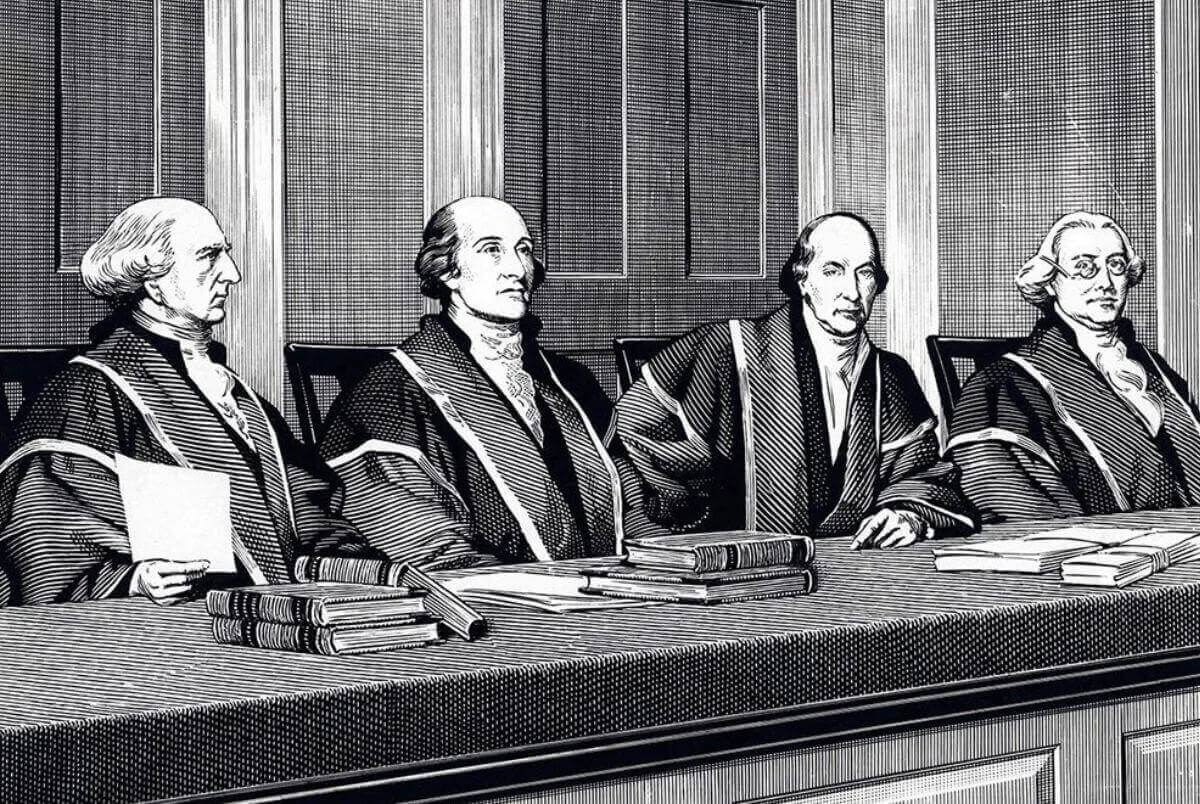
On February 24, 1803, the United States Supreme Court delivered a decision that would permanently shape the nation’s constitutional framework. In the landmark case of Marbury v. Madison, Chief Justice John Marshall and the Court formally established the principle of judicial review — the power of courts to examine and invalidate laws that conflict with the U.S. Constitution.
The case arose from a seemingly small political dispute in the aftermath of the fiercely contested 1800 presidential election. Outgoing President John Adams, a Federalist, had made a series of last-minute judicial appointments in the final hours of his administration — an effort to maintain influence as his party lost power to Thomas Jefferson and the Democratic-Republicans. Among these so-called “midnight judges” was William Marbury, who had been appointed justice of the peace for Washington County, D.C., and whose appointment had been confirmed but not delivered before Jefferson took office.
Once Jefferson became president, his Secretary of State James Madison refused to deliver Marbury’s commission. In response, Marbury petitioned the Supreme Court to issue a writ of mandamus — a court order compelling Madison to deliver the appointment. At issue was not just Marbury’s job, but whether the Supreme Court could enforce such a remedy and, more broadly, interpret the Constitution when disputes arose.
Chief Justice Marshall’s opinion addressed three critical questions: Did Marbury have a right to his commission? Did the law provide him a remedy? And could the Supreme Court legally issue a writ of mandamus in this situation? The Court concluded that Marbury did have a right to his commission and that the law provided a remedy. However, the Judiciary Act of 1789 — the statute that purported to give the Supreme Court the power to issue writs of mandamus in original jurisdiction cases — went beyond the scope of the Constitution. Because that statute conflicted with the Constitution’s definition of the Court’s original jurisdiction, Marshall held it unconstitutional and therefore void.
By striking down part of a federal statute for the first time, Marbury v. Madison established judicial review — the authority of the federal courts to examine and invalidate acts of Congress that violate the Constitution. Although the decision technically denied Marbury the remedy he sought, its broader impact was profound. It confirmed that the Constitution, not the legislature, was the supreme law of the land and that the judiciary had the power and duty to uphold it.
This doctrine of judicial review would become a cornerstone of American constitutional law and ensure that the Supreme Court remained a coequal branch of government, capable of checking the powers of the legislative and executive branches. Over time, judicial review has played a central role in some of the nation’s most consequential legal and civil rights decisions.
In the nearly two and a quarter centuries since Marbury v. Madison, the authority of the judiciary to interpret the Constitution and limit government powers has become an enduring feature of the U.S. legal system — affirming that when laws conflict with the Constitution, they must yield to the will of the people as expressed in the nation’s founding document.






Too bad that the authority of the judicial branch to interpret the Constitution has devolved into requiring the Justices to view cases through a political lens before they can render an opinion.
Praise for all involved in writing this article. This is important history and this explanation of Marbury vs. Madison is clear and easily understood.
It is just a shame that there seems to be very little understanding by the people of what the Constitution is, and how it is supposed to work. If the constitution doesn’t explicitly grant a power to any of the 3 branches, then Congress cannot imply a power.
One of the arguments initially made by Madison about the Bill of Rights is he didn’t think it was necessary. Freedom of Speech, Religion, Press, were protected because the Constitution didn’t grant such a power. And feared that by enumerating rights, might confuse others into believing those are the only rights that are protected. He later withdrew his objections, and felt that the 10th Amendment help to clarify. (Though often forgotten.)
This means at the most local level, the people hold all rights not delegated specifically to the states. And the states hold all authority granted in their constitution, as long as those authorities weren’t exclusively granted to the federal government.
The education system really needs a Constitutional Law class that clearly identifies these issues. Even AI complicates the issue telling you what is true today, not was is ultimately true based on the original text.