
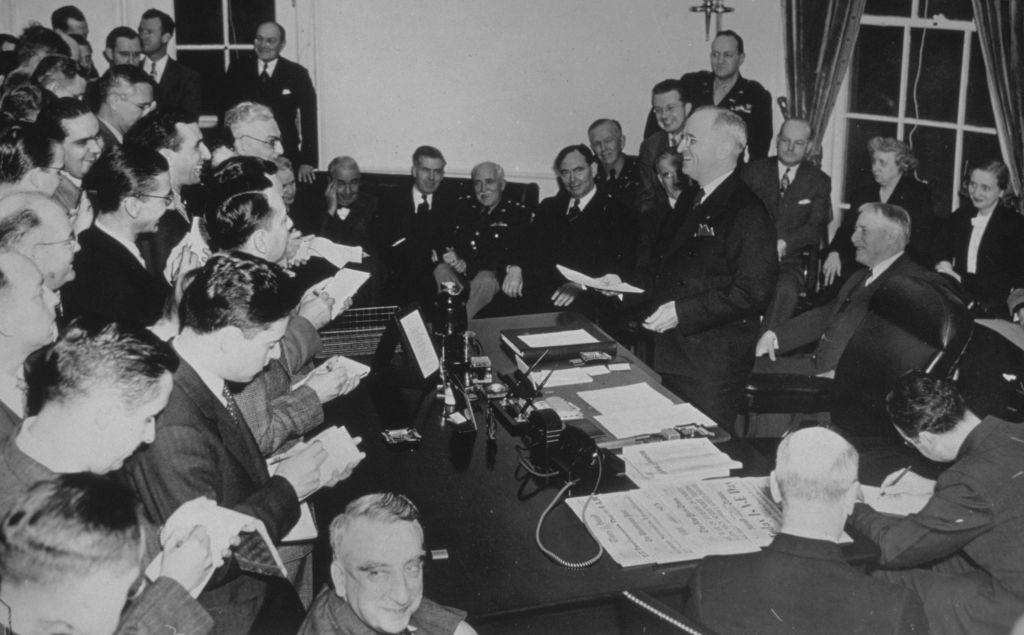
On May 8, 1945, President Harry S. Truman addressed the American people with historic news: Nazi Germany had surrendered unconditionally, bringing an end to World War II in Europe. Speaking from the White House in a nationally broadcast radio address, Truman opened with the words, “This is a solemn but a glorious hour,” capturing both the triumph and the deep cost of victory.
The announcement marked what would become known as Victory in Europe Day, or V-E Day—a moment of immense relief after nearly six years of devastating conflict. Truman informed the nation that Allied forces, under General Dwight D. Eisenhower, had secured Germany’s surrender, and that “the flags of freedom fly over all Europe.” For millions across the United States and around the world, the news signaled the collapse of Adolf Hitler’s regime and the end of a brutal campaign that had engulfed continents and claimed tens of millions of lives.
Yet Truman’s message was not one of unrestrained celebration. Throughout his address, he emphasized the profound sacrifices that made the victory possible. He reminded Americans that countless families were mourning loved ones lost in battle, noting that the nation’s joy was “sobered and subdued” by the heavy human toll of the war. His tone reflected a careful balance—honoring the achievement of Allied forces while urging the public not to forget the suffering that accompanied it.
The president also acknowledged the historical weight of the moment. Having assumed office only weeks earlier following the death of Franklin D. Roosevelt, Truman expressed regret that his predecessor had not lived to see the day. At the same time, he framed the victory as a collective accomplishment, crediting the determination of Allied nations and the resilience of their citizens in overcoming one of history’s most destructive regimes.
Importantly, Truman made clear that the war was not yet over. While fighting in Europe had ended, conflict continued in the Pacific against Japan. He urged Americans to remain focused and committed, warning that “our victory is only half won.” This reminder underscored the global scope of World War II and the continued sacrifices that would be required in the months ahead.
Across the United States and Allied nations, the announcement sparked widespread celebration. Crowds gathered in cities, church bells rang, and people filled the streets in spontaneous displays of joy. Yet even amid the jubilation, many paused to reflect, offering prayers of thanks and remembrance for those who had not lived to see the victory.
Truman’s address remains one of the defining moments of the 20th century. It signaled not only the end of Nazi Germany’s reign of terror but also the beginning of a new chapter in global history. On that day, the world stood at a crossroads—between the devastation of war and the hope for lasting peace—guided by the voices of leaders and the resilience of those who had endured it.






Mr. Truman was a good President , he was the only President to show a surplus in the Treasury for every year of his presidency .