
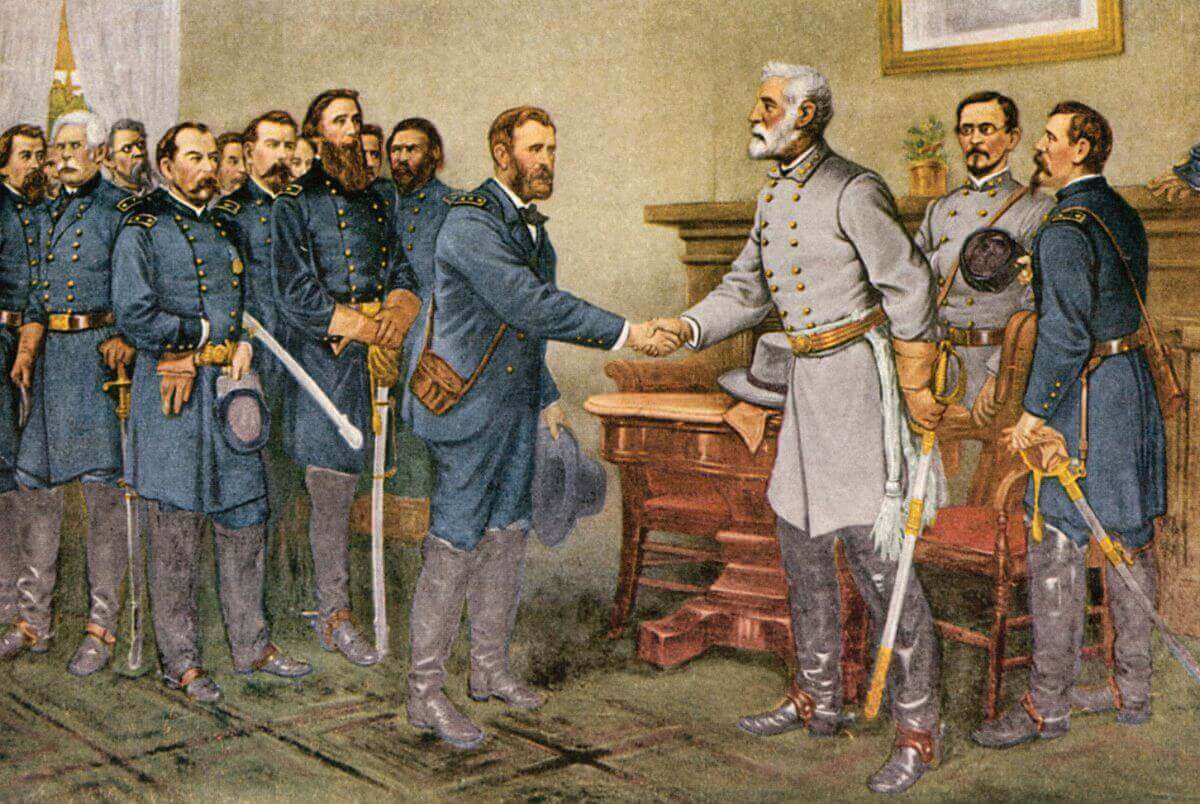
On April 9, 1865, Confederate General Robert E. Lee surrendered his Army of Northern Virginia to Union General Ulysses S. Grant at the small village of Appomattox Court House, Virginia—an event that effectively marked the beginning of the end of the American Civil War. After four long years of brutal conflict, this moment symbolized both the collapse of the Confederacy’s military power and the restoration of the Union.
In the weeks leading up to the surrender, Lee’s army had been in desperate condition. Union forces had successfully laid siege to the Confederate strongholds of Richmond and Petersburg, forcing Lee to abandon the Confederate capital and retreat westward in hopes of regrouping with other Southern troops. However, constant pursuit by Union forces and dwindling supplies left his army weakened, exhausted, and increasingly surrounded.
By early April, the situation had become untenable. Union cavalry under General Philip Sheridan had cut off key escape routes, capturing thousands of Confederate soldiers and blocking Lee’s path forward. Desertions mounted daily as food shortages and fatigue took their toll. By April 8, Lee’s army was effectively trapped, with no realistic chance of breaking through Union lines.
Recognizing the futility of further bloodshed, Lee reached out to Grant on April 9 to discuss surrender terms. The two generals met that afternoon in the home of Wilmer McLean, a quiet civilian residence that would become one of the most famous locations in American history. Despite the gravity of the moment, the meeting was marked by mutual respect. Grant offered generous terms, allowing Confederate soldiers to return home rather than face imprisonment, and permitting officers to keep their sidearms.
Lee formally surrendered approximately 28,000 troops, effectively dissolving the Army of Northern Virginia, the Confederacy’s most significant fighting force. While other Confederate armies remained in the field for a short time, this surrender triggered a series of capitulations across the South, signaling that the war was all but over.
The significance of April 9, 1865, extends far beyond the battlefield. Lee’s surrender marked a turning point in American history, paving the way for the formal end of the Civil War and the beginning of Reconstruction. It also represented a shift toward national healing, as Grant’s lenient terms were designed to promote reconciliation rather than punishment.
Though the war would not officially conclude for several more months, the events at Appomattox Court House stand as one of the most defining moments in U.S. history. The surrender not only ended the Confederacy’s hopes for independence but also set the stage for the abolition of slavery and the reunification of a fractured nation.







This event — the surrender of General Lee of the Confederate Army to General Grant at Appomattox is one of the most important events in American history. Praise for everyone at AMAC for presenting this article to this forum. I do believe that it was very right for General Grant to allow Confederate soldiers. to return home as he did , instead of thinking of them as prisoners of war . That surely had great meaning and indicated a plan to heal a wounded Nation that would involve North and South efforts .
Our obsession with “equality” makes me wonder if “unconditional surrender” wasn’t a mere formality or even a hustle/brain candy for the victor.. More often than not people today think of ALL roles as automatically interchangeable.