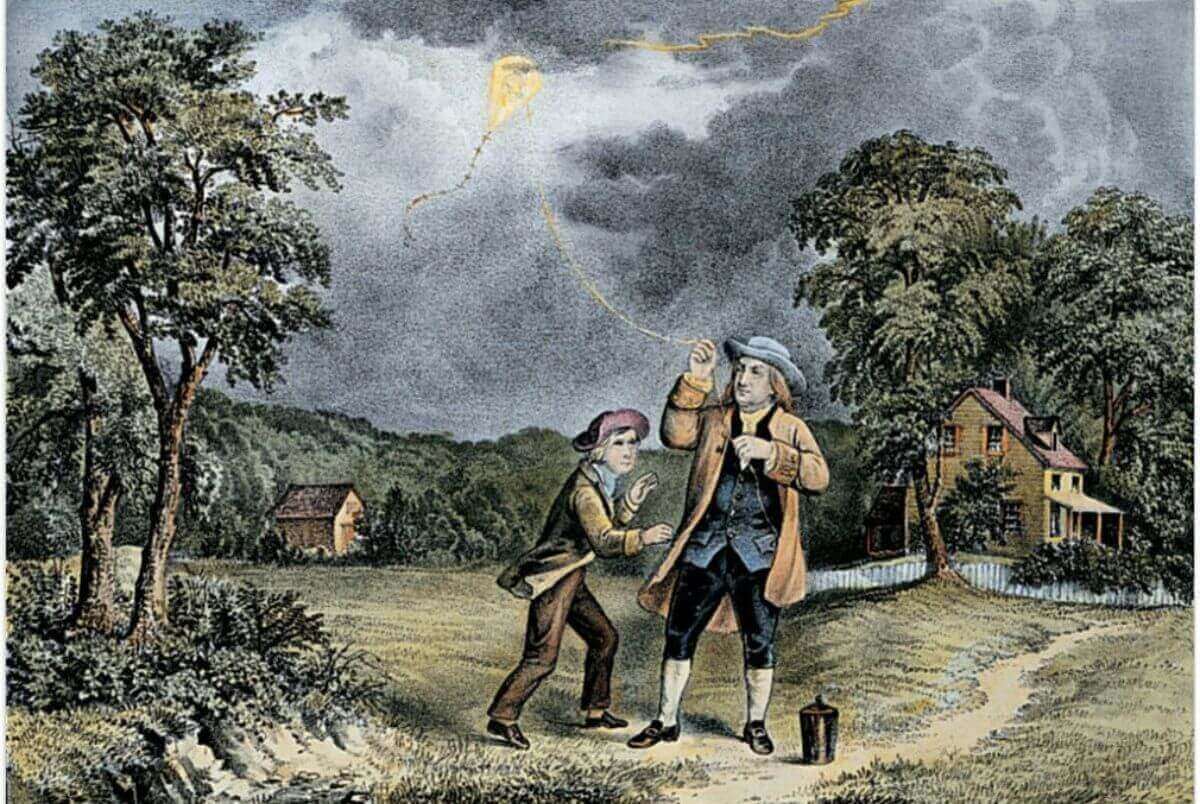
On June 10, 1752, according to popular legend, Benjamin Franklin performed one of the most famous scientific experiments in American history—flying a kite during a thunderstorm to demonstrate that lightning is a form of electricity. Whether every detail of the story occurred exactly as later recounted remains a topic of historical debate, but the experiment has become an enduring symbol of curiosity, innovation, and the pursuit of scientific knowledge.
By the mid-18th century, scientists across Europe and the American colonies were becoming increasingly fascinated by electricity. Franklin, already known for his intellect and wide-ranging interests, was among the leading thinkers exploring the mysterious force. He theorized that lightning and electricity were connected, a groundbreaking idea at a time when the nature of lightning was not fully understood.
To test his theory, Franklin reportedly ventured into a thunderstorm with his son William. They flew a silk kite attached to a hemp string, with a metal key tied near the end of the line. As the storm intensified, Franklin observed loose fibers on the string standing upright, indicating the presence of an electrical charge. When he moved his knuckle close to the key, he reportedly drew a spark, confirming that electricity from the storm had traveled down the wet kite string. The experiment helped demonstrate that lightning was electrical in nature.
Contrary to popular depictions, Franklin was not struck directly by lightning. Had he been, the result almost certainly would have been fatal. In fact, the experiment was extremely dangerous, and several other researchers in Europe suffered serious injuries or death while conducting similar investigations. Franklin’s success owed partly to caution and partly to luck.
The significance of the experiment extended far beyond proving a scientific theory. Franklin’s findings led directly to the invention of the lightning rod, a simple but revolutionary device designed to protect buildings from lightning strikes. By channeling electrical charges safely into the ground, lightning rods dramatically reduced the risk of fires and structural damage. The invention quickly spread throughout the colonies and Europe, saving countless lives and properties.
Franklin’s achievements in science complemented his many other roles as an inventor, printer, diplomat, author, and Founding Father. His work with electricity earned him international acclaim and established him as one of the leading scientific minds of the Enlightenment. He became a member of prestigious scientific societies and received honors from institutions around the world.
Today, the image of Benjamin Franklin flying a kite in a thunderstorm remains one of the most recognizable scenes in American history. Whether viewed as a literal event or a powerful historical legend, the story captures the spirit of scientific inquiry that defined Franklin’s life. More than 270 years later, the experiment continues to symbolize the value of observation, experimentation, and the courage to question the unknown in the pursuit of discovery.