
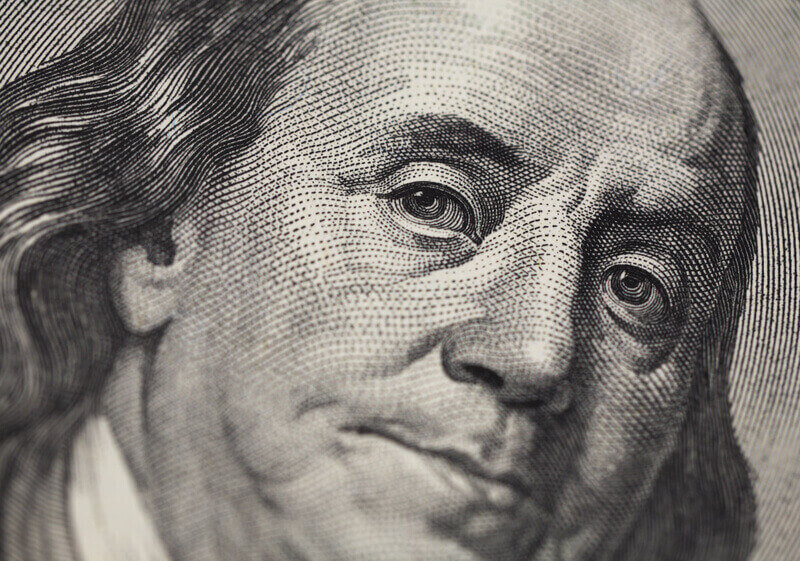
Benjamin Franklin is about as famous, at least in America, as it gets. Two principles he pushed were “industry and frugality.” While he knew “death and taxes” would get us, he wanted the government to be limited. What would he say today?
Rather than numbers – showing federal and state government out of control, spending and taxing to excess, states flirting with communism – indulge history.
Thomas Jefferson was, despite spending beyond his means to buy books, fine wines, and rebuild his house, a fierce proponent of limited and frugal government.
As America’s third president, he cut spending, cut taxes, reduced debt, and advanced individual liberties – all fitting for the author of our Declaration.
In Jefferson’s first inaugural, he famously declared: “Prosperity depends on a wise and frugal Government, which shall restrain men from injuring one another, which shall leave them otherwise free to regulate their own pursuits of industry and improvement, and shall not take from the mouth of labor the bread it has earned.”
As Franklin did, Jefferson believed “life, liberty, and the pursuit of happiness” required room for individual “industry” and keeping government “frugal.”
In New England, this dictum – industry and frugality – became an undeclared motto, people known for hard work and “Yankee thrift.”
Even in my youth, these two ideas – work and thrift – were common. I began working full-time when not in school at 12, opened a bank account, saved for a snowmobile, which in time converted into a downpayment on college.
Our working mother raised us – in rural Maine – to respect industry and frugality. Her habits – cheerful work and thrift – were common in our state and America.
At home, we had no electric heat, dishwasher, or drilled well, so we heated with wood – cut annually to feed wood stoves all winter. Kids did dishes. We economized on water – fewer baths and laundry – in the summer droughts.
Since roofing was expensive, we tried to preserve what we had. I shoveled the roof after storms, while buckets, No. 10 cans, and pans dotted the interior each spring.
No one had to tell us to grow local; we just did. That kept us going all winter, from blue Hubbard, acorn, and butternut squash to cut and frozen green beans, peach, apple, and blueberry pies. Mom made bread. We stretched everything, oatmeal in meatloaf, Hamburger Helper, and never threw anything.
For birthdays, rather than elaborate gifts, we had friends over and hunted hidden peanuts, played inexpensive games, went swimming in the lake, and ate cake.
Every winter weekend, we went ice fishing, caught perch, pickerel, occasionally cusk or salmon, which always became one night’s dinner, breaded with potatoes.
If early New Englanders did not have paper bags, we did and saved ours, used over and over until they transitioned to a fire starter. We had venison, if lucky in a given year, got to a restaurant in the city maybe twice a year.
From rice paper patterns, with a Singer sewing machine, Mom made our clothes, worn until outgrown, then passed down. In time, we bought clothes, but later.
For recreation, we thrived on snow forts, sledding, snowshoeing, using old snowmobiles, then summers swam, hiked, and played games. School mattered, since Mom was a teacher, so we all studied, worked “to make something of ourselves.”
No one had mobile phones. We had a (cheap) “party line,” where you knew the incoming call was yours by a distinct ring. Ours was “long-short-short.” To access the line for an outgoing call, you had persuade neighbors off the line.
Also on the frugal side, we changed our tires, oil, wipers, water, and cleaned the car, a task that fell to me, often a half-day process. Nothing was wasted.
All this describes nothing unique for most of those raised in this time, just how things were. People were frugal and industrious – by nature and eventually habit.
What mattered more was that government – federal and state – was also frugal, encouraged industry, did not overspend, overtax, overregulate, or inflate.
If hard to believe, it should not be. Our Founders made clear what permits any republic – and state – to remain accountable to The People, serve real needs without bankrupting taxpayers, “frugality and industry.”
Their warning to us – Franklin, Jefferson, Adams, all the Founders – was simple. John Adams, our second president, implored us to keep faith, keep governments small, ourselves busy, people moral, and everyone serving in office accountable.
Wrote Adams: “There are two ways to conquer and enslave a country. One is by the sword. The other is by debt.” By debt, he meant giving in to endless spending, taxing, buying votes with benefits, and forgetting accountability. So, from this distance, in the 250th year of the Declaration, what would they say today?
Robert Charles is a former Assistant Secretary of State under Colin Powell, former Reagan and Bush 41 White House staffer, Maine attorney, ten-year naval intelligence officer (USNR), and 25-year businessman. He wrote “Narcotics and Terrorism” (2003), “Eagles and Evergreens” (North Country Press, 2018), and “Cherish America: Stories of Courage, Character, and Kindness” (Tower Publishing, 2024). He is the National Spokesman for AMAC. Today, he is running to be Maine’s next Governor (please visit BobbyforMaine.com to learn more)!





RBC, your final paragraph from President Adams is on the money — DEBT is killing our nation when irresponsible persons and government officials spend crazily and without remorse while filling their pockets with everyone else’s $$$$$.
Mr. Charles,
I believe our founders will say we have lost our way. We have given up our scruples and morals for big government. I like you and have said in the past I don’t want big government in my life. I like you was raised the same way except I was more urban and was lucky in growing up with gas heat. I too started working at the age of 12, learned how to save money, had second hand clothes, shared the bath water with my sister and brother and used the wash cloth to dry ourselves off before using the towel to finish the job, played in the woods, and am still frugal today although I don’t need to be. Just want to thank you for reminding us how we too grew up.
Industry, frugality and grit made this country made of immigrants then, not the government hand outs and vote buying welfare now.
Mr. Charles,
LOVE your articles!! Always thought-provoking. Always good advice. I keep a folder on my computer desktop that has nearly every article you’ve posted here on AMAC. I share them with many people who also love them. Thanks.
This article describes the right way to think, the right way to live it is a reflection of good character and having an intelligent approach to life. Having a sense of purpose and living by a code of conduct – are good ingredients to have in life . Benjamin Franklin started a printing press in Philadelphia in the 1720’s. Growing up in Philadelphia the accomplishments of Franklin were ever present .The Franklin Institute there has an airplane in front of the building , that is made of stainless steel .It was built in 1931 ,it is a float plane, it flew briefly during the 1930s’ , has been on display in front of the Institute since 1935. It was inspirational to me , it provided a genuine example of how something like an airplane was designed and built
Called the Pioneer BB – 1 the fabric wing covering is removed, so the wing frame structure is visible..The Budd. Company built this. flying boat and that company built trains as well. Industry and Frugality ,great stuff to practice for sure, This writing is appreciated RBC.
PTL! We work, save and give to Christian charities and Christian conservatives who run for office. I’ll be cutting back on giving to charities until the end of the year. It’s vitally important that we support our Christian politicians in this next election or else having President Trump is doing will come to a grinding halt!!! Without our help that is exactly what will happen!!!
Another great article. Our forefathers, no doubt, would not recognize our country, THEIR country, because of the ignorance (stupidity?) we have shown for far too long. It just keeps getting worse, because the inhabitants of the USA see nothing wrong with writing checks our future generations are gong to have to make good. Pitiful…
Tell it to Jack The Ripper!
They would be sick to their stomachs.