
AMAC Magazine Exclusive – By Shane Harris
Twenty years ago this past May, a group of six small planes took off from central Ohio on a journey to Washington, D.C. Aboard the aircraft were twelve World War II veterans, men who had risked their lives to defend the United States and save the world from tyranny. Little did they know that they would be the first wave of more than 300,000 veterans the Honor Flight Network has flown to the nation’s capital completely free of charge to see the memorials erected to commemorate their heroism.
In early November, I had the privilege of tagging along with 14 of those veterans from the Middle Georgia Honor Flight chapter, or “hub,” to get a first-hand look at the incredible work the organization does for service members who might otherwise never be able to make it to D.C. The experiences I had that day and the conversations I shared with the veterans will stay with me for the rest of my life—and I hope they will touch your heart as well.
In 2005, the first Honor Flight was led by Earle Morse, a retired Air Force Captain and physician’s assistant who worked at a small Veterans Affairs clinic in Springfield, a mid-sized city between Dayton and Columbus. Most of Morse’s patients were World War II veterans, who were by then in their eighties. In the early 2000s, the country was losing these heroes at a rate of more than 1,200 per day.
A year prior, in May 2004, President George W. Bush had formally dedicated the World War II Memorial on the National Mall—a beautiful monument honoring the service of the 16 million Americans who served in uniform and more than 400,000 patriots who made the ultimate sacrifice in defense of freedom in that conflict.
After the memorial opened, it quickly became the hot topic of discussion among Morse’s patients. But when he asked them if they had plans to visit the memorial, he always got the same answers: it was either too expensive or too physically demanding for these elderly veterans to make the trip.
So, Morse, who had a private pilot’s license, decided to do something about it. After pitching the local aero club on the idea, Morse and 11 other pilots who had never met his patients stepped up and agreed to fly veterans to D.C., charter vans to drive them to the memorial, and accompany them every step of the way—all completely free of charge.
Fast forward to today, and the Honor Flight Network has more than 125 active hubs nationwide, serving 46 states. Its mission has expanded to serve veterans from the Korean War and Vietnam eras, as well as those who are critically ill. The organization is entirely donor-funded and is powered by an army of passionate volunteers with a heart for service.
From the moment veterans arrive at the airport until the moment they depart, they are treated like heroes. I met up with the Middle George Honor Flight at Dulles International Airport just outside of D.C. They were the second of four flights to arrive that day—a testament to the dedication and reach of the organization.
More than 50 people decked out in patriotic garb and American flags were gathered in the terminal to cheer the veterans as they arrived and made their way to the charter buses. Some came from a local alumni chapter of George Mason University. Others represented a local Boy Scout troop. A few moms and dads spent their Saturday morning bringing their kids to the airport to teach them the importance of military service and sacrifice. Two active-duty Army colonels made the trip from a nearby base. Another two enlisted soldiers volunteered to accompany us the entire day and help unload wheelchairs at every stop.
As the veterans made their way into the terminal, many of them tired from the early flight and long trip, their eyes suddenly lit up, and their faces broke into smiles. They waved and shook hands with the onlookers, complete strangers who embraced them like family.
In that moment, I felt overcome with pride, not just for America and all she represents, but also for the goodness and honesty of the people who live here. This was the very best of us—people of all backgrounds, races, religions, and political views coming together to honor the men and women who answered the call to service.
We boarded the bus and made our way to the first stop: Arlington National Cemetery. Along the way, an Honor Flight volunteer shared the history of the program as well as some facts about the city and the monuments we would be seeing.
At Arlington, the veterans sat just to the left of the Tomb of the Unknown Soldier and watched in silence as the sentinel of The Old Guard made his way up and back—twenty-one exact steps each way. The precision and solemnity of the ritual seemed to settle over the group like a quiet reverence. Every click of the soldier’s heel echoed across the crowd. You could see on everyone’s faces that they understood the weight of what they were witnessing—not just the ceremony itself, but also the lifetime of sacrifice and discipline it represents.
The changing of the guard and a wreath-laying ceremony followed. As the crowd stood at attention and the bugler’s notes of “Taps” carried through the crisp morning air, I couldn’t help but feel the gravity of the moment. It was more than a ritual. It was a living expression of respect for every man and woman who has ever borne the cost of defending our freedom.
In the moments leading up to the changing of the guard, I had an opportunity to speak with James Harrison and Mike Bazemore, who helped organize the flight and plan the day. Harrison is a veteran himself, and Bazemore’s father-in-law, a Korean War veteran, went on an Honor Flight in 2019.
They stressed both the passion of the volunteers and the power that these trips have for veterans. Many have never spoken about their service, and their Honor Flight is the first opportunity they’ve had to connect with other veterans and truly begin a healing process.
After the ceremony, an off-duty sentinel came out to speak with the group, answering questions and sharing what it means to guard the Tomb. The respect he showed the veterans was palpable—not as a performer addressing an audience, but as a soldier honored to speak to those who came before him.
Then, in an unexpected moment of quiet humanity, a man visiting from Sweden approached the veterans. In halting English, he thanked them for their service, saying it was an honor to meet them and the world owes America an eternal debt for defending liberty.
It was one of many such encounters throughout the day—strangers from all over the world stopping to shake hands, to say thank you, and to show that the sacrifices of these men and women have not been forgotten.
All 13 of the veterans traveling from Georgia served during the Vietnam era, but the group had a special guest as well: 101-year-old Jerry Rich from Lombard, Illinois, who served in the Pacific during World War II. At every stop, people seemed to light up when they met him. There was a sense of awe in realizing that we were standing beside living history.
From Arlington, the group made its way to the Women’s Memorial, a stop that carried special significance for one member of the group, Jocelyn Bryant—a female veteran who received a personal recognition from the staff. Two other women on the trip, both guardians and veterans themselves, were also honored.
The visit was brief but meaningful—a reminder that courage and sacrifice are not limited by gender, and that generations of women have proudly served with the same devotion as their male counterparts.
Following a quick lunch at the Navy Memorial, we arrived at the World War II Memorial—an especially moving stop given Jerry Rich’s presence.
As we approached, a volunteer stood ready with a special welcome packet for him. “Hello, Jerry,” the man said warmly, shaking his hand. “Your country thanks you for your service. Welcome to your memorial—welcome home.”
It was one of those rare moments that catches in your throat. The volunteer told me he’d been greeting World War II veterans there for 15 years. Fifteen years ago, he said, he would meet dozens of them every day. Now, he’s lucky if he meets one or two a week.
The weight of that reality hit me. This living link to one of the most consequential chapters in human history is fading fast. We don’t take nearly enough time out of our busy schedules to slow down and take stock of the treasure that we have in the few remaining members of the Greatest Generation.
I asked Jerry if he had any advice for younger generations. He paused for a moment and said simply, “Just be kind. Be kind and love each other.” Coming from a man who had seen war and hardship, those words carried the quiet authority of someone who has truly lived. It was a simple message, but it felt like the very wisdom our age needs most.
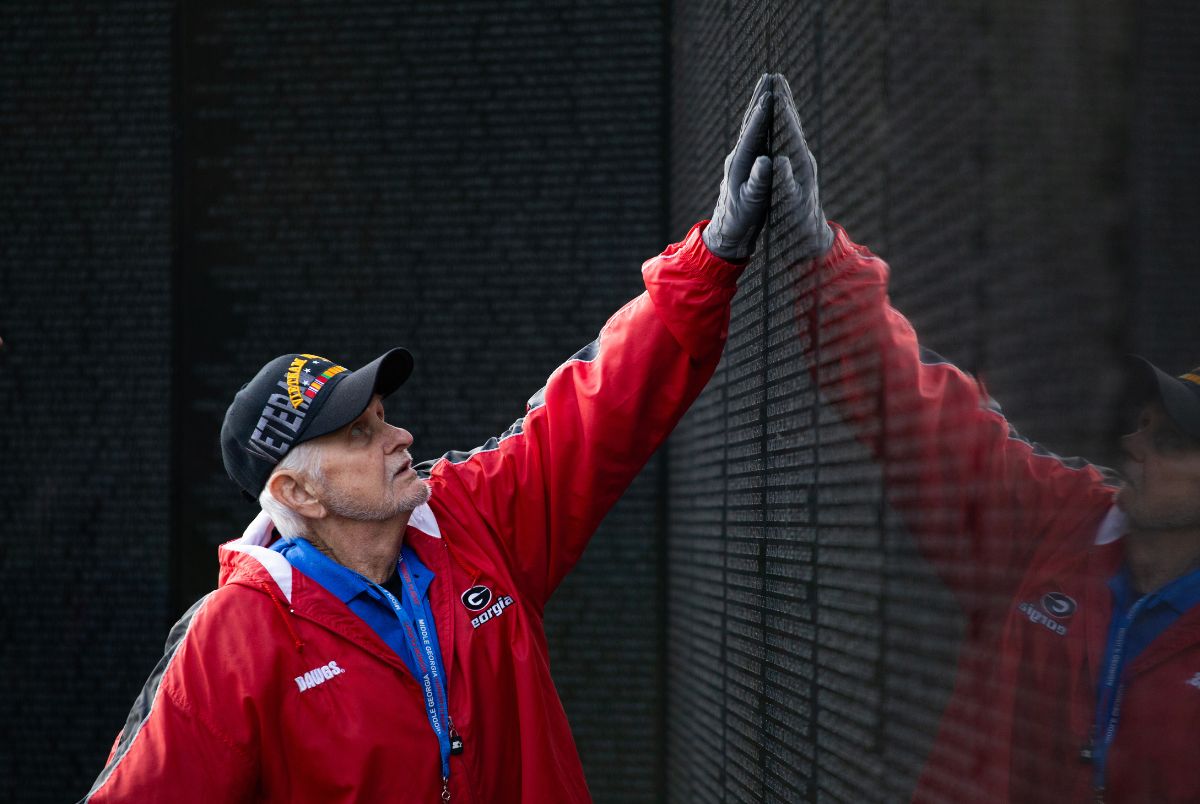
From there, the group continued to the Korean War Memorial, and then to the Vietnam Veterans Memorial. The latter was deeply personal for the group. Each veteran received a slip of paper and a pencil to trace the name of someone they knew whose life was cut short. Every man had a story: a friend, a brother, or a comrade whose name was etched into that wall.
At one point, several veterans gathered around a single name: Rodney M. Davis. When I asked who he was, one of them explained that Rodney was from Macon, Georgia—their hometown.
Rodney joined the Marine Corps in 1961. Six years later, he was deployed to Vietnam. That September, his platoon was on a search and destroy mission when they were attacked by enemy combatants. They retreated to a trench, where Rodney ran up and down the line, encouraging the men to hold strong.
When an enemy grenade was dropped in the middle of a group of men, Rodney threw himself on it without hesitation, sacrificing his life for his unit. He was posthumously awarded the nation’s highest military award, the Congressional Medal of Honor, making him Macon’s only recipient of the medal. To this day, veterans and local community members gather several times a year to tend to his gravesite and the cemetery where he is buried.
Standing there beside them, looking at that name, I understood that this wall is not just a monument to the fallen—it’s a mirror. As you look into the polished black granite, your own reflection overlays the names of those who gave everything, reminding you that their sacrifice lives on in all of us, and we have a duty to honor them every day.
The final stop was the Marine Corps Memorial, a towering statue of the flag-raising at Iwo Jima. Against the late afternoon sky, the monument was illuminated by the setting sun, a fitting final tribute to a day steeped in reflection, reverence, and gratitude. It was there, in the quiet moments before departure, that the meaning of the trip came full circle.
I had heard the phrase “welcome home” repeated many times throughout the day—by our guide, by volunteers, by strangers on the street. At first, I didn’t think much of it. But by the end, I understood. These monuments don’t just belong to history; they belong to the men and women who earned them. For so many of these veterans, especially those from Vietnam, this was the first true homecoming they had ever received.
That’s the power of the Honor Flight program. It’s not just about transportation or sightseeing—it’s about giving something back to those who gave everything for us. It’s about a tangible form of gratitude.
“Welcome home.” Two simple words. Yet after a day like this one, they carry the weight of a nation’s unending thanks.
Editor’s Note: Special thanks to Middle Georgia Honor Flight, and especially to Ben Sandifer, James Harrison, and Mike Bazemore, who made this article possible. Thanks also to Suzanne Lawler, who graciously provided photos for this article and for the entire trip.




Memories for an old man, USMC VET, My grandson Army vet, pushed me around in wheel chair. 3 main points for me. The changing of the guard at Arlington, grandson comment to me at Korean memorial “Your not only one with tears in his eyes” and two young ladies with their class and teacher from Wisconsin. His comment “he could show them history,rather than read”. I have a picture of me with the girls, my regret was I did not get their names or home town.
I had the honor, back in 2023 to be selected to go on an honor flight, (catching up and finally including us Vietnam Veterans.). It was one of the great moments in my life. Behind of course, birth and notable moments of my son, grand daughters and great grandsons of course. It was the 100th flight for Arizona, so rather than honoring 50 Veterans, the group was 100 Vets, With WW2, Korean, and Vietnam Vets. It was an incredible trip, seeing our monuments in our nations Capital. I got to meet and talk to one of Arizona’s house of representatives in Washington … extra nice, as we were both ex Navy. The comradery between branches of the military from various wars, was amazing, and everything was first class, including at the airports, when announcements were made that all 100 of us were Veterans, the applause was deafening. And at home, at the airport, they coordinated to have American Flags, and lines of People, applauding and shaking hands as we passed by. As a Vietnam Veteran who was truly spat on for being a Veteran … never receiving thanks … The honor flight was thanks in spades in my book.