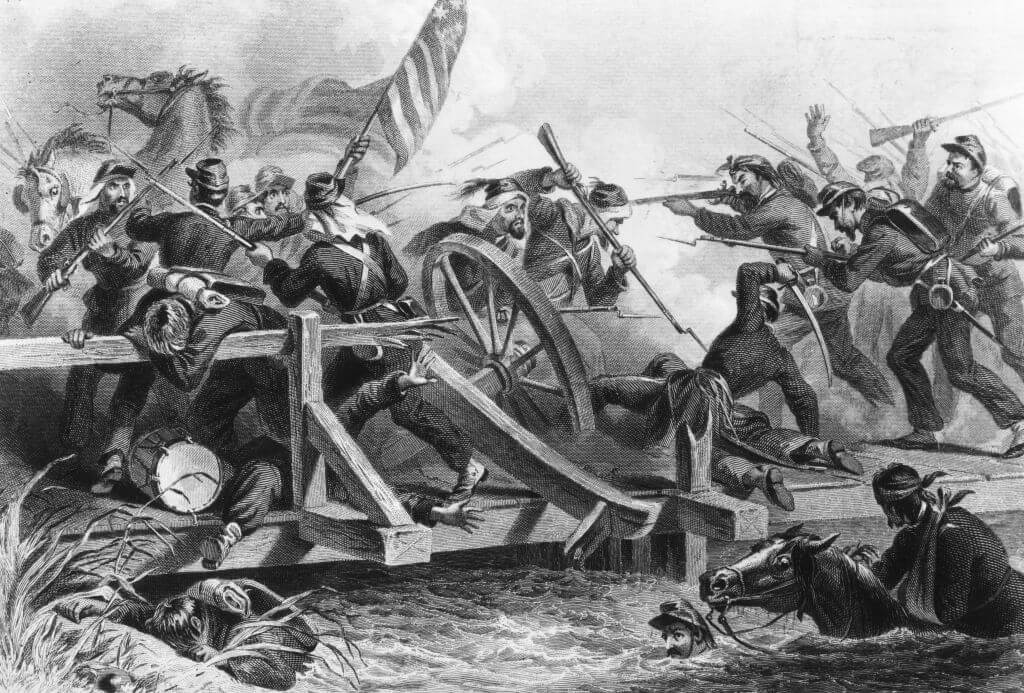
On July 21, 1861, the United States fought the First Battle of Bull Run—known in the South as the First Battle of Manassas—near Manassas Junction, Virginia. It was the first major land battle of the American Civil War and marked a sobering turning point for both the Union and the Confederacy. What many Americans had expected to be a brief conflict quickly revealed itself as a long, costly, and bitter struggle that would ultimately determine the future of the nation.
When the Civil War began in April 1861 following the Confederate attack on Fort Sumter, enthusiasm for the conflict ran high on both sides. Many politicians, soldiers, and civilians believed the war would be over within a matter of weeks or months. President Abraham Lincoln called for volunteers to preserve the Union, while the Confederacy rushed to organize its own military forces. As public pressure mounted for a decisive Union victory, Brigadier General Irvin McDowell was ordered to advance toward the Confederate army positioned near Manassas, roughly 25 miles southwest of Washington, D.C.
The Union force numbered approximately 35,000 soldiers, while Confederate forces under Generals P.G.T. Beauregard and Joseph E. Johnston totaled about 32,000 men after Johnston’s troops arrived by railroad to reinforce the battlefield. That rapid troop movement became one of the earliest examples of railroads playing a decisive role in modern warfare.
The battle began with early Union successes as Federal troops pushed Confederate forces back. However, fierce Southern resistance soon stiffened around a Virginia brigade commanded by General Thomas J. Jackson. According to legend, Confederate General Barnard Bee encouraged his troops by declaring, “There stands Jackson like a stone wall!” Whether those exact words were spoken remains debated by historians, but the nickname “Stonewall” Jackson endured for the rest of his military career.
As Confederate reinforcements arrived throughout the afternoon, the tide of battle shifted dramatically. Exhausted Union troops gradually lost their momentum and eventually broke ranks. What began as an organized retreat soon turned into a chaotic flight back toward Washington. Civilians who had traveled from the capital expecting to witness a quick Union victory found themselves caught in the confusion as soldiers, wagons, horses, and spectators crowded the roads in a disorderly retreat.
Although Confederate forces won the battle, they were too disorganized and fatigued to pursue the retreating Union army aggressively. Even so, the psychological impact of Bull Run was enormous. The Union realized that defeating the Confederacy would require larger armies, better training, stronger leadership, and a sustained national commitment. Likewise, many Southerners gained confidence in their military capabilities, believing independence was within reach.
The First Battle of Bull Run claimed nearly 5,000 combined casualties, a staggering number for Americans at the time. More importantly, it shattered the widespread belief that the Civil War would be brief. Instead, it foreshadowed four years of devastating conflict that would claim more than 600,000 lives, preserve the Union, and ultimately lead to the abolition of slavery through the Thirteenth Amendment. Today, Bull Run stands as a reminder that great national conflicts are rarely as simple—or as short—as they first appear.