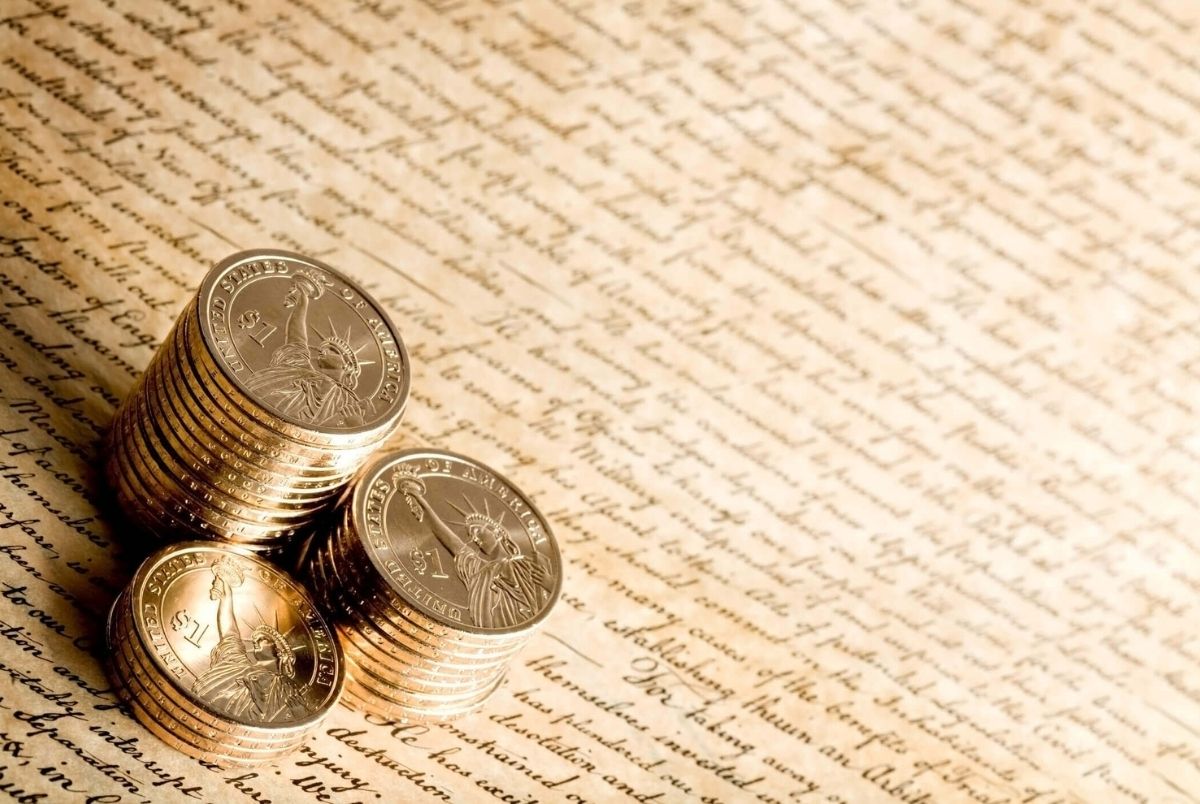
For almost 200 years after the nation’s founding in the Declaration of Independence, the U.S. could brag about having the world’s strongest long-term currency, with hardly any inflation until the 1960s, the decade when President Lyndon B. Johnson took silver out of our coins. Then, Nixon closed the gold window in 1971. This debasement of our currency was a natural outgrowth of excessive spending by LBJ and by every President and Congress of both major political parties in the 60 years since then.
At the time of our nation’s birth, however, all of our major Founding Fathers spoke glowingly of gold and silver. They had struggled with inflation caused by paper “Continentals,” which flooded the nation then. At one point, in 1779, General George Washington wrote to John Jay, our future first Chief Justice, in a plea for sound money, “A wagon load of money will scarcely purchase a wagon load of provisions.”
Meanwhile, the man most responsible for writing the Declaration was no less eloquent about gold. The Declaration’s author, Thomas Jefferson, said, “Paper is poverty … it is only the ghost of money and not money itself.” Later on, as President in 1802, he wrote to Albert Gallatin, his Treasury Secretary, saying, “Specie (gold and silver coin) is the most perfect medium because it will preserve its own level; because, having intrinsic and universal value, it can never die in our hands, and it is the surest resource of reliance in time of war.”
In retirement, during the War of 1812 and the inflation which followed, Jefferson became even more outspoken in his call for gold and restraints on banks. Writing to John W. Eppes in 1813, Jefferson said,
“If the debt which the banking companies owe be a blessing to anybody, it is to themselves alone, who are realizing a solid interest of eight or ten per cent on it. As to the public, these companies have banished all our gold and silver medium, which, before their institution, we had without interest, which never could have perished in our hands, and would have been our salvation now in the hour of war; instead of which they have given us two hundred million of froth and bubble, on which we are to pay them heavy interest, until it shall vanish into air … The truth is that capital may be produced by industry and accumulated by economy but jugglers only will propose to create it by legerdemain tricks with paper.”
After the war’s end, Jefferson didn’t give up the fight, as he wrote to John Taylor, in 1816, “If the American people ever allow private banks to control the issue of their currency, first by inflation, then by deflation, the banks and corporations that will grow up around (them) will deprive the people of all property until their children wake-up homeless on the continent their fathers conquered.”
John Adams was the man most responsible for convincing Jefferson to write the Declaration of Independence and later, in 1787, Adams wrote to Jefferson in Paris, “All the perplexities, confusion, and distress in America arise not from defects in their Constitution or Confederation, not from want of honor or virtue, so much as from the downright ignorance of the nature of coin, credit, and circulation.”
Thomas Paine, famous for saying “Give me liberty or give me death,” also spoke eloquently about gold:
“Gold and silver are the emissions of nature: paper is the emission of art. The value of gold and silver is ascertained by the quantity which nature has made in the earth. We cannot make that quantity more or less than it is, and therefore, the value, being dependent upon the quantity, depends not on man. Man has no share in making gold or silver; all that his labors and ingenuity can accomplish is to collect it from the mine, refine it for use and give it an impression or stamp it into coin…. Nature has provided the proper materials for money: gold and silver, and any attempt of ours to rival her is ridiculous.”
All these forces came together in our Constitution, drafted by James Madison, writing: “Congress shall have Power … To coin Money, regulate the Value thereof, and of foreign Coin, and fix the Standard of Weights and Measures.” (Article 1, Section 8), and “No State shall… coin Money; emit Bills of Credit; make any Thing but gold and silver Coin a Tender in Payment of Debts.” (Article I, Section 10).
As our 250th national birthday approaches, maybe some politicians ought to look to gold, not paper!
The Iran War isn’t Helpful to Gold and Silver Prices but Peace Should Move them Higher
The surprise bombing of Iran began nearly three months ago, on Saturday, February 28. The price of gold on the previous Friday closed at $5,230 an ounce. After a brief spike to $5,400 on Monday, March 2, gold began a relentless retreat in the face of a war that would likely last a lot longer than President Donald Trump had hoped for.
As we’ve always counseled here, smart investors will “buy on the dip,” even if that dip lasts longer than we expected, because the main drivers propelling gold to historic highs have not suddenly disappeared.
#1: Central bank buying. As we showed last week, the continuing de-dollarization of cash reserves of central bankers is no short-term fad – it is now their annual habit. Goldman Sachs recently adjusted its monthly central bank buying forecast higher, due to previously underreported central bank buying. Many major central banks keep buying gold as a strategic hedge against the erosion of all paper currencies at a rate of almost double that of the previous decade.
In fact, Central Bank gold buying was up another 17 percent in the first quarter of 2026.
#2-High and Rising Debt – With High and Rising Interest Payments: Annual $2 trillion deficits will cost more to service, as long as interest rates remain high. With 5% yields on nearly $40 trillion in federal debt service, the interest cost approaches $2 trillion a year, fueling continual $2 trillion annual deficits. Global debt followed the same pattern, rising from $20 trillion in 2000 to over $110 trillion now. The IMF predicts $143 trillion in global government debt by 2029, representing 100% of global GDP that year.
#3-Major banks see over $6,000 Gold and $135 Silver. As we have documented here in recent weeks, JP Morgan Chase now forecasts $6,300 gold this year, Wells Fargo sees $6,100 to $6,300 gold, and UBS sees $5,900 or more. At around $4,500 per ounce now, a rise to $6,000 gold by year’s end represents a 33% gain in seven months. And Bank of America sees a scenario that could push gold to reach $8,000 an ounce in 2027 and set a target price for silver of $135 in 2026, up by 80 percent.
The path may be rocky and irregular, but gold in 2025 soared by over 60%, and that could happen again.
DR. MIKE FULJENZ is one of the nation’s foremost experts in numismatics and has been recognized with the highest honors from each of the industry’s top organizations. He is a published author, columnist, former teacher, school board president and community volunteer.