
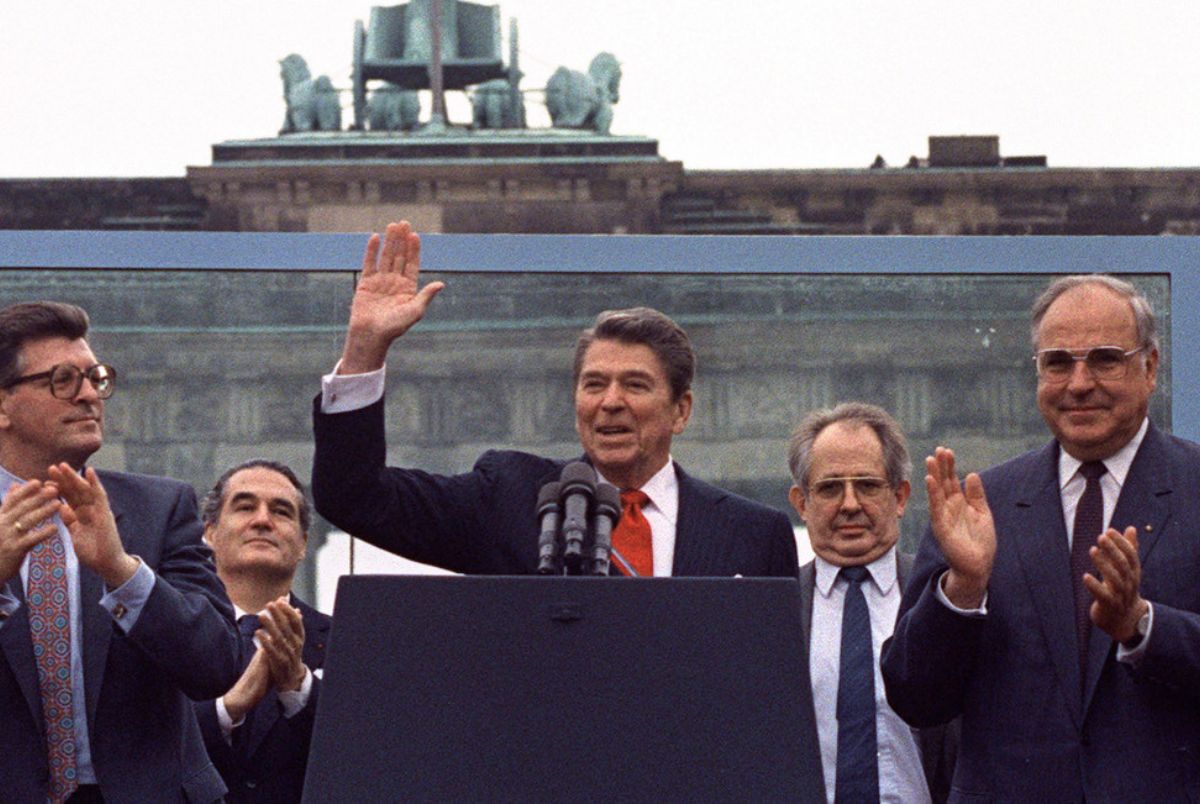
On June 12, 1987, standing before Berlin’s iconic Brandenburg Gate, U.S. President Ronald Reagan delivered one of the most memorable speeches of the Cold War. Addressing a crowd gathered near the Berlin Wall, Reagan issued a direct challenge to Soviet leader Mikhail Gorbachev, declaring, “Mr. Gorbachev, tear down this wall!” The statement would become one of the defining moments of his presidency and a powerful symbol of the global struggle between democracy and communism.
At the time, the Berlin Wall had divided East and West Berlin for nearly 26 years. Constructed by East Germany in 1961 with Soviet backing, the wall served as both a physical and ideological barrier between the communist Eastern Bloc and the democratic nations of Western Europe. Stretching more than 90 miles around West Berlin, it separated families, restricted freedom of movement, and became the most visible symbol of the Cold War.
Reagan’s visit to West Berlin came during a period of significant change within the Soviet Union. Gorbachev had introduced policies known as glasnost (openness) and perestroika (restructuring), aimed at reforming the Soviet system. Many Western leaders viewed these developments as encouraging signs, but Reagan sought to push the Soviet leader further. Speaking near the wall itself, Reagan argued that true reform would require greater freedom for the people of Eastern Europe.
The speech was carefully crafted to emphasize the values of liberty, human rights, and self-determination. While some advisers worried that Reagan’s challenge might be too confrontational, the president insisted on keeping the now-famous line in the address. The words resonated deeply with audiences in Berlin and around the world, reinforcing America’s commitment to democratic ideals and support for those living under communist rule.
Although the Berlin Wall did not come down immediately, Reagan’s speech gained greater significance in the years that followed. Political and economic pressures continued to mount across Eastern Europe, while reform movements gained momentum throughout the Soviet sphere. On November 9, 1989, just over two years after Reagan’s address, East German authorities unexpectedly opened border crossings, and jubilant crowds began dismantling sections of the wall. The event marked the beginning of the end of communist rule in Eastern Europe and foreshadowed the collapse of the Soviet Union in 1991.
Today, Reagan’s challenge to Gorbachev is remembered as one of the most iconic speeches of the twentieth century. Historians continue to debate its direct impact on subsequent events, but there is little question that it captured the spirit of a pivotal moment in history. Delivered on June 12, 1987, Reagan’s words came to symbolize the hope that barriers to freedom—whether physical or ideological—could ultimately be overcome through courage, perseverance, and the enduring desire for liberty.






I thoroughly enjoyed that moment as it was live on the TV. Reagan was my hero that day. I credit that speech with Russia, not only tearing down the wall, but turning from the barbarism of their brand of communism. Maybe I gave too much credit, but the belief persists.
The Ray-Gun Governor of California , I am going to make Californians pay taxes until it hurts . And then the Herald / Examiner found out Mr. Ray-Gun as Governor was not paying any income tax at all .Then the President Ray-Gun took 2.7 Trillion from Social Security and put it in the General Fund .The Mighty Ray-Gun.