
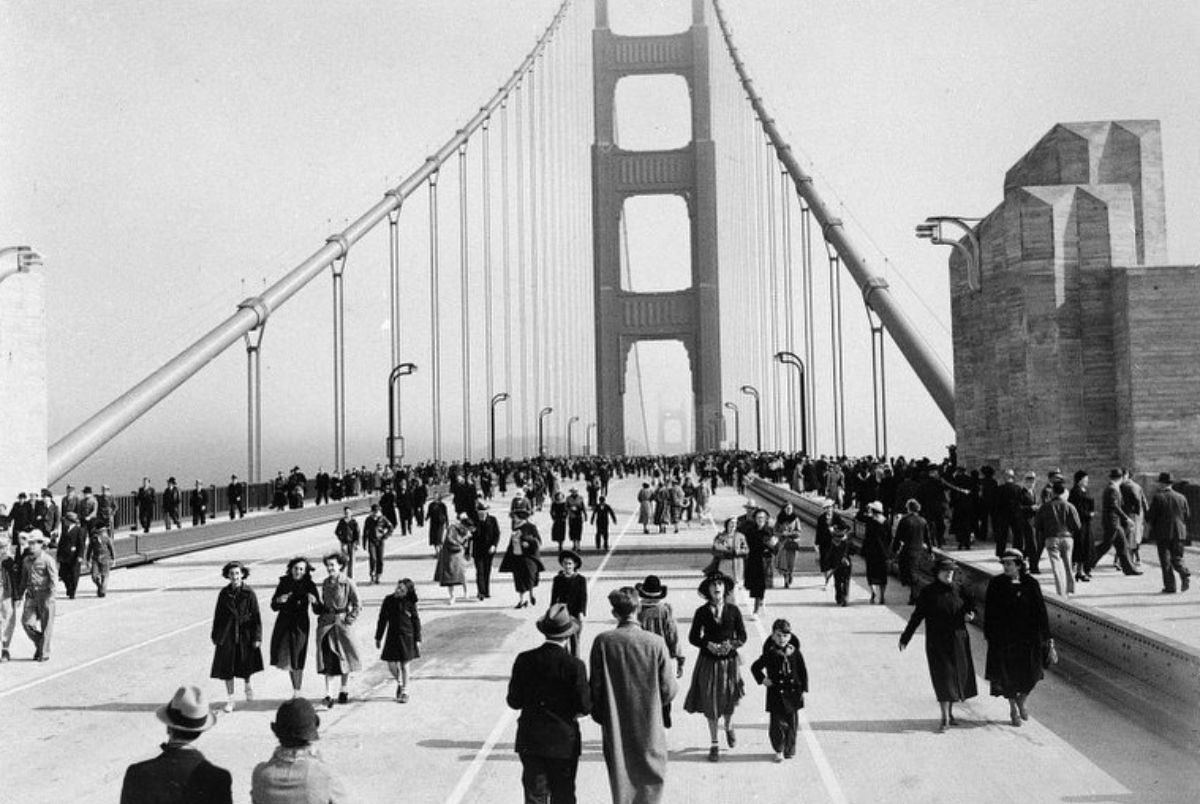
On May 27, 1937, one of America’s greatest engineering achievements officially opened to the public when San Francisco’s iconic Golden Gate Bridge welcomed thousands of pedestrians for the very first time. Stretching across the Golden Gate Strait and connecting San Francisco to Marin County, the massive suspension bridge quickly became a symbol of innovation, determination, and modern design.
Long before the bridge existed, crossing the turbulent waters of the Golden Gate relied entirely on ferry service. Although the idea of constructing a bridge had been discussed since the late 1800s, many experts believed such a project was impossible due to strong ocean currents, dangerous winds, dense fog, and the threat of earthquakes. Still, engineer Joseph Strauss believed the challenge could be conquered. In the early 1920s, Strauss introduced plans for a bridge that would eventually evolve into the elegant Art Deco masterpiece recognized around the world today.
Construction officially began in 1933 during the depths of the Great Depression. Financing the project was a major obstacle, but local counties approved bonds backed by homes, farms, and businesses to fund the ambitious endeavor. Over the next four years, thousands of workers labored high above the water under dangerous conditions. Strauss implemented innovative safety nets beneath the construction area, a groundbreaking measure at the time that saved numerous lives and helped establish new safety standards for future construction projects.
When the bridge finally opened on May 27, 1937, San Francisco erupted in celebration. The event, known as “Pedestrian Day,” drew approximately 200,000 people eager to walk, run, roller skate, and dance across the nearly two-mile span before automobiles were allowed access. Schools and businesses closed as residents gathered for what became a citywide festival. Some visitors reportedly arrived before sunrise to secure a place among the first to cross the historic bridge.
At the time of its completion, the Golden Gate Bridge boasted the longest suspension span in the world at 4,200 feet and stood as the tallest suspension bridge ever built. Its distinctive “international orange” paint color, selected to complement the surrounding landscape and improve visibility in foggy weather, soon became one of the bridge’s defining features.
The following day, May 28, President Franklin D. Roosevelt officially opened the bridge to vehicle traffic by pressing a telegraph key from Washington, D.C. Since then, the Golden Gate Bridge has become far more than a transportation link. It remains an enduring symbol of California, a marvel of American engineering, and one of the most photographed landmarks in the world.








One of the most iconic bridges in the world was made without computers and by todays standard in record time without government interference. Today, that bridge could never be built.
Now, if only the citizens of CA will wake up and realize the stupidity that has ruin their state for decades and put it back on the road of recovery.
A few pictures of the bridge would have been a nice addition to the history lesson.