
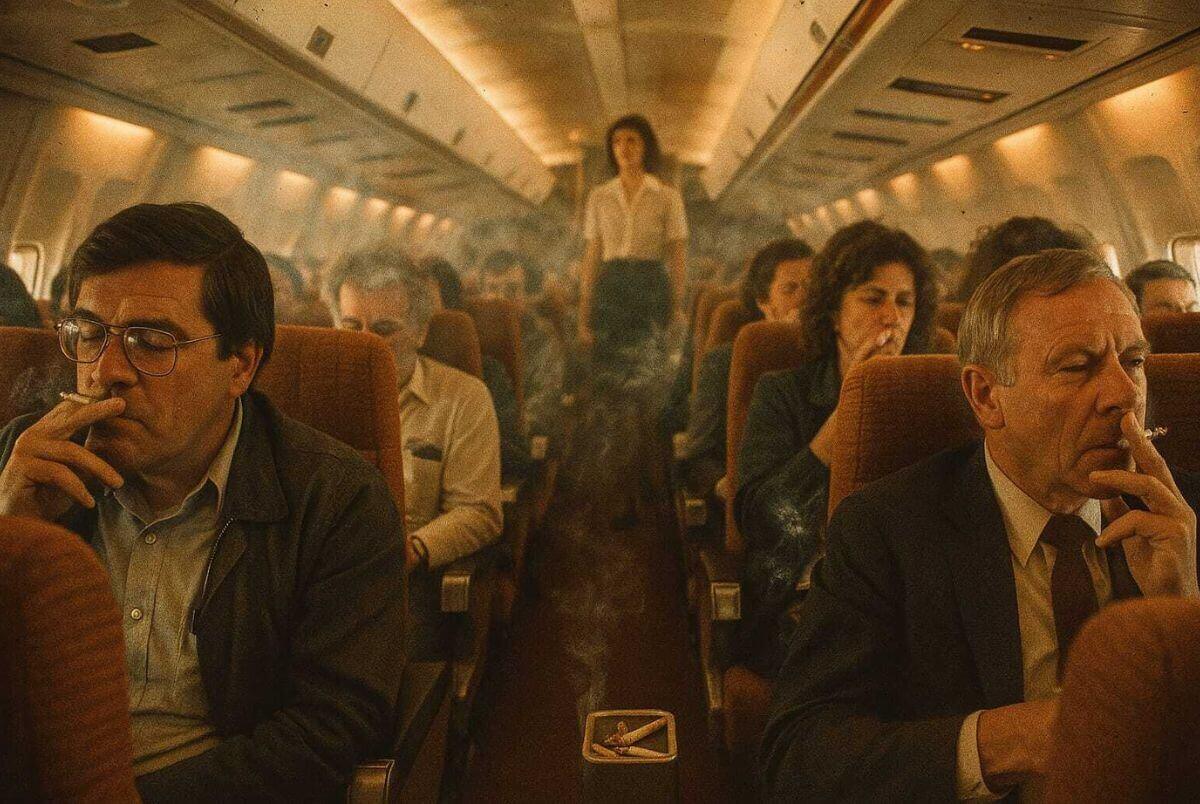
On April 23, 1988, a quiet but transformative change took effect in the skies above the United States: smoking was banned on most domestic airline flights, marking a major turning point in public health and air travel. What had once been a routine part of flying—passengers lighting cigarettes mid-flight, often in tightly packed cabins—began to disappear, replaced by a new standard that prioritized clean air and passenger safety.
For decades, smoking had been deeply ingrained in airline culture. In the mid-20th century, passengers could smoke freely throughout the cabin, and even after early restrictions introduced “smoking” and “non-smoking” sections, the distinction offered little real relief. Smoke drifted easily through the confined space of an aircraft, exposing everyone on board—especially flight attendants—to secondhand smoke.
By the 1970s and 1980s, growing awareness of the health risks associated with secondhand smoke began to shift public opinion. Advocacy groups, medical professionals, and flight attendant unions increasingly pushed for stronger protections, arguing that the cabin environment made prolonged exposure particularly dangerous. Their efforts gradually built momentum, culminating in congressional action in 1987 that targeted shorter flights.
The result was the landmark rule that took effect on April 23, 1988. Initially, the ban applied to domestic flights lasting two hours or less, which still accounted for a large portion of U.S. air travel. Though limited in scope, the policy was groundbreaking—it marked the first time the federal government imposed a widespread restriction on smoking in commercial aviation. Airlines and passengers alike had to adjust quickly to the new reality.
Reactions were mixed. Many travelers welcomed the change, relieved to finally experience smoke-free cabins. Others, including tobacco industry advocates and some frequent flyers, opposed the ban, arguing it infringed on personal freedoms. Despite the controversy, the policy proved popular and effective, laying the groundwork for broader restrictions.
Just two years later, in 1990, the ban was expanded to cover nearly all domestic flights, effectively ending smoking in U.S. airline cabins. Over the following decade, additional regulations extended the prohibition to international routes, completing the transition to smoke-free air travel worldwide.
The April 23 milestone represented more than a regulatory shift—it was part of a broader cultural change. The success of the airline smoking ban demonstrated that large-scale public health measures could be implemented even in highly regulated, customer-focused industries. It also set a precedent for similar bans in restaurants, workplaces, and other public spaces.
Today, it is almost unimaginable to picture a plane filled with cigarette smoke, yet for much of aviation history, that was the norm. The 1988 ban helped clear the air—literally and figuratively—ushering in a healthier era of travel and redefining expectations for public spaces. What began as a limited restriction ultimately reshaped the flying experience for millions, proving that even small policy changes can have a far-reaching impact.





Nothing like concentrated, recycled, reconstituted, second-hand smoke to make you refreshed after a long flight. And as a bonus, you get to take it with you in your hair, clothes and your carry on luggage.