
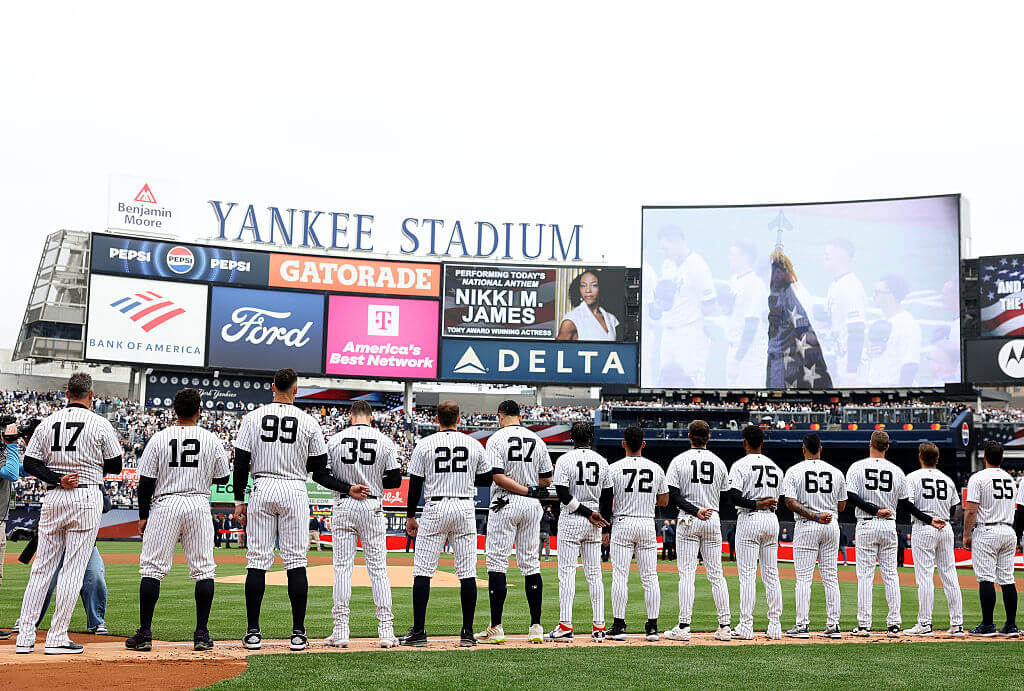
We say that civic life is fraying. We point to distrust, fragmentation, and the steady decline of shared experience in American culture. Much of that is true. But every so often, something cuts against the trend—not as theory, but as lived reality.
I saw it on Opening Day in New York and it began on the train.
This was not just any train, but one of the vintage lines the city takes out of storage for moments like Opening Day—steel cars, worn seats, a living artifact of an earlier public life. The cars were packed, but the mood was different. There was laughter. Conversation. A quiet recognition that we were all headed to the same place for the same reason. Strangers spoke easily. People made room without being asked. It felt less like commuting and more like a pilgrimage.
By the time we arrived at Yankee Stadium, it was unmistakable. This was not just a crowd. It was a gathering.
Opening Day is, by design, selective. You have to choose to be there. You have to care enough to show up early in April, to sit in the cold, to commit to a season that has barely begun. In an age defined by passive consumption and endless digital substitutes, that choice matters. It signals something deeper than entertainment.
And yet, within that select group, there was real diversity—not the thin, performative version institutions gesture toward, but the lived reality of a pluralistic society. Different ages, backgrounds, boroughs, accents. Families and friends. Lifelong fans and first-timers. It looked, unmistakably, like America.
In the row in front of me, two men stood up when the game began. They embraced—genuinely—and one mentioned they had been coming to Opening Day together for more than two decades. They did not see each other regularly. Life had taken them in different directions. But this was their ritual. This was where they returned to one another, year after year. That, too, is civic life.
Then came the national anthem. People stopped. Conversations quieted. Caps came off. Heads lifted. There was no announcement, no enforcement. It was simply understood and that matters. In a moment where even basic symbols can feel contested or ironic, this was neither. It was not coerced. It was not staged. It was chosen. And because it was chosen, it carried weight.
What struck me most was the absence of performance. No one was curating the moment or narrating it for an audience elsewhere. People were not there to be seen. They were there to participate, to experience something together. We underestimate how rare that has become.
Much of contemporary life—especially for younger Americans—is mediated through platforms that reward display over presence. Experiences are documented as much as they are lived. Even community can feel contingent, assembled and disassembled at the speed of a feed.
What I witnessed instead was something closer to what Alexis de Tocqueville described: A democratic culture sustained not by directives from above, but by habits from below. There was no speech announcing this. And yet, the civic content was unmistakable.
It was in the way people stood together without being told to. In the way they treated one another with a baseline of respect. In the way a crowd became, however briefly, a public.
And then it peaked. Aaron Judge stepped to the plate and delivered a walk-off home run. The stadium erupted. Strangers embraced. People turned to one another in disbelief and joy. The barriers we carry—political, social, digital—fell away. What remained was something simple and increasingly rare: shared emotion, experienced in real time, among people who had chosen to be together.
That feeling matters more than we admit for the crisis in our civic life is not only institutional, it is emotional. We have lost, or dulled, the capacity to feel together: to experience joy, awe, and recognition in common spaces. We have replaced participation with observation, belonging with branding.
And yet, the capacity is still there. You could see it in those two men. You could feel it in that stadium.
We are meant to gather, to return, to mark time together. To be part of something that does not revolve around us individually.
That is what the civil sphere requires.
Taking off a cap. Standing for a song. Showing up, year after year, to sit beside an old friend. Erupting together when the ball clears the wall. These are not trivial acts. They are the infrastructure of civic life. You cannot stream that; you cannot simulate it; you have be present.
And if we want to rebuild what we have lost, we should start by recovering the places and the habits that remind us how to feel together.
Samuel J. Abrams is a nonresident senior fellow at the American Enterprise Institute, where he focuses on questions of related civic and political culture and American ideologies. He is concurrently a professor of politics and social science at Sarah Lawrence College, and a faculty fellow with New York University’s Center for Advanced Social Science Research.
Reprinted with Permission from AEI – By Samuel J. Abrams
The opinions expressed by columnists are their own and do not necessarily represent the views of AMAC or AMAC Action.






Is that not what it’s about, we were walking in wilderness too long, maybe there is a way out I pray.
If we stop listening to the lame street media we will find that Americans still love America. It’s only when the socialist/communist faction invades the American lifestyle and thinking that things go south. Mamdani is a prime example.
Greatest city in the world!
Ya , we CAN be good people when we choose what’s important.