
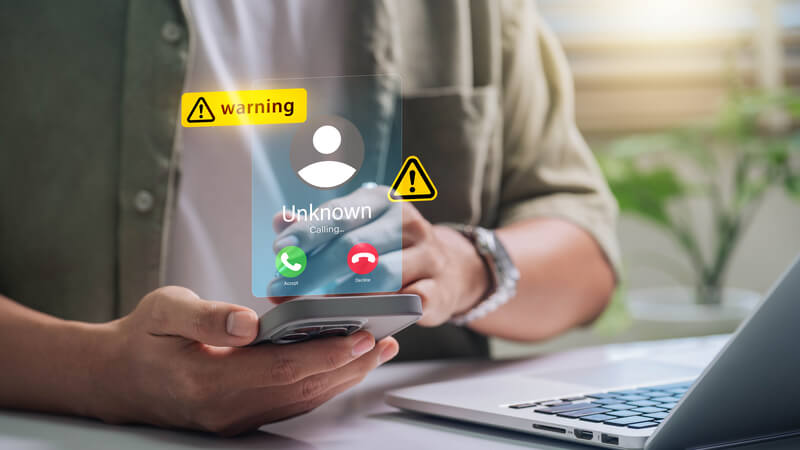
Scams are dishonest schemes involving fraud. Since they are widespread and ever-evolving, people need to be on high alert. Read five popular scam examples, learn how those scams operate, and discover simple ways to stay protected.
Example one: A woman gets a random message on her cell phone from someone outside of her contact list asking what she would like to eat for dinner. The woman is about to politely respond to tell the messenger that they sent the message to the wrong person.
Example two: A man gets an email that says his package is late. He is instructed to click on a link and provide some information to gain the latest updates and tracking information. He is about to do it.
Example three: An elderly woman gets a phone call from her granddaughter saying that she’s in trouble and needs money to get out of jail. The granddaughter tells the grandparent to keep it a secret. A bail bondsman gets on the phone to demand payment via wire transfer. The grandmother is about to comply.
Example four: A man who is recently out of work sees the possibility to make great money working from home. He must provide the potential employer with personal information and a small upfront fee to process his application. He is ready to take those steps.
Example five: A single mother gets a phone call from the security team of her bank. She is told that her bank account is compromised. The security team starts to review some of her banking transactions. The conversation becomes confusing and the bank asks the single mother to provide information to include her debit card PIN to resolve the matter. The single mother is about to share her PIN number.
But wait – what do these scenarios have in common? Each person above is about to be scammed! Let’s break it down and see what we can learn.
The first example is a wrong message scam. Here, scammers send seemingly innocent wrong messages to potential victims hoping to get a response. While it seems helpful and innocent to respond to a wrong message by saying, “Hey, you’ve reached the wrong person,” it is never a good idea to respond to people you don’t know. Wrong message scams, primarily called smishing (SMS phishing) scams, are intentionally designed to start up innocent conversations to build trust over time to perpetuate the scam and steal money or identity. This scam often preys on lonely victims and their emotions. Protect yourself. Should you get a wrong or odd message from someone you don’t know, simply delete it and never respond.
In the second case, the man is about to become the victim of a phishing scam. Here, fake notifications via email or text are sent to victims regarding a package or delivery. These scammers are aware that many people order packages from common carriers. To gain trust, scammers frequently impersonate popular delivery services like USPS, FedEx, or UPS. However, these scammers are lying. The links they send are designed to get their victims to provide personal information or pay a fee. No matter how legitimate a message appears to be, use common sense. Rather than click on messages or links sent to you, contact your carrier using the information you already have for them to determine the status of your package.
Example three is also a scam in progress. This one is called the grandparent scam. Here, criminals impersonate a grandchild (or relative) and create a fake emergency like saying that a grandchild is in jail. Typically, someone impersonating the grandchild will get on the phone and ask or beg for financial help. In this scam, the grandchild (or sheriff or bail agent) will demand payment for bail, bond or fees to be freed from jail. This scam can get sophisticated. Not only can scammers spoof caller IDs for the sake of appearing legitimate, but they can also steal voices from social media or other platforms to pull off the impersonation. Should you receive a call of this nature, be skeptical. Don’t engage with the caller. Instead, hang up and call your grandchild directly using a phone number you have for them. It is likely that you will discover that your relative is just fine.
Likewise, situation four is also a scam. Employment scams typically involve scammers contacting people who are searching for jobs. Here, scammers try to get potential victims to pay money or provide financial information to secure a job. Tell-tale signs of employment scams are unsolicited offers, vague job descriptions that sound too good to be true, the promise of high pay often with little work, requesting upfront fees for training or background checks, or requests for bank details or Social Security numbers to deposit paychecks. Scammers may pose as recruiters from real companies or employment related platforms like LinkedIn. Sometimes, scammers send out checks and ask potential victims to deposit theirs and send part of the money back via gift cards. After the victim provides the funds, the check bounces. Don’t be an easy target for an employment scam. Do your homework and make it a policy never to share information with job recruiters who randomly contact you.
In this fifth scam scenario, scammers are impersonating a legitimate company. Here, scammers pose as the potential victim’s banking institution and create a fake bank emergency, stating that the single mother’s bank account is compromised. Note that scammers are willing to spend lengthy periods of time on the phone with potential victims to gain their trust, cause confusion, and ultimately get folks to divulge personal information like bank account numbers, Social Security numbers, and PINs. Banking scammers often manipulate emotions by making potential victims anxious about their finances. Should you receive word that your bank account is compromised, do not engage with the party reaching out. Instead, hang up and call your bank directly to inquire about your account. Use an established phone number you already have and never call numbers provided to you by potential scammers. Also, closely guard your personal information.
Unfortunately, scams are commonplace
As evident through these common examples, scams are widespread and anyone can be targeted. Thus, in this modern day of technology, protecting yourself against scams is essential. A few things to note; scammers tend to initiate contact, they create fake emergencies, and they offer opportunities for victims to resolve issues by making payments or sharing personal information. This pattern is seen time and time again. Scammers use convincing methods like faking identities, spoofing phone numbers, using voice cloning and more. Scammers are also conniving, attempting to play on their victim’s emotions and pressuring them to act fast to resolve an issue. This sense of urgency pushes victims to make payments or share personal information ahead of realizing what’s happening.
Staying protected
Learn from these scam examples. Understand red flags of scams. Make it a policy not to respond to unknown calls or messages. Be wary of urgent requests for money or personal information. Follow safe practices, like using strong passwords and up-to-date security software. And never, ever share personal information or make payments to people who randomly reach out to you. If you believe the party contacting you is legitimate, independently verify it by contacting the official institution. As always, continue following scam coverage and be aware of the latest cons to stay protected.
[adrotate banner=”1206″]






I think I fell for the Wrong Number scam, but luckily I stopped texting back after wondering why someone kept trying to prolong the conversation,,,,,Never heard of this one before. They said they were waiting for a repairman, so I thought I better let them know they texted a wrong number.
First of all, you can’t be scammed if you don’t respond. It has been my experience that unsolicited phone calls continue to pour in, but when left unanswered they never leave a message. Calling back has revealed numbers that go no where or disconnected. Emails or texts are where scams impersonate legit business such as Netflix or something you have a personal account with saying your payment didn’t process and to immediately update your information, check the sender’s email address it’s usually suspicious. There is no urgency to respond and never click their link, if you are concerned contact them directly. Other forms of scams are internet deals that are too good to pass up, but as they say, if it sounds too good to be true, it probably isn’t. Legitimate transactions are always followed up with a vendor verification email.
Thieves have learned to target the elderly but knowing to verify before responding is key, but if you must answer that phone, that heavily accented person on the phone is usually a dead giveaway. Scammers never seem to use the USPO these days because it’s a federal law to use the mail to defraud, why isn’t there a government deterant for scams?
Example 6, scam messages in AMEC article comments.
I believe AMAC is missing a great customer base in our churches and senior centers I as a member would pass out information about you if you would furnish it
Easy for me. If the number isn’t in my contact list, I do not answer.
Easiest thing I did when I retired was get a call screener. I have a Uniden one a DECT 6.0 version. Basically, it’s an answering machine that does caller “ID” and announces the incoming call by a synthesized voice with the information. Their are many devices out there now so scope it out. Scammers are now “spoofing” their information. Sometimes it says on the screen it’s an Illinois call though it might be from out of state. I let the recording machine to its’ thing and scammers don’t like to talk to a machine. If it announces that the caller is a friend or a business I work with, I pick up quickly while I’m monitoring the device. Otherwise I don’t bother. If a message is not left, the recording side quickly cuts off. Friends, family or businesses will justifiably leave a message for me when I’m not home. Am widowed with guardianship of the mentally handicapped son who I can leave alone when I have to shop or run errands.
I love my PIxel Phone, as it uses Google to answer any #’s that aren’t in my contacts. Google asks for them to leave a message and it they do, and esp if they mention my name, then Google will call me – otherwise the call goes to spam!
If you are a good strong and true CONSERVATIVE, THE ABOVE INFO ON SCAMMERS IS EASIER TO UNDERSTAND AND FOLLOW. BECAUSE IT IS ALL TRUE AND INBORN INSTINCT TELLS YOU SO, VERY GOOD ADVICE. ANYONE CAN BE SCAMMED IF THEY ARE NOT CAREFUL, BECOME LAXED AND TO EMOTIONAL.