
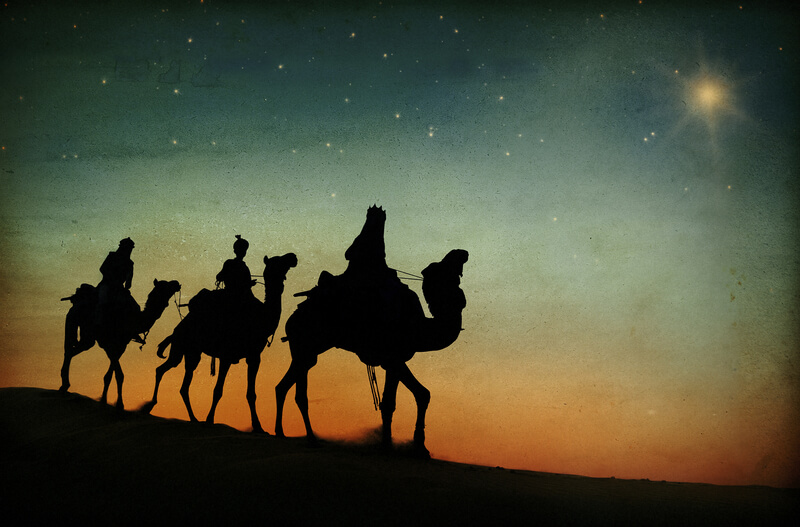
In our increasingly secular society, much of the traditional Christian symbolism that once dominated the Christmas holiday has dimmed. The nativity scene of Mary, Joseph, and Jesus has been overshadowed by the Christmas tree and a Santa Claus who looks more like Father Frost than the kind-hearted Italian bishop St. Nicholas.
But one Christian symbol remains ubiquitous during the “holiday season,” even if its meaning is often forgotten: the brilliant, shining Star of Bethlehem. It tops our trees and decorates virtually every advertisement and Christmas sweater.
The Star of Bethlehem still glows with deep significance, illuminating the values that have shaped and upheld the Western world. The famous celestial body shows up in only one of the four Gospels – Matthew – where we are told that it guides the Magi (the figures who have become known colloquially as the “Wise Men”) to worship the Savior.
Upon Jesus’ birth in Bethlehem, the Gospel-writer tells us, “during the time of King Herod, Magi from the east came to Jerusalem and asked, ‘Where is the one who has been born king of the Jews? We saw his star when it rose and have come to worship him.’”
The Magi travel a great distance until the star stops over the place where Jesus was. “When they saw the star, they were overjoyed,” we are told. “On coming to the house, they saw the child with his mother Mary, and they bowed down and worshiped him. Then they opened their treasures and presented him with gifts of gold, frankincense and myrrh.”
The story of the Star of Bethlehem has sparked wonder and soothed Christian hearts for centuries, offering courage through the darkest trials that tested faith long after the Magi’s journey. This enduring hope glimmers in a fourth-century low relief on the sarcophagus of Saint Agnes, a 13-year-old martyr laid to rest in a Roman cemetery during the empire’s harshest persecutions. In the artwork, three Magi travel by camel, led by the star’s gentle glow as they search for Mary and Jesus. As dark as this moment appears, the artist seems to be telling us, the hope of Christ remains.
For 2,000 years, the star of Bethlehem shone brightly in the chronicles of history, never shrouded in myth or brushed aside as fantasy. The Magi’s journey was as real to the early Christian world as the collapse of empires or the invention of the printing press is to ours, its story stitched into the tapestry of the past.
In the early 1400s, Albanian historian Demetrio Franco embraced the journey of the Magi as historical fact, following in the footsteps of generations of chroniclers. Franco suggested that the Magi may have witnessed a dazzling celestial phenomenon at the time of Christ’s birth, a spectacle certain to enthrall even the most experienced stargazers. With their expertise in astrology, they would have recognized the difference between an ordinary meteor (as some secular astronomers have suggested) and a rare, awe-inspiring sign blazing across the night sky.
As revelations about planetary motion transformed humanity’s understanding of the cosmos, two remarkable minds, Johannes Kepler and Isaac Newton, set out to unravel the mystery of the Star of Bethlehem. They both had in mind the historical record presented by renowned scholars of their era, such as Franco and his predecessors.
Kepler, a devoted Christian, and Newton, a passionate scholar of the Scriptures, both masters of astronomy and mathematics, plunged into ancient chronicles of celestial wonders and the mysteries of the night sky, driven to reveal the true nature of the star that guided the Magi.
In his letters on Biblical studies, Newton pictured the Star of Bethlehem as a wild comet, racing unpredictably around the sun. As it neared, the comet would blaze to life, unfurling a luminous tail of gas and dust that painted the night sky. Such a spectacle could have enchanted ancient sky-watchers, echoing Matthew’s story of a guiding star for the Magi. Halley’s Comet, with its 77-year cycle, seemed a promising candidate. But Newton’s theory faltered: historical records reveal Halley’s Comet appeared in 12 BC and not again until well after Christ’s time on Earth.
On a brisk December evening in 1603, Johannes Kepler looked skyward as Jupiter and Saturn seemed to nearly touch, their paths crossing in a cosmic dance. The sight of these two celestial wanderers converging sparked his imagination. Inspired by the chronicles of ancient monks, Kepler set out on a journey of discovery.
His research, later published in the first volume of his “Gesammelte Werke,” revealed that in 7 BC – a year woven into legend as the time of the Magi – a rare triple conjunction occurred, with the planets meeting not once but three times in a single year.
Professor Michael Molnar, an astronomer and a pioneer of studies of ultraviolet beams from magnetic stars, told this author in an interview in 2003 that Kepler “could have been on the right track,” as “planetary conjunction, rather than other phenomena, appeared to be the best candidate” for the Star of Bethlehem.
Dr. Craig Chester, co-founder of the Monterey Institute for Research in Astronomy, noted that on what would have been September 11 in the year 3 BC, the sky staged a breathtaking performance. Jupiter drew near to Regulus, the brightest star in the constellation Leo. This remarkable alignment mirrored the prophetic image of a child destined to rule the stars from the Book of Revelation. Even more remarkably, this celestial drama played out on Rosh Hashanah, the Jewish New Year.
Though each of these theories are plausible, each also created more questions. If three conjunctions of planets occurred, as Kepler suggested, why does the Gospel of Matthew only mention one star? Could two planets, however close, truly blaze as a single guiding light in the heavens? Might the best explanation still be a supernatural sight not repeated before or since?
The story of the Star of Bethlehem carries a meaning that reaches far beyond a dazzling celestial event. Renowned physicist and Anglican priest Dr. John C Polkinghorne shared with me in a 1995 interview that “this tale offers a model for scientific inquiry, urging everyone to ask honest questions and seek truth with God’s guidance.” According to Dr. Polkinghorne, the Magi’s approach “inspires us today to balance the uncertainty of discovery with the temptation to retreat into personal opinions.” Their journey reminds us that “humility is not just valuable in science but essential for anyone seeking truth.”
The enduring symbolic power of the Star of Bethlehem is a reminder of how the Christian tradition is woven into the very fabric of Western civilization, crafting holidays that beckon each generation to pause and marvel. Christian teachings are a living tapestry, inspiring people from every era – including our own – to unravel its hidden meanings, especially within the awe-inspiring story of Christmas.
This moment of God entering our world, walking alongside us, and facing mortality as we all do, remains one of the most compelling and enduring mysteries of the faith. Just as the Star of Bethlehem guided the Magi, so too do the teachings of Christ continue to guide us today. The mystery of the star beckons to us across the centuries, inspiring theologians, astronomers, and everyone in between to wonder at the miracle of Christ’s birth.
Ben Solis is the pen name of an international affairs journalist, historian, and researcher.







Very good article Ben , Thinking in terms of defense of Faith in God, and in defense of the Holy Family – regarding Mary, Joseph and Jesus Christ
Mystery is part of life . I work on the history of Mathematics of. chart and map projections – part of Navigation . Astronomy and Navigation deal with reasoning. Mystery is what is there before the reasoning is used to determine facts. Mystery provides something of great importance in how our imagination works. Imagination is something of great importance. It could be said that beyond the facts there is more mystery. It is like measuring something that can be regarded as an extremely long distance from where we are to where It is located. Am doing this research on the history of Mathematics of chart and map projections independently. If. I live another 25 years I will be 100 and I do hope that I will still be doing this research. Same goes for another research project that involves Physiological Optics and another Anatomical Illustration. There is much to do .A sense of purpose that connects the present with past discoveries and developments will always be useful in gaining an understanding of those things that are of importance .