
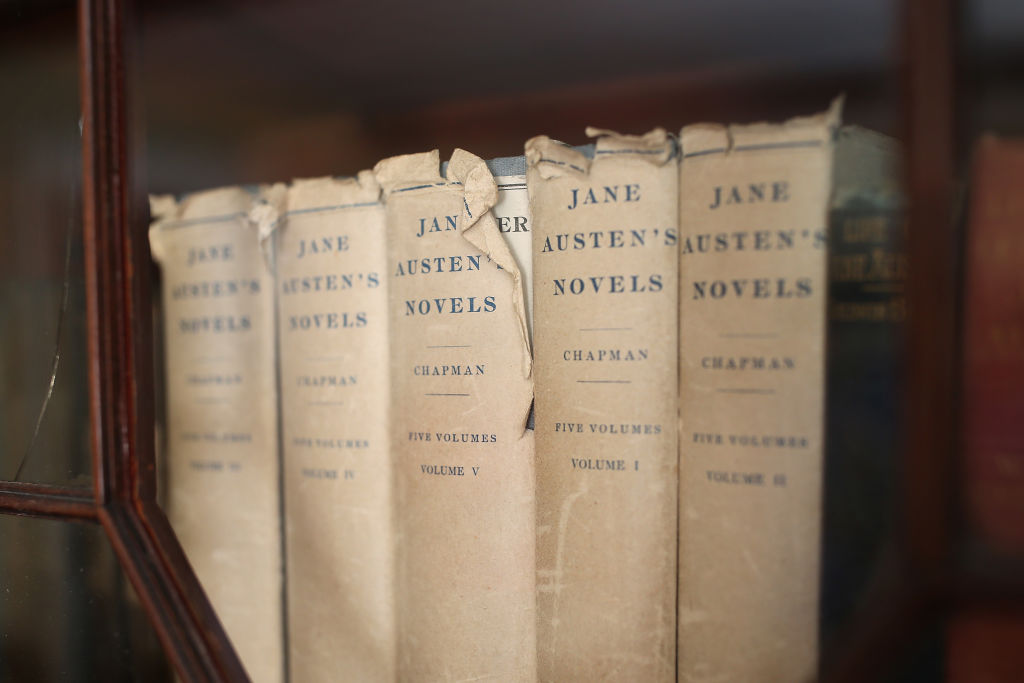
“Jane Austen had little to say about America,” scholar Lauren Gilbert wrote in a 2012 article, adding, “and that little was not good.” Yet, whatever her opinions about us were, Americans do indeed love the author of Pride and Prejudice—and all her works. Born on December 16, 1775, fewer than six months before the Declaration of Independence, Jane Austen is as beloved on this side of the Atlantic as she is in her native land. For good reason!
Though she might have been skeptical of this new land’s arrangements, her good-humored prose, her unforgettable characters, the love of tradition in her stories, the indelible portraits of virtue and vice, and her own keen sense that neither virtue nor vice is distributed by sex or by class make her beloved right here. It’s fair to say that whatever she might have said or refrained from saying, Jane Austen is an Honorary American.
Americans can certainly forgive the things she said about her country, given the circumstances. In the article cited above, titled “Unrequited Love: Jane Austen and America,” Gilbert admits that circumstances likely shaped Austen’s views: “Given the fairly recent loss of the colonies and subsequent revolution and Terror in France, a jaundiced view of America by Austen and her contemporaries would not be unreasonable or surprising.”
Indeed, the one letter from which Gilbert quotes was written in 1814, when the new country was again at war with the mother country. We know that Austen knew Englishmen who were participating in what came to be known as the War of 1812. In an article on Austen’s Virginia connections, George Herbert Tucker observed that “John Knatchbull, a scapegrace half-brother of Sir Edward Knatchbull – who married Austen’s favorite niece, Fanny Knight – served with the British fleet in Norfolk-area waters and helped burn Washington in 1814.”
We can generously assume that Austen, who died only a few years later in 1817, at the young age of 42, might well have changed her views of the United States had she but more time, understanding, and, perhaps, the knowledge that this new country would provide her with many millions of readers—of whom there were some very distinguished ones very early.
Tucker details how the great American jurist, Supreme Court Justice John Marshall, paid tribute to the great, still recently deceased writer, in an 1826 letter to Justice Joseph Story. Story had given a lecture in August to Harvard’s Phi Beta Kappa Society titled, “The Literary Condition of the Age.”
Though he had mentioned several female British novelists, Story’s omission of one in particular caused the generally appreciative Marshall to pause: “I was a little mortified, however, to find that you had not admitted the name of Miss Austen into your list of favorites. I had just finished reading her novels when I received your discourse, and was so much pleased with them that I looked in it for her name, and was rather disappointed at not finding it.”
Nor did Justice Marshall merely observe the lapse. He issued his own judgment on her work and asked Story for a correction. “Her flights are not lofty, she does not soar on eagles’ wings, but she is pleasing, interesting, equable, and yet amusing. I count on your making some apology for this omission.”
Nor was he the only great American champion of Jane Austen. Though there have been American haters, they have always been very peculiar haters. Mark Twain is famous for his slighting comments. For example: “Every time I read ‘Pride and Prejudice’ I want to dig her up and beat her over the skull with her own shin-bone.” Permit just a bit of skepticism about someone who kept picking up books he hated. Perhaps Twain knew that his own reactions were out of whack.
For every famous hater, however, there have been many more admirers. Critic George Saintsbury dubbed the legion’s fanatical Austen fans “Janeites.” Harold Bloom famously ranked her as one of the greatest writers of all time. Many other scholars and ordinary readers agree.
The Jane Austen Society of North America (JASNA), founded in 1979, is the largest society dedicated to the author in the world. It now boasts more than 5,000 members and 83 regional groups, of whom usually close to 800 attend annual conferences. Conservative icon William F. Buckley, Jr. said, “One doesn’t read Jane Austen; one re-reads Jane Austen.” And if Buckley is too highbrow, celebrities from Taylor Swift to Dwyane Wade have declared their love and recommended Austen.
The love has translated into some great American art inspired by her genius. In a well-known essay, political philosopher Mary Nichols labeled American Whit Stillman’s series of brilliant comic films, Metropolitan, Barcelona, and Last Days of Disco, “Jane Austen for the silver screen.” Clueless, perhaps the greatest adaptation of Austen’s novel Emma, is set in Beverly Hills. It’s a great movie, whether people know the original or not.
The work of Austen has even become part of public policy. In 2024, Florida Commissioner of Education Manny Diaz, Jr., chose as one of his “Commissioner’s Books of the Month” Pride and Prejudice.
Even without official pushes, however, Americans keep discovering Austen and claiming her as one of their own. Her tales of men and women, families, and small communities trying to get along in an age where there are real social expectations meet Americans’ current needs for a return to better arrangements. We all want a healthier form of life where freedom can find its place in an order that makes it blossom.
Jane Austen may not have spoken much or well of our young nation, but our nation has embraced her. Happy 250th, Miss Austen. You’re on our list of favorites.
David P. Deavel teaches at the University of St. Thomas in Houston. A past Lincoln Fellow at the Claremont Institute, he is a Senior Contributor at The Imaginative Conservative. Follow him on X (Twitter) @davidpdeavel.




Jane Austen is one of my favorite authors. I have read most of her novels and enjoy the moves as well. I never seem to get tired of the “Pride and Prejudice” movie with Kiera Knightly and Mathew McFadden. The story is not completely the same as the book, but is none the less an entertaining movie for hopeless romantics.
My wife has enjoyed Janes Austen’s works for years. She has watched the adaptations of Austen’s works to the movies, some good and others so so. That’s “Britishwood” for you.
“Pride and Prejudice.” Saw the 1940 film, and enjoyed that so much I read the book. Then several Jane Austen books after that. Good stuff….