
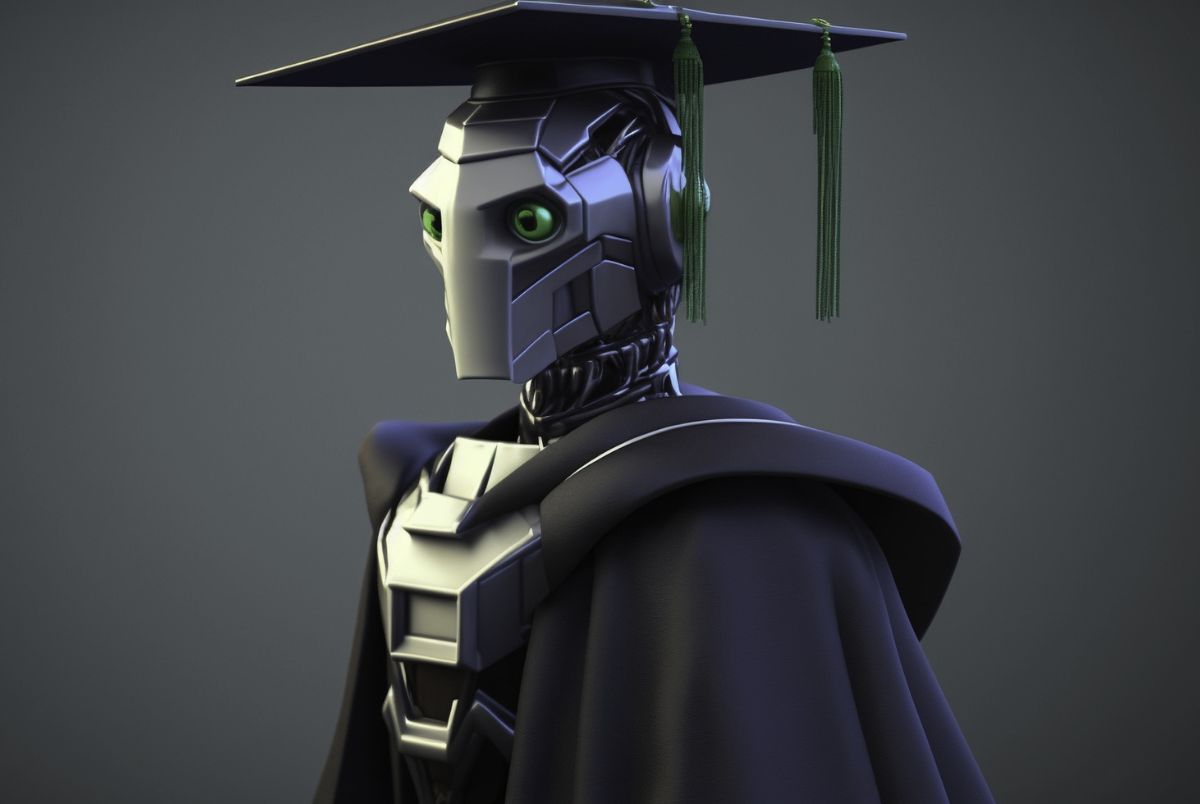
The American education system has a big and growing problem – students are increasingly using artificial intelligence (AI) as a substitute for actual learning, and teachers aren’t quite sure what to do about it.
IBM defines AI as “technology that enables computers and machines to simulate human learning, comprehension, problem solving, decision making, creativity and autonomy.” AI technology, for example, can be used to “better interpret imaging results” and process doctor’s notes, according to Harvard Medical School.
When AI-powered tools like ChatGPT first burst onto the scene a few years ago, they held plenty of promise for education. And indeed, in the right application, AI can be a powerful tool to enable personalized learning and tutoring and to provide instant feedback for students.
But more and more students are also using it to write papers and even cheat on tests as more schools move to online exams.
“All you have to do is copy and paste the multiple choice questions, or take a picture of it so it converts from chat to text, and then paste it into ChatGPT, and out of the multiple answers it gives you the right one and explains why,” one university student recently told The College Fix. The College of Staten Island student admitted he received an “A” on two different final exams after using ChatGPT.
New research has confirmed AI programs such as ChatGPT can be used to pass even complicated courses such as engineering. University of Illinois researchers “found that ChatGPT earned a passing grade in the course without much prompt engineering, but the chat bot didn’t demonstrate understanding or comprehension of high-level concepts,” according to a May 19 Inside Higher Ed article. In another recent development, Google’s Gemini 2.5 AI scored a 49 percent on the Math Olympiad test – better than 75 percent of the students who took the test, a population comprised of the top young math minds in the country.
Students are also using AI to write papers, creating real concerns that schools are producing graduates with no real literacy skills. The plagiarism detection site Turnitin.com reviewed more than 200 million papers written by high school and college students and found that millions of those papers were likely generated primarily through AI. Another study reviewed 10,000 college scholarship essays and found that 42 percent had likely been composed with the help of generative AI.
In some cases AI-written papers are easy to spot, as AI programs have been known to generate “hallucinated” or “ghost” citations, conjuring fake sources out of thin air. ChatGPT, for example, created fake stories of professors being accused of sexual assault, and cited legitimate news outlets. In another rather ironic case, a self-proclaimed “disinformation” “expert” created a legal filing which included fake citations after ChatGPT filled in placeholders, drawing a rebuke from a Minnesota judge.
At New York University, one professor said he “AI-proofed his assignments,” according to the Daily Mail. The teacher found out his students were using AI when one asked for an extension on an assignment “because ‘ChatGPT was down the day the assignment was due,’” the Daily Mail reported.
However, as AI technology advances, the problem of students relying on computers to do their thinking for them is set to only get worse. Just a few years ago, AI could only produce cartoonish approximations of images and videos. Now, hyper-realistic AI videos are all over the internet. The same sort of advancements are occurring with written material, increasingly blurring the line between human-generated and AI-generated content.
But it is not just professors battling against their own students using AI – sometimes the clash occurs the other way.
A Northeastern University student recently requested a refund from her school after finding out her professor used AI in a contradiction of his own policy.
Ella Stapleton dug into her professor’s materials “and discovered other telltale signs of AI: distorted text, photos of office workers with extraneous body parts and egregious misspellings,” according to The New York Times.
“He’s telling us not to use it, and then he’s using it himself,” she said. Students, the Times points out, “make a financial argument: They are paying, often quite a lot, to be taught by humans, not an algorithm that they, too, could consult for free.”
The instructor apologized for how he used AI and said he will be more transparent in the future. Stapleton did not receive the refund.
These stories illustrate the need for a more robust conversation about AI’s place in education and how to guard against both students and faculty taking advantage of it. The University of Pennsylvania has offered some guidance here, saying that faculty and students should “be transparent” and “disclose” how AI was used. Northern Illinois University has other policies which outline positive ways to use AI, such as proofreading papers, brainstorming ideas, or “finding information.”
Ultimately, however, schools may be required to change their teaching models to adapt to the proliferation of AI. The reality is that overtures to integrity and “transparency” likely don’t stand much of a chance against the allure of a website that can do a student’s work for them in seconds.
Ironically, the answer may be a return to more traditional schooling methods – hand-written assignments, in-person tests on paper, and getting cell phones and other electronics out of classrooms. To preserve genuine learning and intellectual growth, schools may need to unplug from the very technologies once hailed as the wave of the future.
AMAC Newsline contributor Matt Lamb is an associate editor for The College Fix. He previously worked for Students for Life of America, Students for Life Action, and Turning Point USA. He previously interned for Open the Books. His writing has also appeared in the Washington Examiner, The Federalist, LifeSiteNews, Human Life Review, Headline USA, and other outlets. The opinions expressed are his own. Follow him @mattlamb22 on X.





Education in this country was destroyed a long time ago by teachers unions along with the Marxist take over of most colleges in universities.
OH great! we’ll have a bunch of engineers, but only while AI is online. Once AI is down these people will be dumb as sticks and useless as – well you know.
Continue this for a couple of generations and we’ll lose all ability to function without the AI crutch. We’ll be just one E.M.P. away from starting over.
I get the idea of increased capability with AI, but we cannot lean too hard on something that can go away so easily. Does anyone still know how to use a slide rule? You won’t be able to just look it up if the system goes down.
AI is going to be destroying a lot more than education, we have no idea the evil it’s going to be used for.
As I’ve said before, the info going into AI is only as good as the person who inputs the info. What I have been seeing is a bunch of kooks inputting info. So I have no interest in AI.
I thought it was a lack of expectations of natural intelligence, no demands in that department at all. Everyone is a genius passes with flying colors and gets a medal.
AI will be Humanity’s “End Times”/”Last Days” Tower-of-Babel! In effect AI subtly is replacing ALMIGHTY GOD. You constantly hear how great AI is, when in essence, you do not hear, how much GREATER GOD truly is. Therefore, why is there a need to replace an ALMIGHTY GOD, WHO isn’t man made, with the fallacy of something man made!?! You cannot improve upon a DIVINE PERFECT GOD, WHO can/does/knows all things PERFECTLY/DIVINELY! A machine has limitations in as much it cannot create miracles!
Let ths be a stern warning to Humanity!
Yes, we can end up with an illiterate, ignorant, and stupid society that takes us back to the dark ages. For all the positives AI provides, there are at least four negatives. AI is beyond dangerous, and I have been deeply disturbed by our great President’s embrace of it. Instead, we need to develop apps and software that can recognize it and thwart it.
Please be in the know of it’s capabilities because you will be confronted one way or another in your lifetime.
of course it is and if it isn’t it will. AI is going to destroy the world. remember hal2000?
For every positive thing AI can do, it has the real potential to do 100 NEGATIVE things. A return to traditional education practices has worked well for producing well qualified engineers, doctors, architects, scientists, etc. WITHOUT AI.
Now we’re going down the road to graduate UNQUALIFIED engineers, doctors, architects, scientists, etc. WITH AI.
YES!!! We are keeping people from having to learn anything which is producing stupid people. AI on Google actually summarizes my emails before showing the email that was sent. I have asked for it to stop but they are not listening to me. I do not need a summary of an email I read. A further dumbing down of the far left to create robots they can control.
We are human beings made with flesh and blood..organs..Robots are not natural, keep these “things” out of education.
No good is going to come from AI. It should be very strictly controlled.
As a retired public ed. teacher of 40 years, the solution is simple; go back to the “Blue Books” in which each student is given a lined, but blank booklet of pages, for the final exam and students have to write in their own hand – print or cursive, if they’ve been taught it – the answer to a question, or set of questions, on a separate sheet of paper. While this may take preliminary training on the teacher’s part to make this work, it gets around the practice of students producing a handed-in paper they printed from an answer asked of AI on their computer. I understand some schools are already implementing this practice. Then too, there’s the teacher generated options of multiple choice and short response essay style questions given on the day of the exam and answered in class which are turned in before leaving the classroom. I did it all the time in my Science classes.
AI can Enhance Education dep on programming
Make History Come alive
Teach language lessons
Probe the sciences
Mentor students
Create new Art, media?
Uncover the Unseen
as posotives +
Other use is Mind Control, Indoc for the Bad side of AI
Thankful for those who are educating us on AI! Extreme caution needed in supporting this!! Thank you!!
AI has the potential to replace most medical, legal, and accounting professionals, saving trillions of dollars each year.