
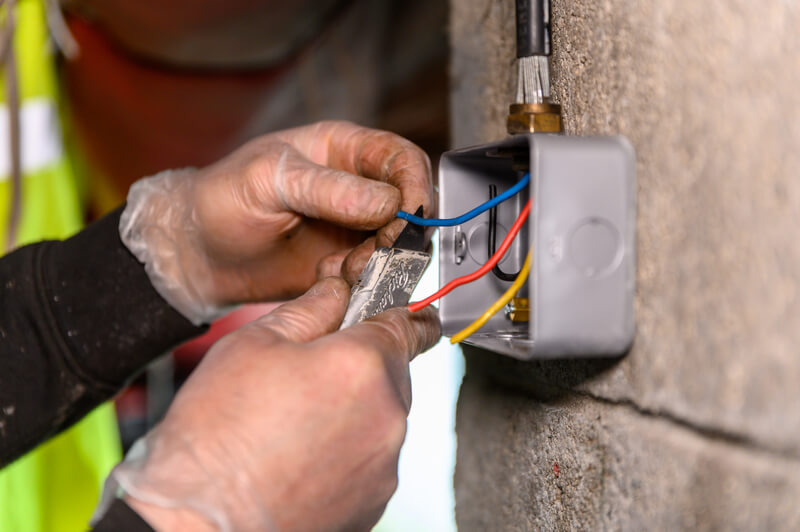
Imagine this: Your generator or furnace breaks mid-winter, and no one to call. The water pump at the bottom of your well fails, and no one to call. You need a plumber, an electrician, and someone to repair the roof, but you don’t know who to call. You need an auto mechanic when your brakes, rear differential, suspension, or transmission fails, but you have no one. Welcome to the future – if we do not restore trades in America.
A new study suggests that, nationwide, we are headed for a crisis in the trades, already exploding in some states. By 2030, the gap between “needs” and trained tradesmen – from welders to equipment operators, builders to HVAC technicians – will be 2.1 million, crippling dozens of sectors, real estate to infrastructure, setting up operationally driven slowdowns or worse.
Why is this happening? How can it be addressed? Who will take responsibility for preempting the trades crisis? The “why?” is simple. We have disincentivized hard work, cut trades from high schools, and created a cohort of young, dependent, untrained people. As professionals in their 50s and 60s retire, they are not replaced. At some point, the pipeline of trades thins out.
The study: “We risk operational disruptions that will ripple through the entire economy, affecting everything from construction timelines to energy costs to building safety. The window to act is now, before the gap becomes insurmountable.”
So how big is that gap already, how fast is the gap growing, and how do we address it?
“The supply-demand imbalance has reached crisis proportions,” say experts. “Last year alone, nearly 600,000 jobs were posted for major skills trades positions … while only about 150,000 new workers entered the labor pool….For every five workers who retire, only two replacements enter.”
While some young people shift toward trades – a good sign – and human replacement options like robotics and artificial intelligence may be partial gap fillers, the need for well-trained, well-paid humans is high and growing, a demand signal that States would do well to focus on.
No matter which side of politics people fall on, from helping heritage industries and reliable fossil energy options to pushing renewables and new sectors, reality is hard to look away from: Without a revolutionary recommitment to the trades, these trades-based critical needs will go unfilled.
Fundamentally, at the national, state, and local levels – in both policy and practice – we must catch the labor market up with foreseeable demands, and stop hemorrhaging top-flight tradesmen.
So, how do we do that?
At the high school, junior high, and early education levels, we must reprioritize real skills – math, reading, writing, thinking, competence with our hands, comfort with manual labor, recreating a labor pool prepared to learn critical life skills, valuable personally and professionally.
In my youth, we were taught by doing – taught how to think, build, imagine, create, and fix things. We played with Erector sets, tinker toys, crystal radios, built bird houses, in Boy Scouts built fire pits, latrines, giant towers, rope bridges, in 4-H farm skills, in Junior Achievement, how to start a business, later how to drive, change tires, oil, air filters, paint, hammer, shoot, saw, and self-reliance.
In Junior High and High School, every student – at least in Maine – could dabble or dive into Industrial Arts (IA) or Shop, everything from wood working, welding, plumbing, and auto-mechanics to project planning and management, and how to be responsible for outcomes on deadline.
These life skills, tackling, assessing, and solving problems – and the confidence that flows from it – must be reseeded. Leaders in families, schools, and even Governors must push problem-solving, real learning, confidence, and competence, not dependence, lethargy, and learned helplessness.
Next: States that already suffer an acute lack of trades must pivot, refocus on lifting their economy, planning for growth, and train youth to anticipate needs. This means assuring junior high and high school students have IA/ Shop, home economics, business, and life skills, on top of performance measurement in key areas, reading, writing, math, science, and history learning.
One step higher: The State must help businesses and schools become anticipatory thinkers, team players in growth, incentivizing the former with tax and labor incentives, the latter with curriculum redrafting, innovation, and metrics, then tying them both together, coordinating for success.
State policy must encourage work, early apprenticeship, early earning, and learning at a young age, rather than disincentivizing these steps; dependence must be discouraged, and work encouraged. Markets must be built around comparative advantage, whether forestry, maritime, agriculture, manufacturing, services, energy production and transport, or emerging technologies.
Finally, the culture of States – and collectively the United States – needs to reflect the historic American pride in hard work, self-help, self-reliance, free markets, individual freedom, equal opportunity, and using God’s gifts to get ahead. If we do this, from Maine to Texas, we will meet and beat this trades crisis. If we look away, well, be ready to fix your own furnace and tune up your car.
Robert Charles is a former Assistant Secretary of State under Colin Powell, former Reagan and Bush 41 White House staffer, Maine attorney, ten-year naval intelligence officer (USNR), and 25-year businessman. He wrote “Narcotics and Terrorism” (2003), “Eagles and Evergreens” (North Country Press, 2018), and “Cherish America: Stories of Courage, Character, and Kindness” (Tower Publishing, 2024). He is the National Spokesman for AMAC. Today, he is running to be Maine’s next Governor (please visit BobbyforMaine.com to learn more)!






I agree with everything you said, but I bet it’s not going to happen. Yes, this affects everyone no matter your political stripe. But you have to remember the democrats want lazy, dependent citizens who will keep voting them into office so they can give them food and housing. This is an uphill battle. The dems control the education system, especially at grade and high school levels. They either can’t see or don’t care what will happen in future as long as they are in power. The teachers and education unions need to be done away with or at least stripped of their power. Then maybe this battle can be won.
RBC, great article and to the point. In my town, 40 years ago, there were an abundance of different tradesmen to call on when they were needed. Over the years there has been an 80% decline with tradesmen as some retired, others moved into other jobs away in the bigger cities that provided insurance for their families and training apprentices lost interest. The few that are left are busy to the point of being overwhelmed with the work they have to do.
The stats that you provide is definitely on the money and definitely needs correction at all levels. The education route for the younger folks needs to be revised so trade options can be available in schools.
Turn Idle college spaces, bldgs for local Voc Tech Ed centers alone nationwide
Partner with Voc Tech Ed for Education
This crisis involving a shortage of skilled people – in plumbing, carpentry, mechanical and electrical fields can be reversed without government involvement. Community spirit could go a long way in that senior citizens could be a source of knowledge to contribute in efforts to revitalize the various trades. At the high school level a good plan would be to have a course on An Introduction to Woodworking and Metalworking ; during first year high school -..second year actual Woodworking projects could take place; third year Metalworking projects ; and in the fourth year there could be An Introduction to Machine Tools that would involve the use of lathes and milling machines .Referring back to the community spirit idea, if the high school doesn’t want to have such programs then skilled craftsmen who are senior citizens could contribute some time , making for some kind of informal training until there is an improvement with the local high school by providing learning for the trades or some alternative situation is established . Ingenuity is an admirable quality and sometimes it is a necessity . Separate trade schools other than the high school is a possibility Much to think about on this topic. It is a matter of survival , so doing things accordingly will be required.
If semiliterate can attend college, why would he go into trade, such lowly position, one of our friends was a brick layer, one electrician, both were sitting on the pot of gold. Learn a trade, you’ll never be out of work is the old saying.
Since I have been fixing my own furnace, plumbing, and tuning up my own car all my life I had hardly noticed. I have never been able to afford specialists to come to my house and fix things I don’t know how anyone else can afford it in this economy.
It’s even worse than you describe. Some of the trades are licensed positions that require years of on-the-job training under a licensee — not schooling. As the number of licensees decline the training opportunities decline too — a shortage of workers = a decrease in the ability to create new workers. Just as with birth rates, it can turn into a death spiral if allowed to decline much further.
Secondarily, it’s bad because they now know that sitting at keyboard/staring at a screen does not develop the brain the say way that doing things with your hands does (typing/swiping does not count). Those changes in brain development are probably not for the better and may even help explain/contribute to some of the cultural/political shifts we’re seeing.
The only way “we” can “…restore trades is America” is to unify a sufficient number of parents and concerned citizens across the nation in this common crusade, device a workable, sustainable, effective plan of action to include appearing at school board meeting to ask pointed questions about educational priorites being emphasized which have no practical applications. First, allow the board members to describe the “philosophy” and intentions behind their comprehensive plans for the education of young people. If their responses do not include practical matters like vocational training and skills related to those students who would most likely follow the paths of tradesmen (and young ladies), remove them from the school boards. Never mind having conversations with them. Just replace them with people endowed with a higher leverl of communal common sense.
Several years ago a friend’s 19 year old son dropped out of college after 1 semester saying it was not for him. He got a job with the local power company as a line man trainee. He is single and volunteers for emergency service throughout the country, lots of overtime, all expenses paid. At the end of his second year at 21 years of age, he grossed $235,000. I have told my 4 college age grand kids this story and one of them has gone the trade school route as a mechanic.
Industrial arts was killed by school boards all over the nation. The only thing unified about schools was its demise of useful trade based teaching. As my pappy used to say “Learn how things work, or pay someone who does”. No one knows how to do anything anymore and the cost of skilled labor like everything else is expensive and scarce.
Part of the solution to this problem is to eliminate the federal Department of Education and the massive amounts of subsidies given to inefficient, government-operated universities and their student to pursue studies without economic value comparable to the investment. Nearly all of the liberal, fine, and performing arts and so-called “social sciences” curricula are superfluous to the purposes of the State “Land Grant Colleges” which were originally established to promote fundamental research in the “hard” sciences, engineering, and scientific agriculture. State universities and associated grant and loan programs for students with academic potential but lacking financial resources in those fields are a feasible and worthwhile investment for the States’ education departments. The liberal, fine, and performing arts and social sciences curricula can be supported and/or studied at private universities by those with the personal wealth to afford them.
A further set of incentives to enter the skilled trades would be for the states to promote public-private partnerships that would subsidize skilled trades apprenticeship programs for high school juniors and seniors in manufacturing as well as installation and maintenance trades. More high schoolers pursuing these programs would reduce demand for classroom teachers and academic guidance counselors, freeing funds to subsidize the apprenticeship programs and provide minimum wage pay for the students, to encourage them to “stick with the program.” These “vo-tech” programs would produce high school graduates with entry level certification in skilled trades, practical job experience, and useful employment-related life skills.
** These programs would also help fill a growing shortage of skilled workers for military and dual-use manufacturing, which has become a significant national security concern. It is a factor in the notorious “supply chain issues” delaying many critical military programs.
Part of the problem came from the emphasis on STEM in education and that everyone needs a college degree. Many places college is only socialist indoctrination, no education. Another part of the problem is that unions are nothing more than a democrat cash/voting machine. A great place to go if you don’t want to work, but want to make big bucks.If you are not pro union, they will come beat you up.When you have to put union membership into law. it offers nothing to the members. If unions were so great everyone would be signing up. Department of education, prime example. All they care about is union activity. Ask you union friends if they prune their own shrubs or do they call a union arborist? Do they work on their own cars or take them to a union mechanic? If they do any of those, they are scabs
The government needs to get out of the business of funding meaningless college degrees and instead provide incentives for the trades.
I hate to say this but I have worked with young people in my part time job after retirement. Most, but not all just don’t want to work. Believe me when I say the job was moving cars which is something less than hard work. When I needed to ask people to stay late none of the younger crowd stayed. The older folks could always be counted on. Sad. I am lucky to have 2 grandsons who are willing to work and go to school too.
As someone who has worked in the masonry field since 1973 (still working), the pay for the work has not kept up with inflation. The reason is because of the cheap labor that was allowed to come over the border. Construction wages are not where they should be. It wont improve until the coming crisis happens and supply and demand correct the pay scale for what it is worth. Getting up at 5AM, working whether it is 20 degrees or 100 degrees. There is also a stigma in society if you are a construction worker. People who are not in construction view you with less respect. In most cases, it is made clear on jobs in or near occupied public spaces, that everything is done to prevent you from being seen or heard. The only benefit (if any) most construction workers have, is some form of employer provided health insurance. They don’t get paid holidays, paid vacations, sick pay. For most, if you don’t work, you don’t get paid. No respect, hard work, getting dirty, pay that does not compensate for the effort. Why would anyone want to start in the trades?
I agree with the premise of the article. A few fine points were overlooked. The problem exists in Western culture; North America for sure but the “physical work” stigma also exists across Europe, Australia, and to some degree, New Zealand. Not having a professional technician available when needed is indeed a crisis but the cost of a competent professional is a matter of other sorts. Labor unions have done a disservice to the professions they supposedly serve. In order to attract the best of the best, trade organizations need to reverse the table on public perception of non-college-degree professions. Achievable salaries need to be advertised. Top-level diesel-hydraulic technicians who are unafraid of global travel can expect yearly salaries >3X what the average bachelor’s or masters graduate will earn. Professional electricians have continued to be in demand for five decades. Building trades professionals and facility maintenance specialists will continue to be in demand. Start with salary comparisons. Promote character development. No physician, surgeon, accountant, attorney or finance professional can function without the lights on, HVAC working, and toilets flushing. And no one functions without the garbage being hauled away.
Trades work is very fulfilling. Find what you’re interested in and become an apprentice and learn the skills. I knew I was not college bound but I loved mechanics, electrical, hydraulics, carpentry. We must encourage the younger along these lines; it’s so self fulfilling.
Going into a trade now carries a stigma created by libs. The libs push the “everyone needs to go to college” nonsense and denigrate those who do not. This is for one reason and one reason only. They know that academia is mostly comprised by flaming libtards and they know they will do their absolute best to indoctrinate/brainwash the students to become democrat voters, thus assuring they stay in power.
This is why AI won’t take over for long. No one could fix it when it goes down!
illegal aliens can handle it for less money and quality!
You better get under your car then broke boy hahaa