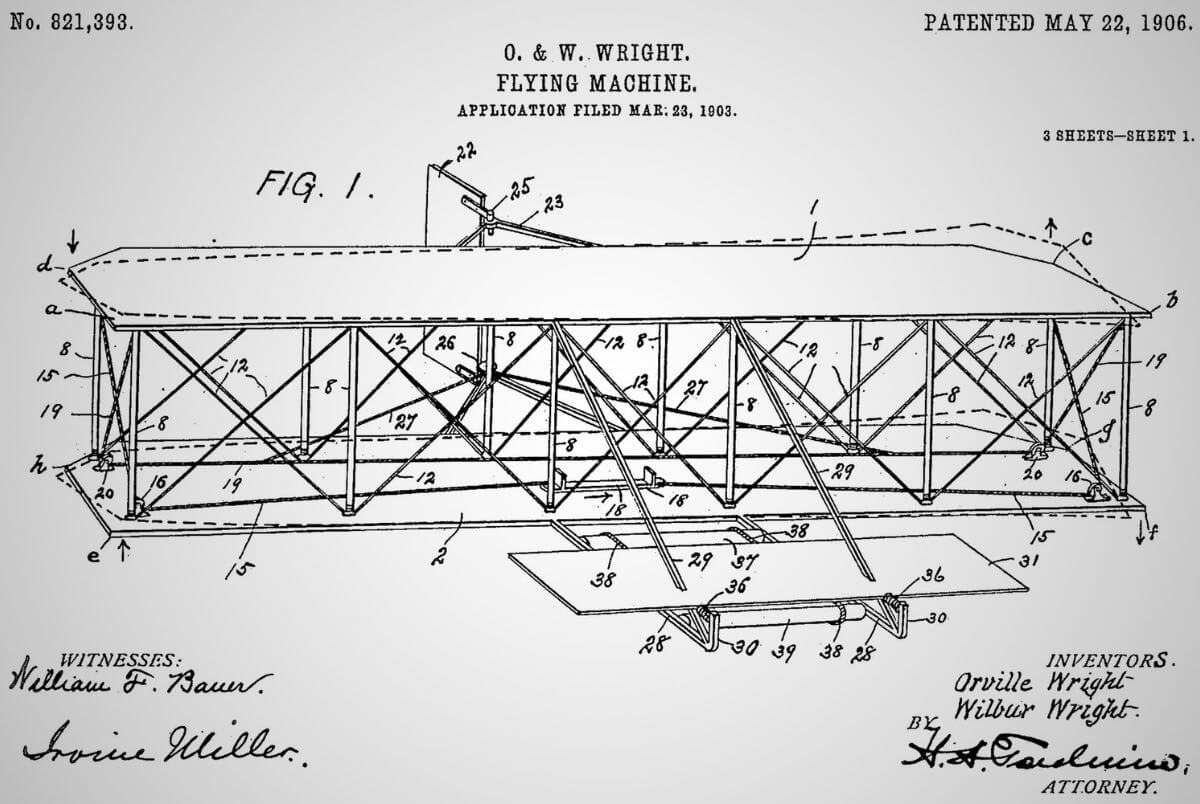
On May 22, 1906, the United States Patent Office granted patent number 821,393 to Wilbur and Orville Wright for their invention, simply called a “Flying Machine.” While the Wright brothers had already achieved the first successful powered flight at Kitty Hawk, North Carolina, in December 1903, the patent represented a pivotal moment in aviation history. It formally recognized the brothers’ groundbreaking work and protected an invention that would forever change transportation, warfare, commerce, and human connection around the world.
Wilbur and Orville Wright were not formally trained engineers or scientists. The brothers operated a bicycle shop in Dayton, Ohio, where they developed mechanical skills and a fascination with motion and balance. Inspired by earlier aviation experiments and childhood memories of flying toy helicopters powered by rubber bands, the Wrights dedicated themselves to solving the mystery of human flight. Their greatest breakthrough was not simply building an aircraft that could lift off the ground, but creating a reliable system that allowed pilots to control the machine in the air.
On December 17, 1903, the Wright brothers made history when Orville piloted the Wright Flyer for 12 seconds across the sands of Kitty Hawk. Though brief, the flight proved that powered, sustained, and controlled flight was possible. Additional flights that same day demonstrated increasing stability and distance, launching the modern age of aviation. Yet despite the achievement, the brothers spent years refining their invention and fighting for legal recognition of their innovations.
The patent awarded on May 22, 1906, focused heavily on the Wrights’ method of controlling an aircraft in flight, particularly through wing-warping technology that allowed pilots to maintain balance and steer effectively. This system laid the foundation for modern airplane controls still used today. Their patent was considered extraordinarily broad because it protected the concept of controlled flight itself, not merely the specific design of their aircraft.
The patent also sparked years of legal disputes with competing aviation pioneers who attempted to build similar aircraft. The Wright brothers aggressively defended their intellectual property rights, believing they deserved compensation and recognition for years of experimentation and risk. Though controversial at times, their patent battles underscored the enormous value of the invention and the rapidly growing aviation industry.
More than a century later, the Wright brothers’ “Flying Machine” remains one of the most transformative inventions in human history. Air travel shrank the world, accelerated globalization, revolutionized military strategy, and connected people and cultures in ways once thought impossible. The patent granted on May 22, 1906, symbolized far more than legal ownership — it marked the official beginning of the aviation age and the realization of humanity’s centuries-old dream of flight.