
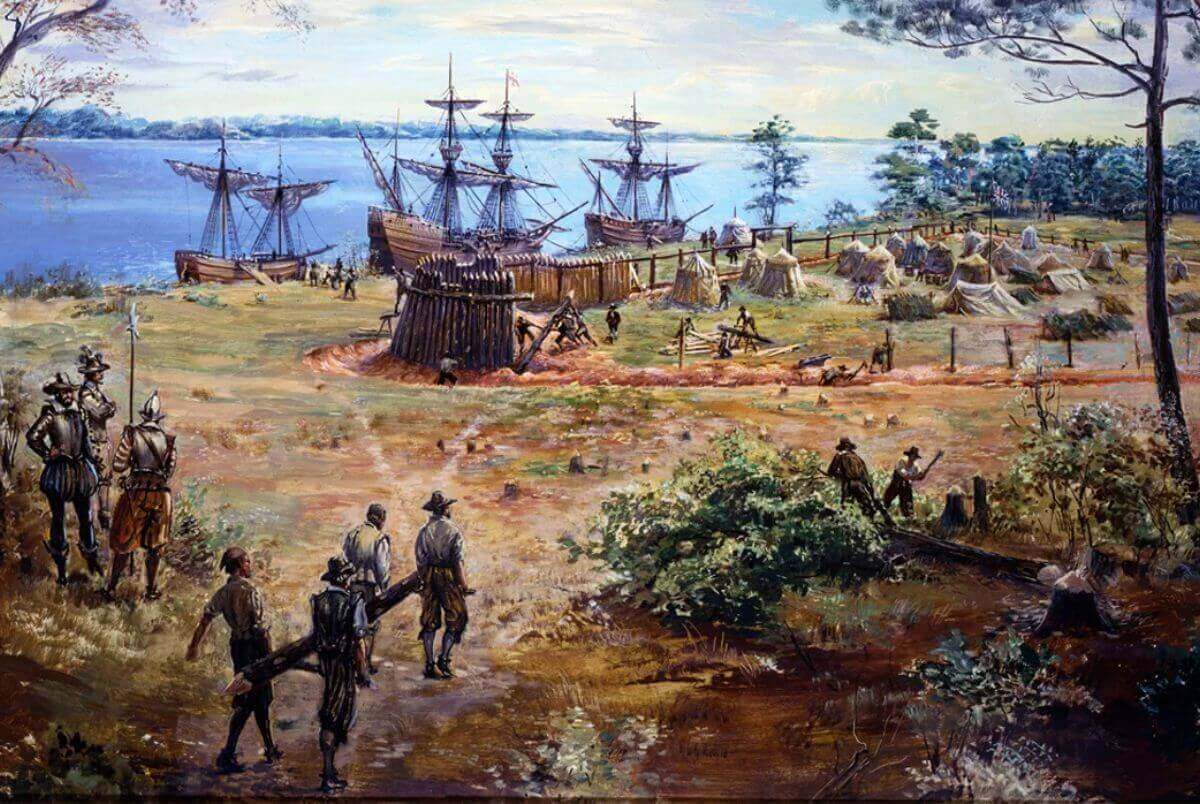
On May 14, 1607, a small group of English settlers arrived along the banks of the James River in present-day Virginia, establishing what would become Jamestown—the first permanent English settlement in North America. Sponsored by the Virginia Company of London, the expedition marked the beginning of a lasting English presence in the New World and laid the foundation for what would eventually become the United States.
The journey to Virginia had been long and uncertain. In December 1606, three ships—the Susan Constant, Godspeed, and Discovery—departed England carrying just over 100 settlers. After months at sea, they reached the Chesapeake Bay in April 1607 before sailing upriver to select a settlement site. The location they chose offered a defensible position against potential Spanish attacks, but it also came with serious drawbacks, including brackish water, swampy conditions, and a high risk of disease.
From the outset, survival proved difficult. Many of the settlers were gentlemen unaccustomed to manual labor, and the colony struggled with food shortages, poor leadership, and harsh environmental conditions. Relations with the Powhatan Confederacy—an alliance of Native American tribes in the region—were complex, ranging from cautious trade to periods of conflict. The colonists depended heavily on Indigenous knowledge and resources, yet tensions frequently arose over land and control.
The colony’s early years were marked by crisis. Disease, famine, and internal discord claimed many lives, and by the winter of 1609–1610—known as the “Starving Time”—the population dwindled drastically as settlers faced extreme hunger and desperation. Jamestown nearly collapsed entirely, surviving only through resupply efforts and new leadership that imposed stricter discipline and organization.
Despite these hardships, Jamestown gradually stabilized. The introduction of tobacco cultivation by John Rolfe in the early 17th century provided the colony with a profitable export, ensuring its economic survival and attracting more settlers. Over time, the colony expanded, and in 1619 it established the House of Burgesses, one of the first representative legislative bodies in the Americas. That same year also saw the arrival of the first recorded Africans in English North America, a moment that would have profound and lasting consequences for the development of slavery in the colonies.
Jamestown’s legacy is complex and far-reaching. It represents both the determination of early settlers to establish a foothold in an unfamiliar land and the beginning of profound cultural, economic, and political changes that would shape the continent. The settlement also marked the start of enduring conflicts with Native American populations and the emergence of systems that would define colonial society.
Today, the arrival of the Jamestown settlers on May 14, 1607, is remembered as a defining moment in early American history. It was the beginning of a permanent English presence in North America—one that would grow, evolve, and ultimately lead to the creation of a new nation.








Wasn’t it Captain John Smith who was quoted “HE THAT WILL NOT WORKE, SHALL NOT EATE…”1608?
Even welfare was a problem back then, we haven’t learned a thing from history.