
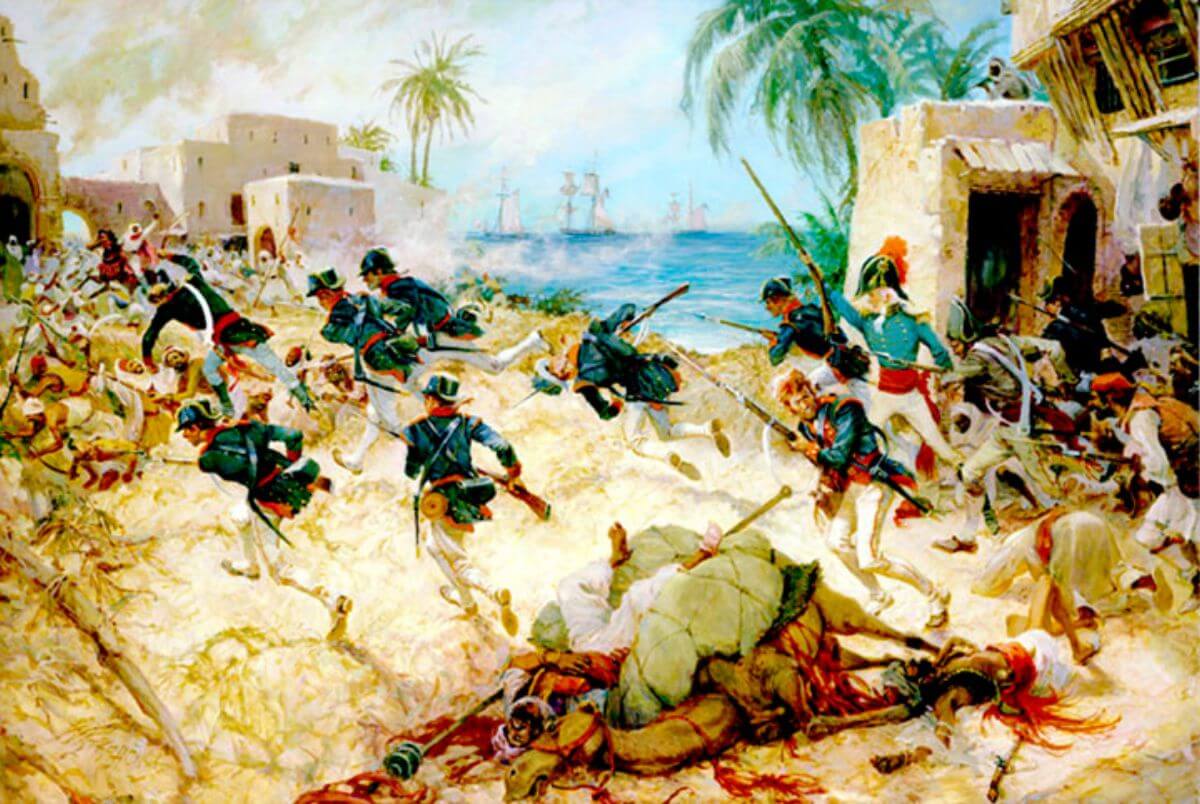
On April 27, 1805, a daring and little-known campaign in North Africa gave rise to one of the most famous lines in U.S. military history: “to the shores of Tripoli.” The phrase, immortalized in the Marine Corps Hymn, traces back to the First Barbary War—a conflict between the United States and the Barbary states of North Africa, whose pirates had long harassed American shipping and captured sailors for ransom.
Determined to end these attacks without paying tribute, President Thomas Jefferson deployed naval forces to the Mediterranean. But it was a bold land operation that would mark a turning point. U.S. agent William Eaton, working alongside a small contingent of Marines led by Lieutenant Presley O’Bannon, embarked on an ambitious mission: to overthrow the ruling pasha of Tripoli, Yusuf Karamanli, and replace him with his more pro-American brother, Hamet.
What followed was a grueling 500-mile march across the desert from Egypt to the port city of Derna, in present-day Libya. Eaton’s force was a diverse coalition, including U.S. Marines and local Arab and Berber fighters. Despite the harsh terrain, limited supplies, and constant risk of mutiny among the mercenaries, the expedition pressed forward, demonstrating both resilience and strategic ingenuity.
When the force reached Derna in April 1805, they launched a coordinated assault with support from U.S. Navy ships positioned offshore. The attack succeeded, capturing the city and marking the first time the American flag was raised in victory on foreign soil. This victory was not just symbolic—it represented the United States’ growing willingness to project power abroad and defend its interests without capitulating to extortion.
Lieutenant O’Bannon’s leadership during the battle earned lasting recognition. In gratitude, Hamet Karamanli presented him with an ornate sword, which later inspired the distinctive Mameluke sword still carried by Marine Corps officers today.
The capture of Derna helped force a favorable peace settlement in the First Barbary War and cemented the reputation of the U.S. Marines as a formidable fighting force. More broadly, the campaign signaled a shift in early American foreign policy—from defensive diplomacy to assertive action on the global stage.
Though often overshadowed by later conflicts, the events “on the shores of Tripoli” remain a defining moment in U.S. military history, blending endurance, international cooperation, and bold strategy into a legacy that continues to echo in Marine Corps tradition today.






Semper Fidelis. Semper Vigilans.
Historical events isn’t on the list on public school curriculums. No wonder these generations are so ignorant and lack patriotism.