
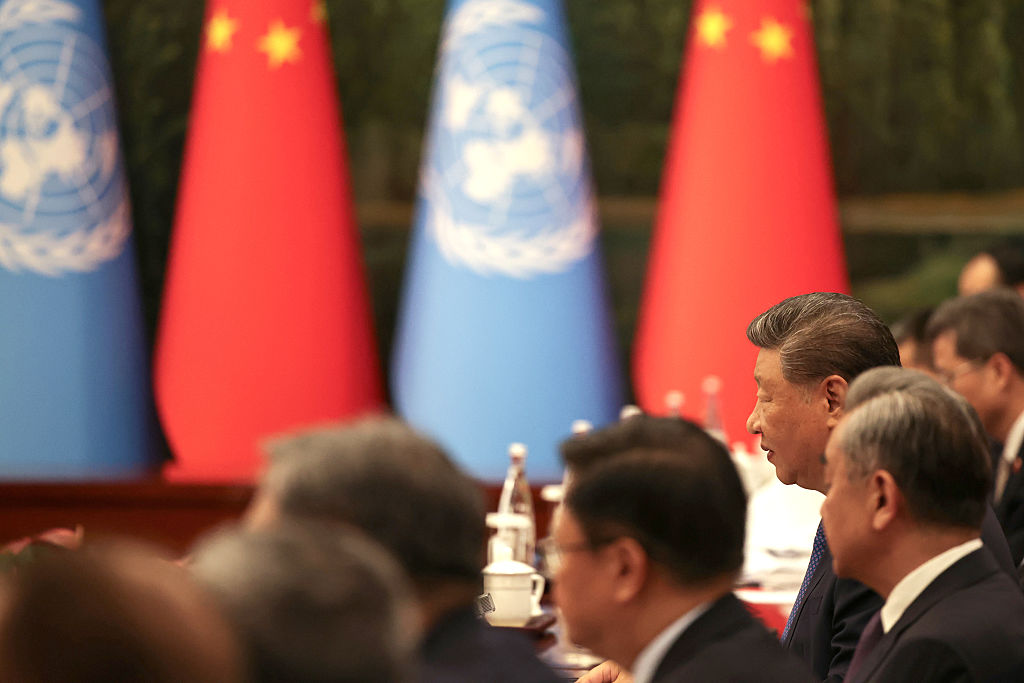
President Harry Truman envisioned the United Nations as a force for global stability and justice. But a new congressional report argues that Beijing is steadily transforming that institution into a vehicle for advancing the interests of the Chinese Communist Party to the detriment of the United States.
According to a sweeping investigation by the House Select Committee on the Strategic Competition Between the United States and the Chinese Communist Party, China has carried out a coordinated campaign to reshape the UN’s structure, personnel, and priorities in ways that serve its own political and economic objectives.
The report’s findings point to a strategy that is predicated on quietly bending global governance to the will of the CCP. The end goal is that the more that countries comply with UN edicts, the more they serve Beijing’s interests.
The CCP has accomplished this by expanded its financial contributions, increasing its personnel footprint, embedding ideological language into official documents, and leveraging UN peacekeeping and civil society mechanisms to advance its agenda.
One of the clearest indicators of this effort is the rapid growth of Chinese personnel inside the UN system. Between 2005 and 2023, the number of Chinese nationals working for the UN rose from 579 to 1,664, an increase of roughly 187 percent. These placements are concentrated in agencies and departments tied to economic development, technology, agriculture, and global governance standards – areas central to Beijing’s long-term geopolitical ambitions.
These positions are particularly consequential because they sit at the intersection of global rule-setting and economic planning. Chinese nationals have taken on influential roles connected to development policy, digital governance, and sustainability frameworks, areas that shape how capital flows and standards are set worldwide.
In some cases, these roles overlap with Beijing’s own strategic priorities, including initiatives tied to infrastructure, resource management, and long-term industrial policy – specifically Beijing’s Belt-and-Road Initiative. By helping define the rules in these domains, the CCP is not just participating in the system, but aligning it with its own economic model and political goals.
These roles, while often bureaucratic and low-profile, carry significant institutional power. They influence hiring decisions, shape internal reports, and guide how policy frameworks are interpreted and implemented. As the report makes clear, this growing personnel presence allows Beijing to exert influence from within rather than through overt confrontation.
Professor Herman Voelke, a veteran UN diplomat, has long observed this gradual shift. He recalled how Beijing’s approach became more apparent after the Tiananmen Square massacre, when the regime faced international condemnation but avoided sustained consequences. “The UN’s silence has persisted for decades,” Voelke noted, adding that China carefully cultivated its image “as a vital trade partner” until “for most nations, exclusion became too costly.”
That strategy, the report suggests, has paid dividends. Chinese officials and aligned personnel have helped introduce and normalize CCP-preferred language inside UN resolutions and policy frameworks. Phrases like “community with a shared future for mankind” have been incorporated into official documents, subtly shifting the ideological tone of the institution.
Professor Courtney J. Fung explains how this works in practice. China, she notes, embeds “ritualized language” into multilateral discourse while framing Western norms as destabilizing. Many countries interpret these phrases as benign commitments to cooperation and development. But in Beijing’s usage, they signal a broader effort to redefine global governance around state sovereignty and away from individual rights.
Personnel influence is only one part of the strategy. The report also highlights how China has used its financial contributions to gain leverage over the institution. As the second-largest contributor to the UN budget, Beijing has increasingly tied funding to political outcomes, shaping priorities and, at times, delaying payments to pressure the body on sensitive issues.
At the same time, China has expanded its military footprint through UN peacekeeping missions. Chinese forces are now deployed in key regions aligned with Beijing’s economic interests, particularly in Africa. As of early 2026, China had more than 1,600 personnel involved in UN peacekeeping operations, with a significant concentration in South Sudan, a country where Chinese firms have major oil investments.
These deployments serve multiple purposes. They provide operational experience for the People’s Liberation Army, help secure Chinese investments abroad, and allow Beijing to project military presence under the cover of multilateral legitimacy. The report describes this as a conversion of soft power into hard power, carried out under the UN flag.
Yunteng Qian, a former CCP insider who later defected, described the logic behind this approach in blunt terms. Beijing, he said, is willing to maintain relationships on multiple sides of a conflict while using economic and institutional leverage to secure its long-term interests. As he put it, “For Marxists, economic ties outlast all others.”
The report also details how Chinese influence has extended into UN agencies through more direct forms of interference. One of the most striking examples involves the International Civil Aviation Organization, a UN body based in Montreal.
In 2016, a Chinese state-affiliated hacking group known as Panda Emissary infiltrated ICAO’s servers, compromising sensitive data and using the system to access information from other organizations. Internal investigators identified the breach and its origins. But according to subsequent reporting, senior officials within ICAO, including Secretary General Fang Liu, obstructed efforts to fully investigate the attack.
The agency’s internal IT team, led by a Chinese national, was accused of attempting to conceal the scope and source of the breach. Despite being temporarily removed, those involved were later reinstated after pressure from higher levels within the UN. The episode, as outlined in the congressional report, illustrates how leadership positions can be used to shield misconduct and protect Chinese state interests from scrutiny.
Beyond personnel and operations, Beijing has also leveraged non-governmental organizations (NGOs) to expand its influence. The report identifies a network of NGOs that are closely tied to the CCP and its United Front system. These groups have gained consultative status within the UN, giving them access to meetings, policymaking processes, and human rights forums.
Rather than representing independent civil society, many of these organizations act as extensions of the Chinese state, promoting its positions, suppressing criticism, and shaping narratives in international settings.
China’s influence also extends into softer, less scrutinized areas of the UN system, including global tourism and cultural initiatives. Through its leadership and participation in UN-affiliated bodies such as the World Tourism Organization, Beijing has been able to elevate domestic destinations, steer development priorities, and reinforce political relationships abroad.
Tourism, in this context, becomes more than economic activity. It is a tool of statecraft. By directing travel flows, rewarding cooperative governments, and signaling approval through international designations, the CCP can translate institutional influence into real-world leverage over foreign partners while strengthening its global image.
Taken together, these efforts form a coherent strategy. China is not seeking to dismantle the UN. It is seeking to redefine it from within, aligning its norms and operations with the priorities of the Chinese Communist Party.
Voelke summarized the approach succinctly. “The Chinese Communist Party fuses economic and political strategies to boost its influence,” he said.
The report’s authors argue that this strategy has already begun to alter how the UN functions, often in ways that disadvantage the United States and its allies. By combining financial leverage, personnel placement, military participation, and ideological influence, Beijing has positioned itself to shape global governance in subtle but consequential ways.
The implications of this alarming trend are clear. What was once intended as a neutral forum for international cooperation is increasingly becoming a battleground for competing visions of world order. And as this report outlines, China is playing the long game.
Ben Solis is the pen name of an international affairs journalist, historian, and researcher.






President Trump needs to kick the United Nation out of the United States, we foot most of the money for them and they are worthless! China can go to hell, trying to intimidate and terrify people who do they think they are!
The UN is an anti-American anti-freedom glob of globalist parasites. We must quit pretending it serves any useful purpose, stop funding it and eject it from our shores.
China and the CCP need to keep their mouth shut! I am sick of hearing about them, it is time for America to stand up to all of these countries and let the cards fall where they may! China can go to hell with Iran! It is time for God to build a new world, this one has become evil!
The UN is a toothless lion that caters to whomever opens their checkbook. A world wide fake kangaroo court that jumps around a lot but seldom gets anything done. China’s thug mentality and a scorched earth policies are well known and the only one to stand against it is President Trump. What exactly does the UN do? They aren’t against human trafficking, slave trades, drug smuggling or genocide but they say they are. They might be the first to condemn attrocities but just sit on their hands waiting for someone to offer real consequence. China has given the world the middle finger for ages, now they’re taking the high ground? A bunch of spoiled children who can’t decide on anything is what defines todays UN, but now we have a Chinese bully with treats, what could go wrong?
To President Trump: PUL THE US OUT OF THE UN AND BOOT THEIR US-HATING A$$ES OUT OF OUR COUNTRY!!!!!
Now can we leave the UN??
Perhaps Truman was experimenting with LSD when he imagined UN a force of stability justice peace etc. He such pragmatic and practical, sensible man should have kicked it to the garbage dump where it belongs, there is no other option, did they found a mother of all scams.
Take a look at the book “The Red Tsunami”
AMERICA really doesn’t the U.N.,they only use us,and we sure the hell don’t need China and their threats and junk that they shove off on us.The U.N.is basically anti AMERICA.
So with this being known, what is the USA doing about it.to stop them.
Our Government needs to Kick the U. N. out of this country, NOW.
With all of the Treaties that were made post WW2 I believe the premise for peace and good will and working together and trading ideas was a good idea. But it seems that the corrupt nations that have joined the UN do not have any idea of cooperation. I have prayed for years that DJT would ethically remove the USA from the UN and NATO and the other organizations that the US belongs to “in the spirit of cooperation”. Power is an aphrodisiac. It seems that the only way to employ checks and balances is to be out of the Frey. Take our financial help out of it all. I find that America should not be the world’s ATM!!!!! Get the Chinese out of our country.. Shut down their computer programs. Remove the scourge.MAGA MAGA MAGA MAGA MAGA MAGA
OK. Admittedly, yours truly is not the sharpest knife in the drawer, but you ‘spect ME to believe China is JUST NOW tryin’ to undermine ‘Murica?
Just NOW?
Nope. I may have been born at night, but it wad’nt LAST night…..
All the more reason for the USA and it’s best ally Israel to leave the U.N. Stop the money to them and let them have their headquarters far from us. The United Nations today are a bunch of Dicks so let them go play with themselves!
Nothing new here. Revoke the U.N.’s tax exempt status and let mayor mamdani tax them.
In God we trust; all others pay cash. I also trust in Prez Trump. We should reduce our 25% or however much our contribution to the UN’s budget our is now,
Guess that explains why the UN has become more in power-grabbing internationally.
So if the US kicks the UN Headquarters out of NY, will they relocate in China?
Why are we still in the UN and why are the headquarters still in NYC? We need to immediately get out and kick them out of the US as well. I will celebrate the day I hear that Trump is withdrawing us from the UN and NATO.
They already did that
“Kicking out” the largely worthless UN only isolates America further. We would be on the outside looking in. We would have far less opportunity to influence events and shape outcomes. Engaging with a bite is preferable to leaving the stage to our adversaries.