
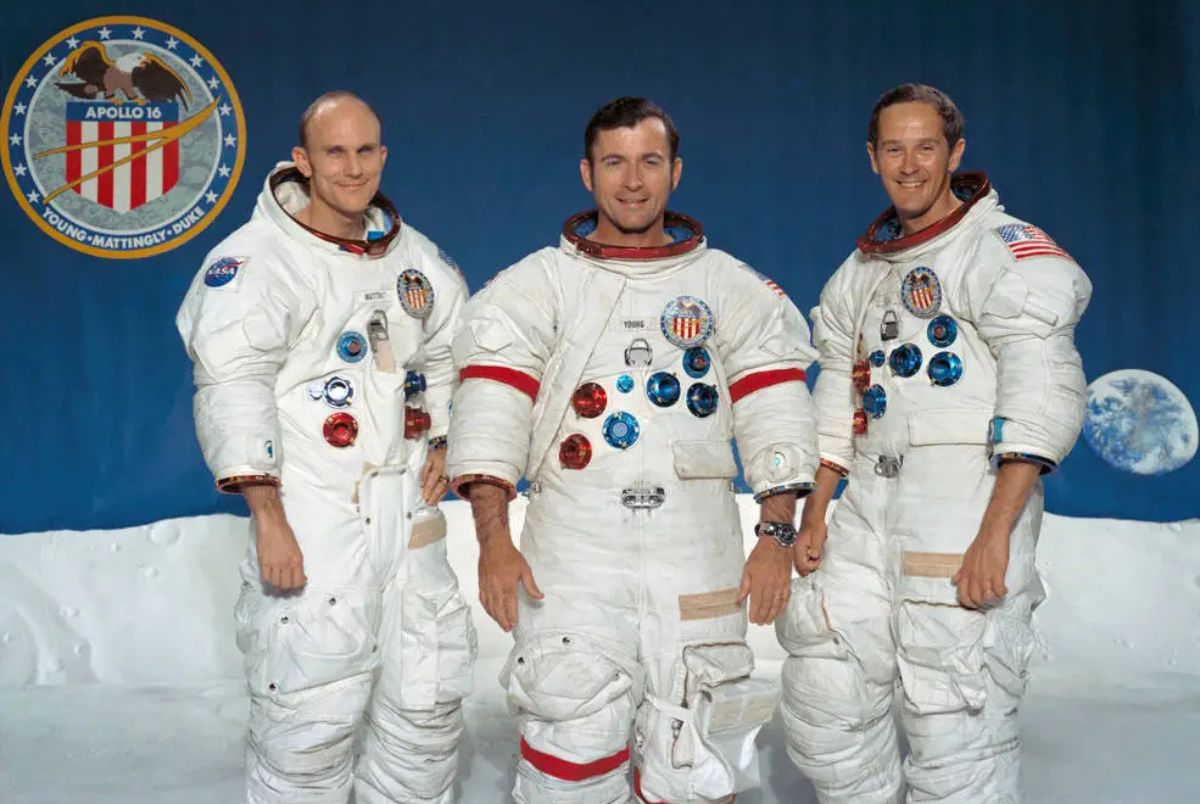
On April 16, 1972, Apollo 16 lifted off from Kennedy Space Center in Florida, beginning a historic journey that would become one of NASA’s most scientifically significant lunar missions. As the fifth of six successful Moon landings in the Apollo program, the mission represented both the culmination of years of technological achievement and a shift toward deeper exploration and research beyond the initial goal of simply reaching the lunar surface.
The towering Saturn V rocket carried three astronauts—Commander John W. Young, Command Module Pilot Thomas K. Mattingly, and Lunar Module Pilot Charles M. Duke—on a 238,000-mile voyage to the Moon. Their mission was part of NASA’s more advanced “J missions,” which focused on extended stays, increased scientific experimentation, and the use of new tools like the Lunar Roving Vehicle to explore greater distances across the lunar terrain.
After several days in space, Apollo 16 reached lunar orbit, and on April 20, Young and Duke descended to the Moon’s surface in the lunar module Orion, while Mattingly remained in orbit aboard the command module. The landing site—the Descartes Highlands—had been selected because scientists believed it might provide evidence of volcanic activity on the Moon. While that hypothesis was ultimately disproven, the mission yielded valuable insights into the Moon’s geological history.
During their nearly three-day stay on the surface, Young and Duke conducted three moonwalks totaling more than 20 hours. Using the Lunar Rover, they traveled across rugged terrain, collecting more than 200 pounds of lunar rock and soil samples. These samples, along with photographs and experiments conducted both on the surface and in orbit, significantly expanded scientific understanding of the Moon and its formation.
The mission was not without challenges. Technical issues, including concerns about the spacecraft’s main engine, forced NASA engineers to delay the lunar landing while they assessed whether it was safe to proceed. Ultimately, the mission continued, though it was shortened slightly as a precaution. Despite these setbacks, Apollo 16 successfully achieved its primary objectives.
After completing their work, the astronauts reunited in lunar orbit and began the journey back to Earth, splashing down safely in the Pacific Ocean on April 27, 1972. The mission lasted just over 11 days and marked one of the final chapters in the Apollo program, which had captured the world’s imagination throughout the 1960s and early 1970s.
Apollo 16’s launch came at a time when the space race between the United States and the Soviet Union was winding down, and public attention was beginning to shift. Yet the mission underscored the enduring value of exploration—not just for national prestige, but for scientific discovery. By pushing farther across the Moon’s surface and gathering unprecedented data, Apollo 16 helped transform humanity’s understanding of our closest celestial neighbor. It remains a testament to the ingenuity, courage, and ambition that defined the Apollo era and continues to inspire space exploration today.








The history of the exploration of the Moon is appreciated. There is a great deal of history involved and it is different than other areas of history and therefore should be approached accordingly. AMAC does that with these ” This Day in History” articles. In the early 1970:s I purchased a NASA book at one of the Government Printing Office bookstores – “Space Mathematics A resource for teachers”. It covers Geometry and Trigonometry Related to the Sphere ; orbital mechanics .There are drawings that accompany almost all of the examples . It was one of the best investments I ever made in a book. If memory serves correctly I believe it was about.Five Dollars Mathematics is a form of reasoning and I was helped in understanding that by the periodic review of the contents of Space Mathematics over the years since the early 1970’s. In those days I was often using a Slide Rule in calculations. Did not have an electronic calculator ’til 1981 . Still use a slide rule occasionally, ether one of two that I have . One is a rectangular rule ,the other is a circular slide rule made in the I930’s. In many ways the circular rule is easier to use. Have had some interesting discussions with some people critical of slide rules and have always felt good pointing out that the pioneers in computer design were mathematicians and engineers who had only books and slide rules to work with. And their imaginations and sense of purpose .
.