
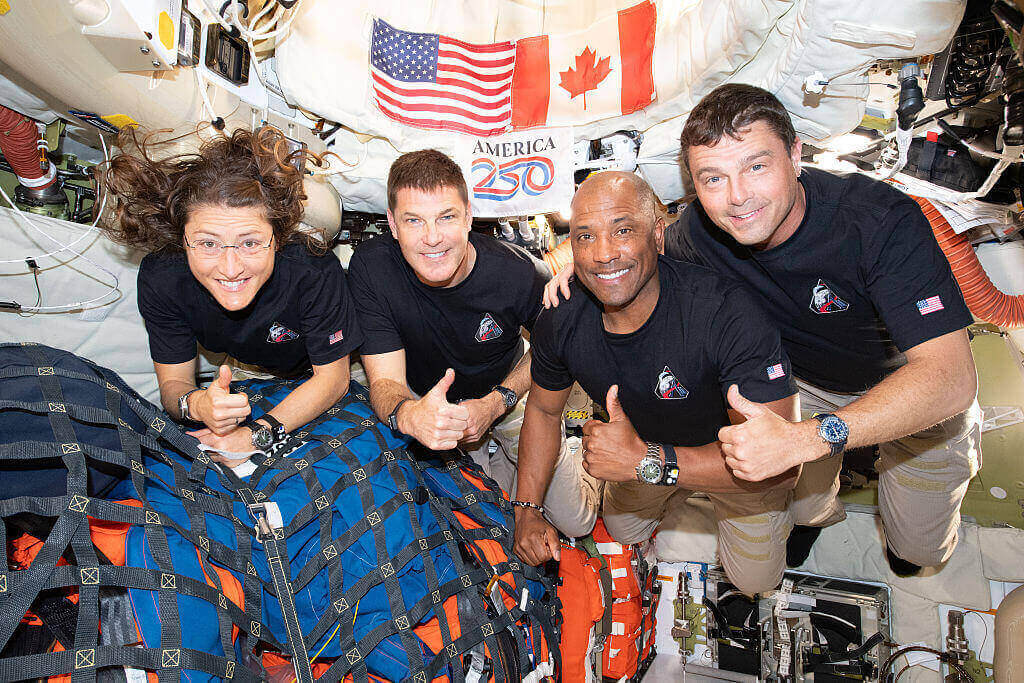
For about 40 minutes on Monday, the four astronauts of NASA’s Artemis II mission were more alone than any human beings had ever been in history.
The Orion spacecraft had rocketed 252,756 miles into space – further than any manned mission before it. Then, at approximately 6:45 p.m. Eastern Time on April 6, the fragile blue crescent of Earth dipped below the Moon’s horizon, creating a physical barrier that blocked any radio signals from reaching the Artemis II crew. They were completely, totally alone.
Around 7:25 p.m., the brilliant blue-green marble of our home planet burst forth from the darkness, and contact was restored.
Then came the next crucial test: returning home. With Orion making re-entry into Earth’s atmosphere from deep space, it reached the astonishing speed of 24,000 miles per hour. The friction between the spacecraft and the atmosphere created temperatures in excess of 5,000 degrees Fahrenheit, resulting in a plasma bubble around Orion that again cut off radio communication for about six minutes.
In the final 13 minutes of the flight, the crew of the Artemis mission traveled 400,000 feet – about 75 miles – finally splashing down off the coast of San Diego after 10 days in space.
As they emerged from the capsule, NASA officials and engineers – and indeed the entire country – were able to breathe a collective sigh of relief and fully marvel at the achievement. It was one of those increasingly rare moments in our culture that seemed to unite everyone.
“What a time to be alive,” a liberal political commentator posted jubilantly after the White House released a stunning photo of a solar eclipse from behind the Moon. Hills and craters on the lunar surface shine in brilliant detail as a backlit halo dazzles human minds peering from a never-before-seen vantage point. A conservative columnist also wrote how this 21st-century moonshot has elevated his children’s imaginations and emboldened their dreams for the future – much like when he was a schoolboy in December 1968 watching the Apollo 8 astronauts make the daring space voyage for the first time.
These reactions are fitting. But the deeper significance of Artemis II is not merely admiration for the technical genius of rocket scientists and the tenacious skillset of astronauts. This mission is reviving something in each American that we’ve been in danger of losing: that this country is, at heart, a frontier nation.
After the last Apollo astronauts returned from the lunar regolith in the early 1970s, light-hearted ribbing endured for more than 50 years that America had somehow “lost” the expertise to return to the Moon. The surface claim reveals a facile and preposterous understanding of knowledge development, but beneath the joke sat a deeper frustration that a nation which once stretched the limits of human possibility seemed now content to live off the memory of past glories.
No doubt our accomplishments over the decades in robotic exploration, satellite mastery, and life aboard the International Space Station are not trivial. They reflect real ingenuity and real discipline.
And the first moonshot helped build the technological scaffolding on which much of modern American life now rests. Yet still, if we are honest, there is something faintly decadent and deeply unsatisfying about a people living on the luxury and materialism won by the boldness of our predecessors while shrinking from boldness ourselves.
What the Artemis Program is restoring is not just capability, but character.
This past week felt like a nation shaking off years of drift and recovering the frontier spirit that has long defined America at its best. Americans instinctively know that we are strongest when we press beyond the known horizon, accept risk in pursuit of discovery, and turn our achievements into blessings for all mankind.
Like a prizefighter rediscovering his power or a pitcher getting his fastball back, the Artemis II mission encapsulated the unmistakable energy of a country remembering itself. That is why the mission stirred something deeper than admiration. It gave Americans a renewed sense that the future still belongs to a people willing to dare greatly.
America’s return to the Moon could not have happened without President Donald Trump’s leadership. Although I helped launch the Artemis Program at NASA during Trump’s first term, it’s only now that I fully appreciate the impact of the President’s vision in establishing the 2017 Space Policy Directive-1 which reorganized the federal agency around a lunar-focused campaign.
Trump did not merely jumpstart lunar ambitions. He pointed America back toward the frontier.
When those frontier instincts are once again summoned in America, the whole world notices. There is a difference between American power and the power of rival countries.
History is full of authoritarian nations, like China or Russia, who act only out of self-interest and a desire to demonstrate their power. This is per usual and what the world expects from them. It’s incredibly rare, however, to have a global superpower like the United States of America that will – in the words of Neil Armstrong – take a “giant leap for mankind.”
There is hardly a person on Earth today whose standard of living isn’t drastically improved by America’s space exploration missions. No one in the early space age could have foreseen satellite-enabled GPS devices guiding runners and drivers alike, much less the long list of spinoffs like memory foam, scratch-resistant lenses, CAT scanners, LEDs, ear thermometers, and portable computers.
But now the world knows that when America wins, humanity’s conditions will improve. The world expects American leadership because the country embodies the higher aspirations of humanity.
President Abraham Lincoln acknowledged the unique standing the country holds in the minds of men and women across the world when he referred to the country as “the last best hope of Earth.” President Trump, like his predecessor, recognizes that power to shape the world and its dreams will inevitably be wielded by someone, so it is up to us to ensure America continues to wield that same influence.
The clock is ticking, however. The Chinese are aggressively improving their space capabilities and pressing to land their taikonauts on the lunar surface by 2030.
NASA Administrator Jared Isaacman is confident America will arrive first, but the stakes extend far beyond national pride. “This time the goal is not flags and footprints,” Isaacman told reporters. “This time the goal is to stay.” He is referencing Trump’s directive for the Artemis Program to establish a permanent lunar presence, recognizing that the new race to the Moon between the United States and China may determine not only who leads in space exploration, but who writes the rules beyond Earth.
This context is what makes Artemis II feel so important to so many Americans.
As the four astronauts splashed down off the coast of California on Friday evening, they returned to more than cheers and celebration. They returned to a nation that, for a brief and glorious moment, saw itself clearly again. A nation that remembered it was not made to coast on inherited greatness, but to extend and expand it. Not made to shrink from the horizon, but to chase it.
Fittingly, as we celebrate the 250th anniversary of America this year, Artemis II reminded us of what it feels like to be American again. A nation is shaped by what it aims for. If we choose to embrace America’s frontier spirit at this crucial juncture, we can literally shoot for the Moon – and beyond.
W.J. Lee has served in the White House, NASA, on multiple campaigns, and in nearly all levels of government.








The Artemis crew were never alone, God was with them. Praise God for His creation and for giving intelligence to mankind so that this is possible.
” What the Artemis Program is restoring is not just capability but character.”That is a very important thought Mr.Lee , it is great that you wrote that for this article.. I am 75, in the early 1970’s I purchased a copy of the book published by NASA entitled. ” Space Mathematics – A resource for teachers ” the examples in that book of Geometry and Trigonometry Related the Sphere , the Mathematics of Orbits in the chapter on Conic Sections ( orbital mechanics ) are great for having an appreciation of the basics of space travel , space exploration . Faith in God should be part of the picture as well as going into the Unknown is Big Time Uncertainty and a sense of purpose that includes good character, Faith and Courage will help in these endeavors. Praise for all of those Artemis astronauts for their good qualities that helped in this continuation of exploring the frontier involving the Moon
now somebody out there is going to bitch about nasa because there isn’t enough money to go for welfare & food stamps.well tough-go get a job like the rest of us to buy your steak & lobster.
Attention AMAC Editor – this site is experiencing a troll attack .This attack ( Comment Invasion) is getting more extensive the longer it is in place. Meaning.that. more trolls – comment Invaders are posting their garbage every five minutes or so . Thought it would be right and proper to bring this to your attention.
If we give the Democrats the thumping they so richly deserve in the Mid-Terms than the Sky is the limit for our country!
It makes me ask the Question . . . What has NASA been doing for the last 50 Years and why did we stop going to The Moon. WTF ?
You have too much hate in you. You need God in your life
Artemis is Apollo rerun BUT better Video, Film then in 60s 70s era for Apollo
Improved menu, controls, but took too long to extract crew from Orion after splashdown
Wait a minute. If we landed on the moon already, why couldn’t they do it this time??
Did we really land on the moon in the 60’s?
What unfortunate small perspective…