
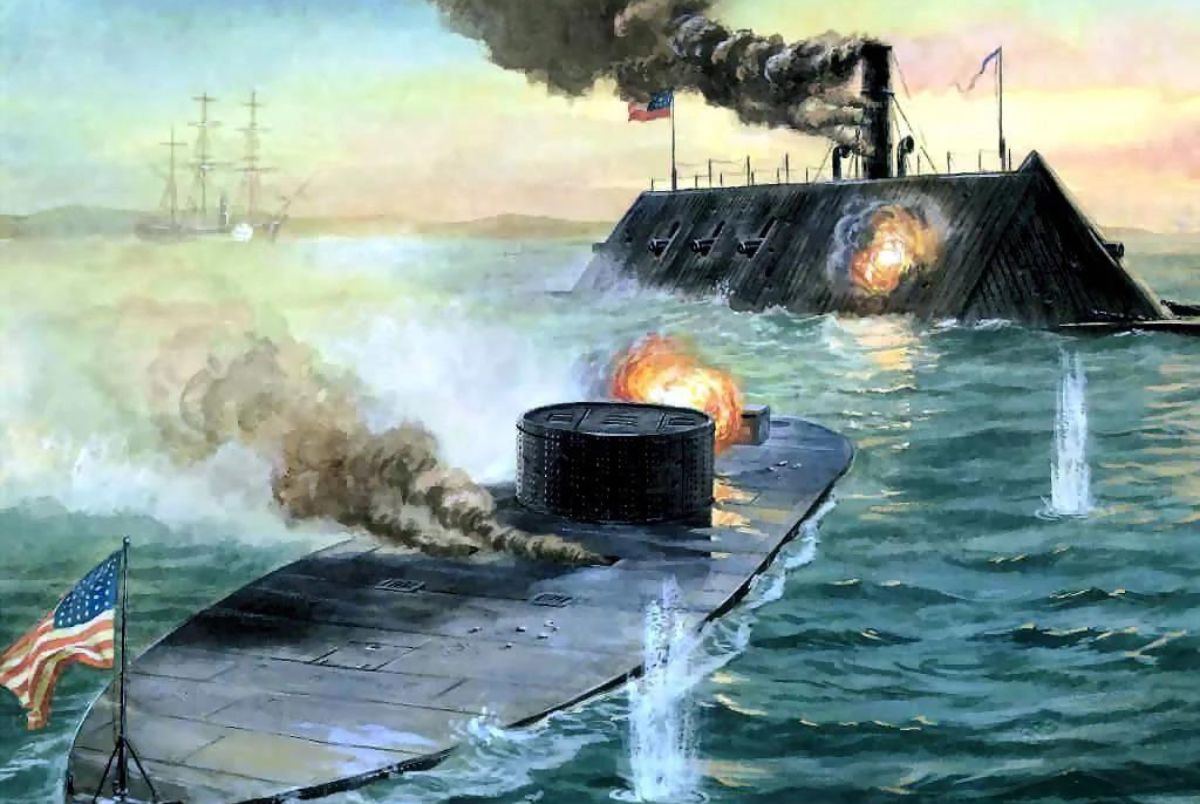
On March 9, 1862, one of the most famous naval clashes in history unfolded at Hampton Roads, Virginia, during the American Civil War. The battle between the Union ironclad USS Monitor and the Confederate CSS Virginia marked the first-ever combat between ironclad warships and signaled a dramatic turning point in naval warfare.
The confrontation followed a destructive Confederate attack the day before. On March 8, the newly built CSS Virginia—constructed from the remains of the former U.S. frigate Merrimack—steamed into Hampton Roads and attacked the Union’s wooden fleet. The armored warship proved nearly unstoppable against traditional ships, sinking the USS Cumberland and forcing the USS Congress to surrender before setting it ablaze. Union forces feared that the Virginia would destroy the rest of their fleet and possibly break the Union naval blockade that restricted Confederate trade.
During the night, however, the Union’s own experimental ironclad, the USS Monitor, arrived from Brooklyn under the command of Lieutenant John L. Worden. Designed by engineer John Ericsson, the Monitor was unlike any warship previously built. It featured a low-profile hull and a revolutionary rotating turret armed with two powerful cannons, allowing it to fire in multiple directions without turning the ship.
The next morning, as the Virginia moved to finish off the damaged Union fleet—particularly the grounded USS Minnesota—the Monitor intercepted it. What followed was a remarkable four-hour duel between the two ironclads. The ships circled each other at close range, firing heavy shells that repeatedly bounced off their iron armor. Despite the thunderous cannon fire and several direct hits on both vessels, neither side could inflict decisive damage.
At one point, a shell from the Virginia struck the Monitor’s pilothouse, temporarily blinding Captain Worden and forcing the Union ship to pull back briefly. Still, the battle ultimately ended in a stalemate. The Virginia withdrew to Norfolk for repairs, while the Monitor remained on guard, effectively protecting the Union fleet and maintaining the blockade.
Although tactically inconclusive, the clash had enormous historical significance. The Battle of Hampton Roads demonstrated that ironclad warships were far superior to traditional wooden vessels. Navies around the world quickly recognized that the age of wooden warships was ending and began building armored fleets of their own.
The Monitor and the Virginia never fought each other again, but their dramatic encounter reshaped naval warfare forever. What began as a desperate Civil War confrontation became a technological revolution at sea, ushering in the era of modern armored warships.







CSS Virginia ended up being scuttled and destroyed by her own troops when Union forces took over Norfolk. The USS Monitor was lost in a storm off Cape Hatteras, NC while being towed to Charleston, SC to reinforce the Union blockade of the harbor.