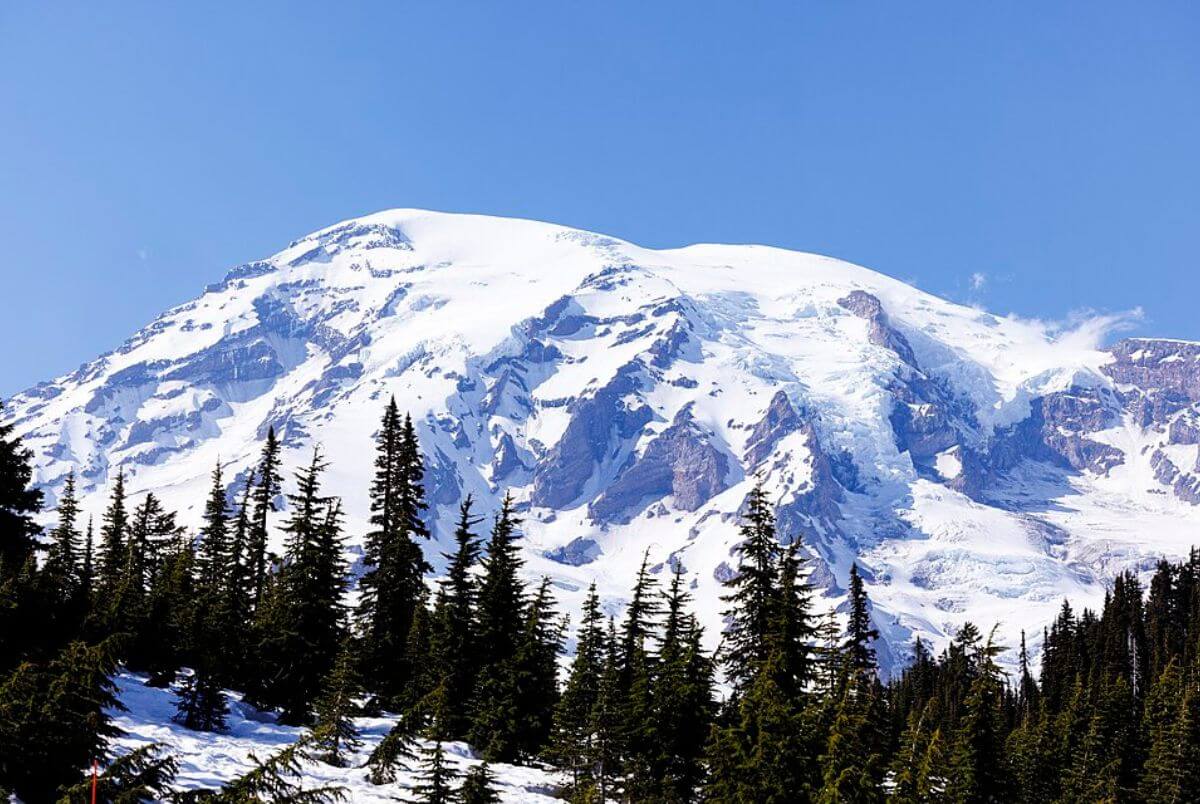
On March 2, 1899, a landmark moment in the conservation history of the United States unfolded when President William McKinley signed legislation establishing Mount Rainier National Park in the state of Washington. The act brought into federal protection some 365 square miles of rugged wilderness centered on the towering volcanic peak of Mount Rainier — a landscape of forests, glaciers, and alpine meadows that would become one of the nation’s most cherished natural treasures.
Mount Rainier itself dominates the horizon of the Pacific Northwest. Rising to an official height of 14,410 feet, it stands as the tallest peak in the Cascade Range and is visible from cities like Seattle, nearly 100 miles away. Once known to regional Native American tribes by names such as Tacoma or Tahoma, the mountain was renamed by British explorer George Vancouver in 1792 after his friend Admiral Peter Rainier, long before the idea of a national park took shape.
The movement to protect this stunning environment was far from automatic. In the years leading up to 1899, Washington lawmakers introduced bills across six successive sessions of Congress to establish the park, reflecting both the growing voice of conservationism and persistent political resistance to expanding federal land protection. At the time, many in Congress questioned the role of the national government in creating and managing parks, worried about costs, and preferred to leave land decisions to local interests. Only assurances that the area lacked agricultural or mining potential — and that no federal funds would be needed for its upkeep — helped break the legislative impasse.
Even amid these debates, advocates of the new park — from local business leaders to scientists inspired by the writings of naturalist John Muir — pressed the case that Mount Rainier’s unique geologic features, extensive glaciation, and unparalleled scenery were worth preserving for future generations. This vision helped broaden public support for conservation and foreshadowed the later expansion of the national park idea across the American West.
Once established, Mount Rainier National Park became the fifth national park in the United States, joining Yellowstone, Yosemite, Sequoia, and General Grant. Its creation marked a turning point: a recognition that preserving spectacular landscapes not just for extraction or economic use but for enjoyment, study, and inspiration was a worthy mission of the federal government.
Today, millions of visitors — hikers, climbers, and nature lovers — annually explore the park’s trails, witness its wildflower meadows, and test themselves against its glaciers and snowfields. The park remains a powerful symbol of the American conservation movement, embodying both the beauty of the natural world and the enduring importance of protecting it.