
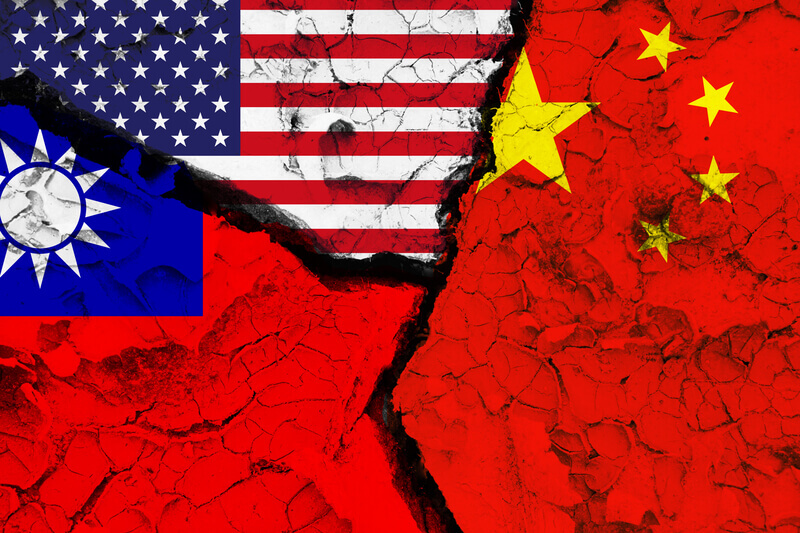
A new report from the Heritage Foundation analyzing a potential conflict between the United States and China was so precise—and so unsettling—that the Trump administration requested portions of it be redacted before public release, even though the analysis relied entirely on publicly available information. The report underscores not only the growing role of artificial intelligence (AI) in modern war planning but also the sobering reality that the U.S. military faces structural weaknesses that could prove decisive in a high-intensity conflict with Beijing.
The report, titled “TIDALWAVE: Strategic Exploitation and Sustainment in a U.S.–China Conflict,” uses an AI-enabled model to simulate thousands of iterations of a U.S.–China war over Taiwan. Unlike traditional tabletop exercises, TIDALWAVE tracks how losses in aircraft, ships, fuel, and precision munitions compound over time, revealing how quickly modern warfare can drive even a powerful nation to the breaking point.
According to the report, “existing programs of record do not adequately address shortfalls in the resources required to combat the PRC effectively, despite the increasing risk of confrontation.” That conclusion, grounded in open-source data rather than classified intelligence, forms the backbone of TIDALWAVE’s warning to Congress and defense planners.
The AI model drew on more than 7,000 open-source government, academic, industry, and commercial data points to assess both U.S. and Chinese vulnerabilities. Its findings are stark. In most high-intensity scenarios, the first 30 to 60 days of conflict determine the war’s long-term outcome. Early losses in aircraft, ships, fuel throughput, and munitions rapidly compound and cannot be recovered on operationally relevant timelines.
TIDALWAVE finds that the United States would culminate (reach the point at which it can no longer sustain operations) far sooner than China. In some scenarios, up to 90 percent of U.S. and allied aircraft positioned at major forward bases in Japan and Guam are destroyed on the ground during the opening phase of the conflict, as Chinese missile strikes simultaneously hit runways, fuel depots, command facilities, and parked aircraft. The implication is straightforward: hardening, dispersal, and missile defense are not “nice-to-haves.” They are prerequisites for operational survival.
Precision-guided munitions emerge as another critical vulnerability. Long-range anti-ship missiles, air-to-air interceptors, and missile defense systems begin to run short within five to seven days of major combat operations. Across most scenarios, those munitions are exhausted within roughly 35 to 40 days, leaving U.S. forces unable to sustain high-tempo combat.
Fuel, however, is the most decisive factor of all. The report makes a crucial distinction: in most possible scenarios, the United States does not typically run out of fuel—it loses the ability to move fuel under fire. Chinese doctrine explicitly prioritizes attacks on tankers, ports, pipelines, and replenishment vessels. Even limited disruptions are sufficient to drive fuel throughput below survivable levels, forcing U.S. commanders to sharply curtail air and naval operations despite fuel remaining in aggregate stockpiles.
By contrast, the report assesses that China is capable of sustaining high-intensity combat for months longer under the modeled assumptions. Although Chinese ammunition stockpiles begin to decline after roughly 20 to 30 days, substitution effects and industrial resilience extend Beijing’s ability to fight well beyond the point at which U.S. forces culminate.
The implications extend far beyond the battlefield. TIDALWAVE concludes that once a Taiwan conflict begins, the United States is highly unlikely to prevent massive global economic fallout. Disrupted shipping lanes, destruction of critical infrastructure, and the collapse of Taiwan’s semiconductor production would trigger an estimated $10 trillion global economic shock—nearly a tenth of global GDP.
As Fox News reported, it was the precision and operational relevance of these findings that prompted senior U.S. national security officials to request redactions before the report’s public release. According to the authors, those officials were concerned that adversaries could exploit the analysis to identify or remediate vulnerabilities.
“Redactions were made at the request of the U.S. government to prevent disclosure of information that could reasonably enable an adversary to (1) remediate or ‘close’ critical vulnerabilities that the United States and its allies could otherwise exploit, or (2) identify or exploit U.S. and allied vulnerabilities in ways that could degrade operational endurance, resilience, or deterrence,” the report explains.
Notably, the Trump administration’s concerns were not about classified leaks. The report used only open-source information. An unredacted version was provided to authorized government recipients for internal use, underscoring how much can now be inferred about military readiness through publicly available data—especially when processed at scale by AI-enabled models.
A Department of War spokesperson declined to comment on discussions surrounding the report’s publication, stating only that the department “does not endorse, validate, or adjudicate third-party analyses,” while emphasizing the importance of protecting information that could affect operational security if aggregated or contextualized.
That redaction story is the headline—but it’s not the only reason TIDALWAVE matters. The report’s most unsettling contribution may be what it implies about the trajectory of war planning itself; namely, a future where AI can fuse “harmless” data points into something operationally actionable, fast enough to shape real-world decisions. If an open-source model can map weaknesses so convincingly that the federal government asks for black ink, the era of assuming “it’s public, so it’s safe” is over.
And Beijing is watching this shift as closely as Washington is.
Several former PLA officers who defected to the West in the late 1990s and early 2000s told this author that, in their view, the CCP has long treated a Taiwan confrontation as a legitimacy test—one that could decide the regime’s future.
They stressed that, historically, internal CCP rhetoric often outpaced actual war planning. Before Xi Jinping, they said, party congresses routinely invoked Mao’s call to reclaim Taiwan, but most senior leaders still favored prosperity over conflict—and many war planners privately doubted the regime would risk everything on a roll of the dice.
But as China’s leadership hardened after the 2010s, those officers described a more dangerous mindset. Some Chinese plans, they said, envisioned two weeks of air and sea attacks followed by a rapid seizure of Taiwan and key sites in “just over three days,” with diplomats prepared to warn NATO of a potential nuclear response if the West intervened. After 2014, the same officers argued, Beijing’s willingness to entertain high-risk scenarios increased—especially as Russia’s threats appeared to influence Western behavior. As one assessment put it, “Putin’s overt willingness to threaten NATO seemed to diminish Western resolve.”
They also pointed to draft regional concepts that contemplated strikes “behind enemy lines” and even “possible” attacks on the U.S. mainland—ideas they described as more reckless than earlier schemes. Some PLA circles, they said, repeated rumors that the CCP had considered bombing an American city like Los Angeles.
Those claims, they acknowledged, were not based on classified access and should be treated as rumor—but the fact that such talk circulated at all, they argued, reflected the radicalization of strategic thinking under Xi. More concretely, they said the CCP “aimed to strike U.S. allies,” especially the Philippines, as part of a broader effort to isolate the region and fracture U.S.-led coalitions.
Even inside China’s system, they contended, there is unease about what a Taiwan war would actually require. In light of the regime’s rhetoric, they said, many PLA professionals still question the feasibility and quietly doubt Beijing’s ability to execute its most ambitious plans under real conditions of attrition, interdiction, and chaos.
One former planner, Lt. Col. Quán Chāngpǔ, framed it bluntly: ideology sets the stage for strategy, shaping both international ambition and battlefield maneuver. Another retired officer said the CCP’s determination to take Taiwan remains unshaken, but only a minority within the PLA “still burn with the desire to fight.” He contrasted the mood of the 1990s—when “confidence, even arrogance, ran high”—with today’s more brittle reality that certainty has faded. Russia’s “disastrous showing in Ukraine,” he added, served as “a sobering wake-up call for many.”
Another voice, Dr. Xiàhóu Li Wei, a former senior CCP security official, offered a warning that cuts to the core of regime survival. “If Xi attacks Taiwan, Beijing will fall,” he said. His argument is that the logistical and strategic burdens now exceed what the system can absorb under wartime stress—precisely the kind of cumulative failure dynamic TIDALWAVE models on the U.S. side.
Multiple former PLA officers put it in similarly apocalyptic terms. In their view, Taiwan “would be the grave of the CCP” and an “unimaginable suffering for Chinese and Taiwanese people.” Their point was not that war is impossible, but that the stakes are existential in a way the West sometimes treats as abstract.
Taken together, these accounts shouldn’t be treated as substitutes for modeling or intelligence. But they do align with the broader lesson of TIDALWAVE that high-intensity war is not a contest of slogans. It is a contest of endurance, logistics, and survivability—and it punishes illusions quickly.
TIDALWAVE also warns that the scale of losses in the Indo-Pacific would leave the United States unable to deter or respond effectively to a second major conflict elsewhere in the world. A war over Taiwan could invite follow-on aggression from adversaries such as Russia, Iran, or North Korea, fundamentally destabilizing the global security order.
The report’s authors are blunt in their assessment that existing Pentagon programs and congressional funding are too slow, too fragmented, and too modest to address the scale of the challenge. In many cases, the timeline required to fix critical vulnerabilities exceeds the likely timeline to conflict.
To avoid what the authors describe as a strategic defeat, the report urges Congress to immediately expand munitions stockpiles, strengthen fuel reserves and distribution infrastructure, harden and disperse forward bases, and accelerate sustainment and logistics reforms. Without rapid action, the United States risks entering a conflict it is structurally unprepared to fight—or sustain.
With intelligence warnings mounting that China could move on Taiwan before the end of the decade, TIDALWAVE delivers an unsettling message. The window to correct these deficiencies may be closing faster than Washington is prepared to act—and thanks to AI-enabled analysis, that reality is now harder than ever to ignore.
Ben Solis is the pen name of an international affairs journalist, historian, and researcher.






Seems that AI needs to take into consideration which party controls each of the three branches of government. Democrats present the greatest threat to US military capability.
And people wonder why China is purchasing acreage in rural areas posing as farms, but, near military compounds.
If this doesn’t make illegal entry into the United States critical it probably won’t matter. They are already here. Discoveries of foreign bio-laboratories inside our own house was allowed all because of money. If covid wasn’t enough to get our attention nothing will, it’s already too late.
We have become dependent on China for everything, our own stupid politicians have shut down domestic refineries in California, they are already helping China eliminate fuel supplies that are high on their checklist.
China is already on record that if they can’t possess world dominance, no one will. What is the deterant against a regime that has no moral compass?
Speaking of AI..A certain oogl has unsubscribed me from my conservative media outlets…Get out of my mailbox and quit trying to think for me…
Unfortunately, the contents of this article are on the money. The US is woefully unprepared for a major war with China and they know it. It will not be much longer when China will go after Taiwan.
Some comments:
1) At the present time, the PLA is without experienced leadership as the result of Xi’s
purging. How long will it take to resolve that is anyone’s guess? The comment by
Chinese insiders that there may not be the stomach for attacking Taiwan is a factor.
2) The Taiwan semiconductor industry by TSMC is currently being backed up with 3 fab
plants being constructed in Arizona, of which two are already operating.
3) In this analysis, there is no mention of our submarine activity, which has a lot of throw
weight.
4) Where do all of our allies fit into this analysis?
5) Trump has ordered munitions manufacturers to put production on a fast track.
6) Any first strike will certainly cause immediate retaliation, so this scenario of everything
on our side being wiped out is a bit overly optimistic.
7) China has a lot of targets that could wreak havoc, i.e. the Three Gorges Dam.
8) This analysis is a good exercise in what-if, and maybe a wakeup call.
9) As for our internal vulnerability, there is no doubt that the risk is there, and the Biden
administration open border policy increased that.
We could only win if Russia helped. Europe is useless and I doubt highly would even come to our aid under almost any circumstances, which is why NATO is a joke without the US. If Xi lasts too much longer China WILL invade Taiwan and if a Democrat is President and Congress is mostly liberal, forget us doing anything (like Obama’s red line with Syria). They wouldn’t need to use nukes, just threaten to. China’s war capability is far superior to ours, which is why DOW under Hegseth is modernizing and reorganizing as fast as he can. That will all change if Republicans lose the Congress in November. They will impeach Trump, then Hegseth, and keep going. And budget cuts will kill any projects (oh, that’s right, no actual budget, just CRs!)
Does anyone remember the Matthew Broderick movie “War Games?” Much like Ahhnold’s “Terminator,” what seemed unlikely when these movies were made is now knocking at our doorstep.
AI needs to be sent back to where it came from. We need to encourage our gray matter to work harder, duh!
The problem is not artificial intelligence, it is that we are relying on a machine that may well lead to our destruction. We must build are military back to Vietnam capabilities, also modernizing it to be supreme. We must take measures now to defeat China on our terms in all ways.
I Robert Anderson as a Citizen of the United States of America. Who has served Honorably and have taken the oath to the United States Constitution for life: I, do solemnly swear (or affirm) that I will support and defend the Constitution of the United States against all enemies, foreign and domestic; that I will bear true faith and allegiance to the same; and that I will obey the orders of the President of the United States and the orders of the officers appointed over me, according to regulations and the Uniform Code of Military Justice. So help me God. (Title 10, US Code; Act of 5 May 1960 replacing the wording first adopted in 1789, with amendment effective 5 October 1962
Proclame:
“Whenever any form of government becomes destructive of these ends [life, liberty, and the pursuit of happiness], it is the right of the people to alter or to abolish it.” — Declaration of Independence, 1776, Thomas Jefferson”The time is now for a national conversation in a Constitutional Convention of the States to form a better Republic for the people of the United States of America. We must do this! Because of an out of control representation, technologies that were not available, or thought of in the formation of the United States Constitution and this Republic, to remove antiquated laws that no longer are useful but detrimental to the life, liberty and the pursuit of happiness for all of the people. This must become the most important campaign of this age, to save our Republic. We must all united to achieve it, speak about it, and advertise this, and promote it with all your zeal, and enthusiasm! Your representatives will never do this, they are entrenched in themselves and for themselves only. United States Constitution: Article Five. The people must act Amendment One, Amendment Ten. In order to take complete control there must be a majority of States for the convention. “A Republic, if you can keep it. Benjamin Franklin”
Thanks to Biden selling America to Xi and the CCP. Demoralizing our military, China has now the upper hand. We should be grateful to have Trump as president. If Kameltoe had succeeded ole Joe we would already be at war. And NATO would not bother to support America. America rescued them from the evil Nazis. And helped build up their countries after the. War. They have forgotten that already and hate America with a passion only because Trump makes them pay for their own defense. We Americans are done carrying the European Union to defend them if they get into a war. They are rich enough and capable enough to take care of that themselves only they like America to do that. They will prosper, only Trump says hold on not on my watch and to detriment of America. You have responsibilities. I think they owe America. After all America lost many of its soldiers in WW II to liberate them in order to live in luxury today. Payment is coming due Europe.
So, here it is folks. Keep playing they/them. and BS such as that, and watch WTF the world has in store for our mollycoddled country. Lots of folks out there have NO IDEA what it is really like in the REAL world. They don’t care how new your phone is or what your pronouns are, as rompin’ and stompin’ is all they understand or care about.
I did my time in the service. Have you done yours?
If we have a war with China we may as well go nuclear right from the start and settle it all quickly.
Does AI take into account human courage, fortitude, and ability to adapt to changing situations? We should certainly strengthen our armed forces and get them the right equipment but I wonder if a “computer brain” can really predict some things!
United States Constitution:The PreambleWe the People of the United States, in Order to form a more perfect Union, establish Justice, insure domestic Tranquility, provide for the common defence, promote the general Welfare, and secure the Blessings of Liberty to ourselves and our Posterity, do ordain and establish this Constitution for the United States of America.
The article is quite sobering; a bit different from what I had previously thought. I don’t know that we have the political will to fix these deficiencies in the next few years; China is continuing to build up!
Can we Counter plans
At some point the total freedom of such information becomes a liability. Bad enough we permit massive spy networks to flourish in our country. Now we spoon feed critical analysis.
Any WAR with China or anyone would not be winnable. Vietnam proved that. Wars, now are fought in the Media and in the voting booth where they do the most damage.The only way to win a war is to not have one. Right Now we have a President that has not as of yet started a war. Do people praise him for this, NO. Instead they would prefer to have a war with anyone instead of him and peace. I have been to war as many of us have and we can tell you, it isn’t glorious, as Sherman said, “WAR is hell” and we don’t need it. Trump is proving that we can economiclly handle the disputes without bloodshed and we should not squander our economy on wars.
A lot of technology that Communist Red China has is our own. They have students at our universities that teach them the latest and newest technology. They are able to take advantage of this new technology before we do.
This is a disturbing reality that I have thought about and continue to learn more about this topic.
The X factor in the Tidalwave simulation , God can intervene to destroy China & Russia. The last wars are outlined in the Book of Revelation Chapters 6-20
Scary
Hmmm … why does this topic, send me vibes of the early 80’s film ‘War Games’. Where an all powerful computer (wrongly thinking war was a game) begins a scenario that truly could create an earth ending war. Kind of like AI vs Man?
Unfortunately AI doesn’t take into consideration the tragic human cost. A nuclear war would be so catastrophic and damaging all human beings would call for a stop to this madness. I am very thankful for a president that wants to stop wars, not promote them. Dialog, even with potential enemies is a good thing, not bad like so many corrupt politicians want to declare.
I would never put all of my eggs in one basket when it comes to AI generated wargames. Having dealt professsionaly with computer driven wargames in my military career, there are many factors outside of computer parameters that can greatly affect any outcome of any conflict. These excercises are OK for a baseline but not anything you can defintielsy hang your hat on.The CCP thinks it can defeat Taiwan in slightly over three days? Reminds me of Russia’s swift and decisive victory over Ukraine that is yet to happen! And do they really expect Singapore and Japan to patiently wait their turn when they can join against the CCP as it overextends itself? China never got South Korea or Viet Nam in the end, did it?
If what was revealed in this article is not among the redacted info then I am starting to worry!