
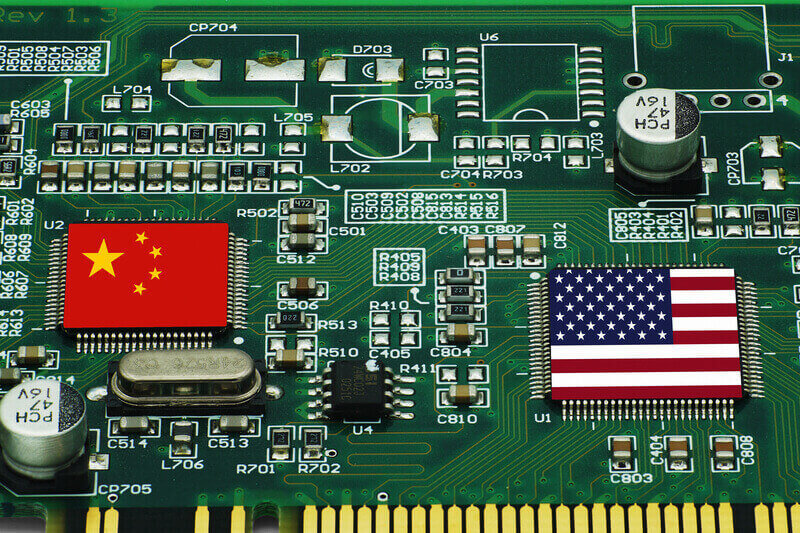
In the 21st century arms race between the United States and China, the most important assets are not nuclear warheads, but rather advanced microchips used to power everything from artificial intelligence tools to passenger vehicles and military equipment. While Beijing boasts that it can develop its own domestic chip supply chain amid U.S.-led export controls, that confidence may belie increasingly dire shortages.
According to the Council on Foreign Relations, “the best U.S. AI chips are currently about five times more powerful” than those offered by Huawei, one of China’s leading AI companies. That advantage could expand to as much as 17 times as soon as 2027, particularly as Chinese chipmaker SMIC struggles to meet production targets for the most advanced chips.
While Chinese labs have been able to design and manufacture prototypes of advanced chips, they lack the enormously complex and sensitive equipment needed for mass production – a direct result of U.S. pressure to prevent the communist nation from acquiring such equipment. The current yield of Huawei chips is just 20 percent, meaning that out of five chips made, four are faulty on average.
Earlier this month, President Donald Trump blocked the sale of chip-making assets to a company controlled by a Chinese national, just the latest evidence of the administration’s commitment to preserving the advantage that the United States and its allies currently enjoy in chip manufacturing.
As a result of this edge, Huawei produced just five percent of the computing power produced by U.S. AI giant Nvidia in 2025. That figure is expected to fall to four percent in 2026 and two percent in 2027 – a likely insurmountable lead even as China’s demand for AI compute power increases exponentially.
Rep. John Moolenaar, chairman of the U.S. House Select Committee on China, recently wrote to Secretary of Commerce Howard Lutnick that “Huawei and China remain far behind the United States” in AI development and total available compute. Ray Wang, a Seoul-based analyst at SemiAnalysis, also said that China’s memory chip champion, ChangXin Memory Technologies, is “still years behind industry leaders” such as U.S.-based Micron Technology and South Korea’s Samsung Electronics and SK Hynix. Tang Jie, co-founder and chief AI scientist at China’s Zhipu AI, also known internationally as Z.ai, observed that the true magnitude of the disparity remains unclear. “In reality, it could be widening, since the U.S. possesses many models that have not been made public,” he remarked.
Nonetheless, Chinese leaders are projecting an air of supreme confidence, insisting that trade restrictions are only spurring domestic innovation. Zhang Hengming, a representative of a Chinese AI electronics alliance, told NPR last December that Chinese chips are “excellent” and “will be able to compete in the world, no problem.” Despite repeated production shortfalls and the ongoing chip “blockade” from the West, the Chinese government has reportedly invested some $200 billion in its chip industry.
But if the lessons from the last “great power” competition between the United States and the Soviet Union tell us anything, it’s that rhetorical bluster on the part of totalitarian communist states is notoriously unreliable. Soviet leaders, always desperate to appear as if they were competing with the United States technologically, spent enormous sums on propaganda and creating the illusion of advancement and progress.
The Chinese Communist Party (CCP) now appears to be following the Soviet Union’s path, repeating its fruitless quest to match or surpass American power. “The essence of these wasted efforts is to mimic the U.S. while having no idea how to develop a country,” Professor Jun De Níng, a CCP dissident and former advisor to Hu Yaobang, a former General Secretary of the CCP, told me.
Another area where the CCP is feigning progress is on renewable energy. Headlines claim that China reigns supreme in the field, with even many Western media outlets lauding supposed Chinese progress. But coal still dominates China’s energy grid, accounting for about 60 percent of production.
China is also falling behind in a new space race. As Elon Musk’s SpaceX continues to pioneer reusable rockets, Chinese engineers have been unable to match that feat. A spate of recent failed launches and crashes have complicated the CCP’s goal of putting 200,000 satellites in low orbit to compete with Musk’s Starlink.
China’s chip ambitions, like its boasts about green energy and space dominance, appear to rest more on political theater than technical reality. Industrial policy, state subsidies, and propaganda can narrow gaps at the margins, but they cannot easily substitute for decades of accumulated expertise, open research ecosystems, and trusted global supply chains.
For now, the United States and its allies retain decisive advantages in the technologies that will define economic and military power in this century. If current trends hold, Beijing may discover that the real constraint is not Western “containment,” but the limits of centralized control itself.
Ben Solis is the pen name of an international affairs journalist, historian, and researcher.







The overall problem with the technology advantage against China is their massive industrial espionage and our open, many times lackadaisical attitude towards industry security. Millions of Chinese nationals are in our country and some even hold elected office, (i.e the current mayor of San Francisco is a Chinese national). Remember where Silicone valley is. Just like the USSR, China learned industrial espionage is much cheaper than trying to grow smart scientists and engineers. Just steal it, which has been going on since Nixon went to Beijing, (Peking back then). People are so ignorant of Communist China’s nefarious Long range plan to rule the world and have the largest slave labor camp available to support All the wonderful blessed leaders opulent lifestyle.
China will do what China has always done, steal the technology to catch up. They have the forces in place here to make it happen; from students to cloaked military and spies. We permit China to invest in (buy in) universities, flood our universities with “students”, buy property and much of it near or next to sensitive installations and military bases, take jobs in sensitive industry. Yes, they will stay up to us handily!
Is China falling behind? In ANYTHING? Don’t count on it.