
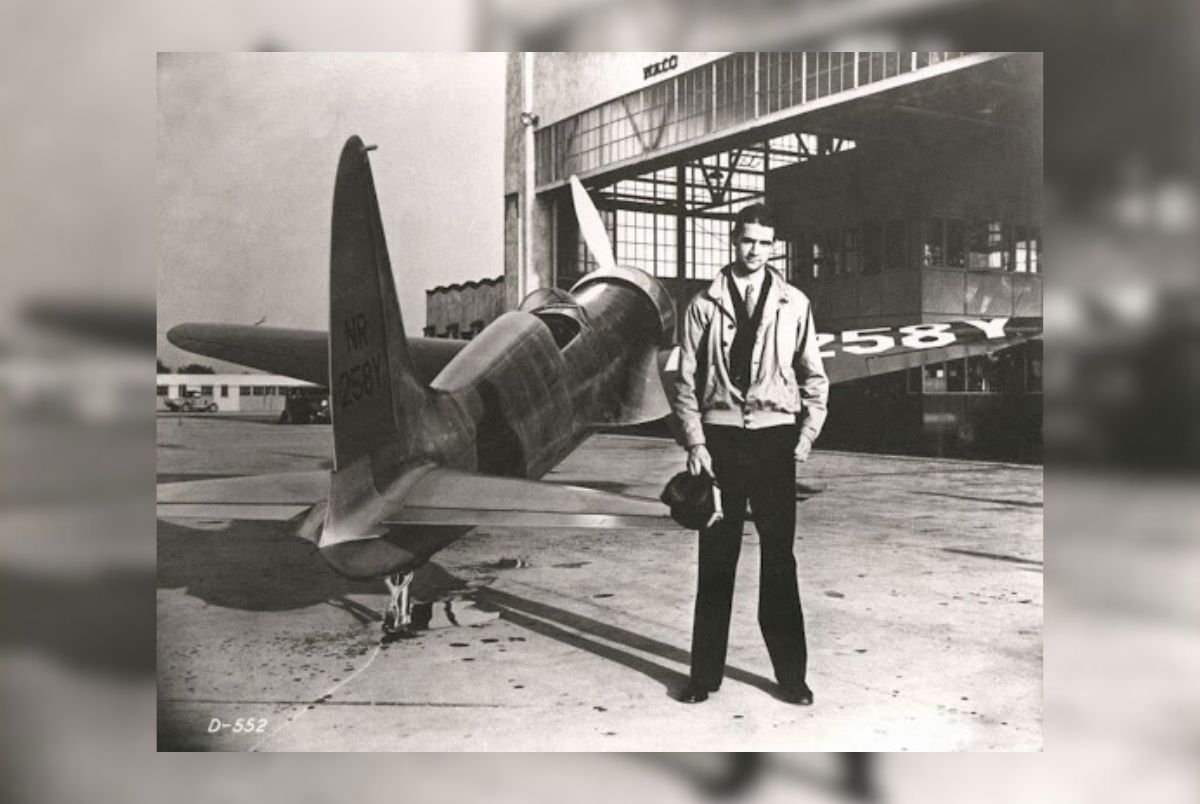
On January 19, 1937, American aviator, engineer, and eccentric industrialist Howard Hughes etched his name into the annals of aviation history by setting a remarkable transcontinental airspeed record — a feat that showcased both technological innovation and the spirit of daring that defined early 20th-century flight. On that winter day, Hughes piloted his sleek, custom-built Hughes H-1 Racer nonstop from Los Angeles to Newark, New Jersey, completing the roughly 2,490-mile journey in 7 hours, 28 minutes, and 25 seconds at an average speed of about 332 miles per hour.
The achievement wasn’t just a statistic; it was a dramatic demonstration of how far aviation technology had advanced in less than a decade. Designed by Hughes in collaboration with engineer Richard Palmer and built by his fledgling Hughes Aircraft Company as a purpose-built racing plane, the H-1 was crafted to be the fastest landplane in the world. Its streamlined fuselage, flush rivets, retractable landing gear, and powerful Pratt & Whitney engine pushed the boundaries of aerodynamics and performance at a time when many military and commercial aircraft still relied on biplane designs.
Hughes had already established a reputation for bold aviation exploits before this flight. In 1935, flying the H-1 with shorter, speed-optimized wings, he set a world landplane speed record of 352 mph — a groundbreaking accomplishment that made headlines and fueled public fascination with aviation’s potential. Building on that success, the H-1 was fitted with longer wings better suited for endurance and range, preparing it for Hughes’s ambitious transcontinental attempt.
Departing in the pre-dawn darkness from Burbank’s Union Air Terminal, Hughes faced the challenges of long-distance flying at a time when navigational aids were rudimentary, and weather forecasting was still evolving. Despite those limitations, he maintained a blistering pace west to east and touched down at Newark Metropolitan Airport late that afternoon, shattering his previous record by nearly two hours.
The flight captivated the nation and underscored Hughes’ dual identity as both showman and serious aviator. His achievement was more than a personal triumph; it illustrated the rapid technological advances in aviation between the World Wars and helped inspire further innovation in aircraft design. Although the H-1’s revolutionary design was not directly adopted by the U.S. Army Air Corps, historians credit its aerodynamic lessons with influencing later high-performance fighters.
The legacy of Hughes’ 1937 record endures: the H-1 Racer, once a symbol of individual ambition and engineering daring, is now preserved at the Smithsonian’s National Air and Space Museum, where it continues to remind visitors of an era when pushing the limits of speed and distance was still uncharted territory.
[adrotate banner=”1184″]






Wow. I didn’t know that any planes had retractable landing gears in 1937.