
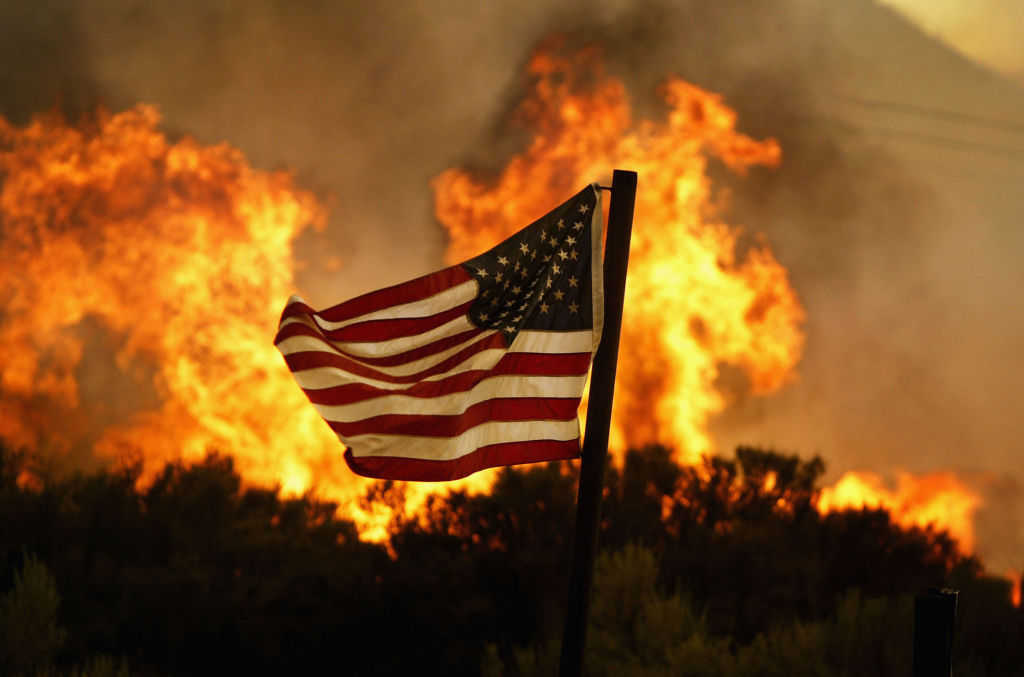
President Donald Trump has recently drawn widespread corporate media criticism for issuing an executive order directing the Department of Justice (DOJ) to investigate potential criminal cases involving the burning of the American flag. While the Supreme Court seemed to have settled the flag-burning question in a landmark case decades ago, the President may have exposed a new wrinkle in the debate.
In accordance with Trump’s order, federal prosecutors in the nation’s capital filed two misdemeanor charges against a man who set fire to the flag outside the White House shortly after the order’s issuance. The flag burner, 54-year-old Jan Carey, who identified himself as a military veteran, explained that he did so in order to put the President’s order “to the test.”
To avoid directly challenging Texas v. Johnson (1989), in which the Supreme Court held that flag-burning constitutes speech protected under the First Amendment, the DOJ’s prosecution focused on the fact that Carey lit a fire outside a “designated area and receptacle,” and “in a manner that threatened, caused damage to, and resulted in the burning of property, real property, and park resources.”
Nonetheless, the real intent of the charges, and of the executive order that generated them, was transparently to challenge the Court’s rulings in Johnson and related cases. Carey’s prosecution will inevitably lead, as he intended, to such a constitutional challenge.
Leaving entirely aside the question of how far the President enjoys the authority to ban flag burning in D.C., let alone in the rest of the country, the case offers a welcome opportunity to revisit the Court’s jurisprudence in this field.
Texas v. Johnson overturned the conviction of one Gregory Lee Johnson for burning the flag outside the 1984 Republican National Convention meeting in Dallas as a protest against the policies of President Ronald Reagan. Johnson had been prosecuted under a Texas statute that prohibited the desecration of “venerated objects,” including the national flag.
However, the Court overturned his conviction on the ground that Johnson’s act was a form of “symbolic speech,” and was therefore protected from punishment by the First Amendment’s free speech guarantee (as applied to the states through the Constitution’s “due process” clause).
In particular, the Court majority (including, surprisingly, the professed textualist – but also libertarian-inclined – Antonin Scalia) held that the Texas law constituted an improper form of “viewpoint discrimination.” The Court’s reasoning was that the Texas law punished actions, such as flag burning, that might arouse anger in others, while specifically exempting from prosecution physically comparable actions that were respectful of venerated objects (for example, burning and burying a worn-out flag). Justice Brennan’s majority opinion stressed that the very notion of freedom of speech protects actions that society may find very offensive, whereas society’s outrage alone is not justification for suppressing free speech.
Far more plausibly, Justice Stevens argued in dissent that the flag’s unique status as a symbol of national unity outweighed “symbolic speech” concerns. Accordingly, he reasoned, the government could lawfully prohibit flag burning.
But even Stevens’s valid point may be an insufficient ground for upholding the right of the government to ban the desecration of the American flag, as it leaves the Court in the constitutionally dubious position of simply “balancing” competing concerns – as if a different Court might with equal justice subsequently decide that “symbolic speech” concerns actually outweigh the defense of national unity.
As constitutional scholar Christopher Wolfe argues in his classic study The Rise of Modern Judicial Review, balancing competing policy concerns is normally a job for the people’s elected officials rather than judges. The root of the problem here, which Stevens’s opinion fails to address, is the very adoption of the term “symbolic speech” to regulate behavior that has nothing to do with speech.
The doctrine of symbolic speech originated in a 1931 ruling by the Court in Stromberg v. California (1931), which held that “speech” might take a nonverbal form. This case reversedthe conviction of a woman who displayed a red flag as a symbol of opposition to the government.
In a subsequent case, Tinker v. Des Moines (1969), the justices ruled that students had the right to wear armbands as a form of protest against the Vietnam War, since such behavior was “closely akin to ‘pure speech’” and hence a constitutionally protected form of symbolic expression.
But in fact, these decisions, like Texas v. Johnson, grossly misapply the First Amendment, since they disregard the Founders’ very purpose in seeking to protect freedom of speech and of the press.
“Speech,” as any dictionary will confirm, meansmaking statements composed of words and (normally) sentences. Both the freedom of speech and that of the press are essential to republican government, since they enable citizens (and office holders) to express opinions about public issues aimed at persuading others that various public policies, or judicial rulings, are or are not conducive to the public good and to justice.
As Aristotle famously observes in his Politics, human beings, unlike other animals, are naturally “political” because they have the faculty of logos (reason or speech). Hence, they can deliberatewith their fellows about how they should be governed. He distinguishes logos from the mere sounds of pleasure, pain, fear, or anger that other higher animals are capable of expressing without rising to the level of deliberative argument.
Wearing armbands, holding up revolutionary flags, or burning the American flag are not at all expressions of logos that other citizens, or government itself, are intrinsically obliged to respect. Whether the causes that those actions represent are worthy or not, the acts themselves are merely expressions of feeling.
But in a free government, as James Madison (not only the “father of the Constitution” but the chief architect of the Bill of Rights) argues in Federalist No. 49, “it is the reason, alone, of the public, that ought to control and regulate the government. The [people’s] passions ought to be controlled by the government.”
Madison’s remark follows an explanation of why the Constitution’s authors made that document relatively difficult to amend. As this context indicates, the American Founders were under no illusions that human beings in their political behavior can be relied on to naturally follow reason rather than passion.
As Madison explains earlier in Federalist No. 49, too-frequent alterations to the Constitution would “in great measure, deprive the [American framework of] government of that veneration which time bestows on everything, and without which perhaps [even] the wisest and freest governments would not long survive.” While “this consideration” might safely be “disregarded” in “a nation of philosophers,” among whom “a reverence for the laws would be sufficiently inculcated by the voice of an enlightened reason,” “in every other [actual] nation,” even “the most rational government will not find it a superfluous advantage to have the prejudices of the community on its side.”
There is good reason to believe that the authors of our Constitution indeed devised the “most rational” system of government ever established. British Prime Minister William Gladstone, writing some 90 years after Madison, proclaimed the Constitution to be “the most remarkable work known to me in modern times to have been produced by the human intellect, at a single stroke… in its application to political affairs.” And it remains, with a limited number of amendments, by far the longest-lasting constitution of any major nation in the world.
But as Madison’s remarks indicate, he would attribute its longevity not merely to the wisdom with which it was designed, but to the gradual development over time of a widespread popular reverence for our system of government and the principles on which it rests. That reverence – the spirit of which has led many thousands of Americans to risk and sacrifice their lives in their country’s defense – is exemplified by the high regard in which most of us hold the nation’s symbol, the Stars and Stripes.
Think, for instance, of the iconic photograph of soldiers hoisting the flag atop Iwo Jima following the terrible battle that preceded our victory there against the Japanese. Or of firefighters raising Old Glory over the rubble of the World Trade Center post-9/11. As a baseball fan and as the grateful offspring of an immigrant father and grandparents, I always find it heartwarming to see fans (mostly) standing reverently before the start of each ballgame to sing or at least listen to the National Anthem while gazing at the flag being raised.
Why shouldn’t Americans insist that anyone who chooses to enjoy the benefits of living in this country show respect for its flag? And won’t ideologically motivated Court decisions, based on a foolish political relativism that seems to devalue patriotism, tend to reduce respect for the authority of the Court itself?
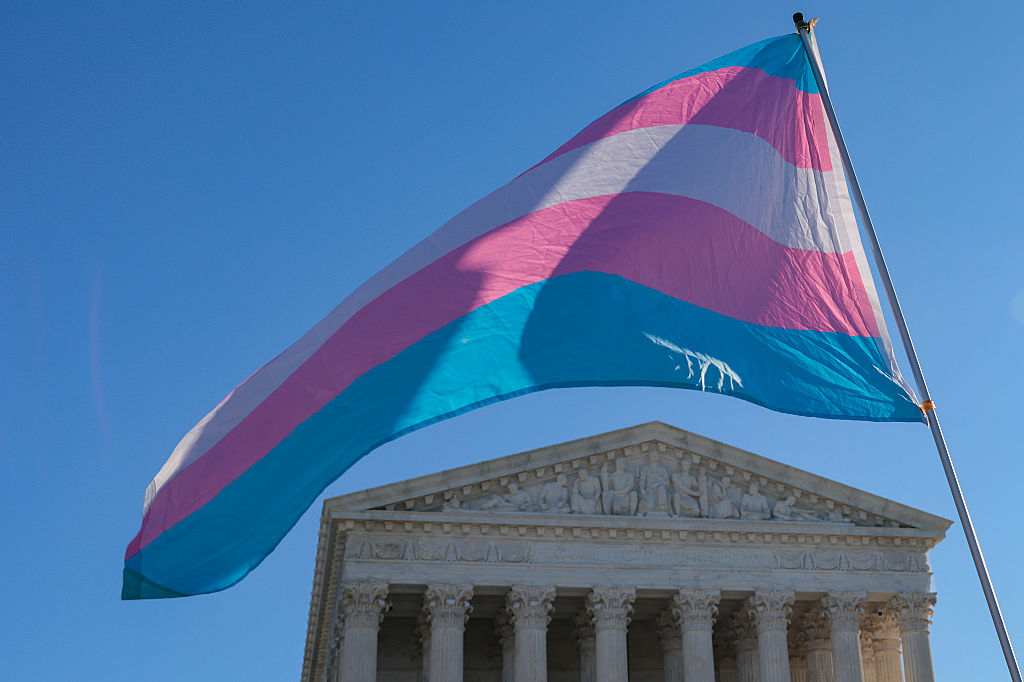
But there is a deeper irony at work today; namely, that some other inherently political flags and symbols currently enjoy more legal protections than our own national flag. One need only look at the harsh punishments threatened toward anyone who desecrates the LGBTQ+ “pride flag” to see that this is the case.
In June, for instance, four Georgia teenagers were arrested for committing a “hate crime” by cutting up LGBTQ+ “pride” flags. Meanwhile, in Delray Beach, Florida, a teenager faces felony charges for leaving tire burnout marks on a street intersection painted in the colors of the “pride progress” flag, marking the second time the streetscape has been deemed vandalized since it was unveiled less than three years ago.
Even the U.S. government, under the leadership of former President Joe Biden, seemingly sought to elevate the pride flag above the American flag. In 2023, the Biden White House infamously displayed a pride flag side-by-side with two American flags, apparently violating the U.S. Flag Code. The administration was also scrupulous about placing rainbow flags on U.S. embassies abroad, prior to a 2024 Congressional ban on the practice.
No word, yet, on whether those Georgia teenagers will win vindication for their acts in the courts. Nor on whether Joe Biden’s version of pride won or lost his party votes in last year’s election. But one thing is certain – it’s time that America’s judicial establishment acknowledges government’s right to protect our flag from desecration.
David Lewis Schaefer is a Professor Emeritus of Political Science at College of the Holy Cross.




Try burning the rainbow flag of the LGBTQ+ and see what kind of reaction occurs. I’m betting there would be an effort to create national legislation banning such efforts.
Overall. the National and State flags should be respected and be treated as such at all times. Those flags that represent various groups should be respected if flown at someone’s home or business. If one buys a flag such as a pirate or LGBTQ flag and then destroys it, that is their right as they paid for it. If one places a Non desired flag in my yard or business without my permission, then I have the right to remove it and trash or destroy it as I see fit. As for a design on a public roadway, it should have not been there in the first place.
The Left have gone too far with their antics of disrespect toward our nation and heritage.
Burning our national flag is a disrespectful manner is not speech and should be prosecuted. The Supreme Court should take another look at this and reverse the previous opinion.
I don’t care if it’s a law or not. You don’t burn the flag . Too many people have fought for the freedom it represents. Listen to the Star spangled banner. This man was a prisoner on an English boat. As long as he could see the flag, he knew the British hadn’t won. It represents freedom as well as a great country which I am very proud of again.
Honor the Flag of America. DO NOT BURN IT!!
On July 18, 1863, the 54th Massachusetts Volunteer Regiment led the charge on Fort Wagner outside of Charleston, South Carolina under the command of Col. Robert Gould Shaw. When the unit’s flag bearer fell after being shot down during the battle, Sergeant Carney retrieved the American flag and continued to march it forward “pressing his wound with one hand and with the other holding up the emblem of freedom.” Despite multiple serious wounds, Carney pushed forward and planted the flag upon the parapet. When Union forces had to retreat Carney continued to carry the flag until he made it to friendly lines and handed it to another member of the 54th Massachusetts. Upon arriving at federal lines Carney cried, “Boys, I did but my duty; the dear old flag never touched the ground!”
Bravo David Lewis! Well researched and written.
It weighs on my heart when I hear rebels being allowed to desecrate our national flag, let alone military veterans! It also grieves my heart to see the hellish symbol of rebellion against our Divine creator flying freely. I am grateful that President Trump is painting over some street rainbows. More is needed to end this rainbow madness!
Nine Line apparel has a T-shirt that says “Stomp on my flag, and I stomp on your face.” I’m all for some face stomping. I’ll add that I consider the teenagers who cut up the offensive, anti-Christ rainbow flag and did donuts on the painted street to be heroes. Perhaps the state governors should extend pardons.
Isn’t anyone who burns the American flag in protest inciting a riot?
Wonderful article! I dispise the burning of our flag. The United States of America flag!
Great comment. The price for FREEDOM is not cheap and there are many on this site that have served this nation and have lost comrades in defending that cause.
The Stars and Stripes is a national symbol and it represents a body of people, a nation, and so many have died (past and present) defending the freedoms we all enjoy today. The flag should be respected by all who call themselves an American.
As far as burning; no one is permitted to burn anything inside of any city limits without a burn permit, including in your own back yard. Also, to burn anything outside of any city limit(s), the Bureau of Land Management (BLM) requires burn permits to reduce the risk of wildfires and to also protect public lands. Furthermore, there are laws in place to prevent the incitements of riots. Burning our national flag in the streets (in public) — in the middle of a downtown (anywhere across our land) is already breaking other laws and the police should deal with those lawbreaker as required.
If burning the flag is free speech, what is burning down an individual’s property during a riot? That would also be free speech. Come on, lighting something on fire is not speaking. It’s destruction. Just stop with this stupid topic, burning the flag is not speaking nor is it free speech.
Let would-be burners of Old Glory express themselves verbally or in writing.
There is so much smoke in many states, causing poor AQI, why permit burning of anything that is not necessary?
I ask if there is a moral right to burn the flag. If you don’t like it, try somewhere else and shut up. Don’t be an ass and try to change my country. You won’t like what I do. That goes for the Democratic Party, too.
If burning a gay pride flag is a hate crime, then the lefties have already DECIDED this issue and burning the US flag should also be a hate crime: against America! Its a slap in the face to our service members and all the families who fought for the right to be an idiot.
I acknowledge that burning the American flag is disrespectful. However, President Donald Trump’s recent executive order targeting flag burning has sparked serious constitutional concerns. In the landmark 1989 Texas v. Johnson case, the U.S. Supreme Court ruled that flag burning is a form of symbolic speech protected by the First Amendment. Trump’s order instructs the Justice Department to prosecute flag burning when it involves other legal violations, such as inciting imminent violence or breaking content-neutral laws, with penalties including jail time and immigration consequences for non-citizens.
Legal experts and civil rights organizations contend that this executive order conflicts with established constitutional protections, since the First Amendment safeguards flag burning as political expression—even when it is offensive. Groups like the American Civil Liberties Union argue that the government cannot criminalize protected expressive conduct by executive decree. Although the order attempts to focus prosecutions on cases involving violence or harm unrelated solely to speech, critics assert that it unfairly targets flag burning and may represent an unconstitutional restriction on free speech. The full legal effect of the order remains uncertain and is likely to face judicial challenges, as it challenges Supreme Court precedent without explicitly overturning it.
I understand how burning the Stars and Stripes is a way to get attention to whatever you think you’re suffering. Remember that our enemies always desecrate the flag publicly when they get a chance, and those who do it on American soil are no better. It’s not like throwing a few cases of British tea in the bay. Hundreds of thousands have sacrificed life and limb for the Stars and Stripes.
While burning the flag may be protected speech, don’t be surprised if a patriotic American decides to show his/her feelings when you do so. Actions have consequences!
Trump didn’t ban burning the flag, he just committed to investigating any crime committed in association with the burning of flags which is perfectly appropriate.
Behavioral actions have nothing what so ever to do with speech, unless of course one starts to burn a flag to get someone else’s attention because they are mute and do not have voice to speak with. With that said, I would hope they could find something else to set fire to other than our National Flag. Let anyone go to China and set their national flag on fire and see what happens to them!!!!
If you look up the definition of “speech” in the dictionary it will talk about what you say or read. There is no mention of burning anything anywhere in the entry. The Supreme Court based their erroneous decision on an unauthorized redefining of the meaning of speech, free or otherwise! Perhaps they should revisit that decision like they did with Roe Vs. Wade!
If anyone wants to burn the U.S. flag, let them go to a country who won’t appose it. They don’t deserve to live here.
It’s not a person. Just a stupid flag. Who cares if someone burns it? The people who are bent out of shape about flag burning are saying the quiet part loud (they hate free speech and have mental issues that make them want to control others)
People! Pay attention to the comments of the patriots which follow. Respect and honor the national symbols. Don’t misreat them. Don’t allow their desecration.
Yes, it should be a crime. Burning stuff in public is a crime. The flag is representative of our nation. And, yes, it’s a form off free speech, but we could require a permit. Or, we could make the punishment be that the perp must purchase a new flag, a good one, say from Allegiance or someone comparable, and deliver it personally, and be required to raise it on a public pole with a video of it with a clear facial shot. We could have a website where all the videos would be posted.
Or we could make it a felony and nail the perp to the wall, but it would never get by the courts.
It’s just an insult. I don’t think we should make a federal case out of it. We’ve got much bigger hills to die on.
The US flag, just like all the agency seals, is owned by the US Government. Trump should enact trademark laws to protect the flag from being burned by leasing the rights to manufacture the flag, but all rights belong to the US Government as far as ownership of the flag. Destroying it constitutes a breach in agreement. Make the person pay a huge fee for the destruction.
They laid a gang war on ONE of Trump’s Team with JFK jr.
Why can’t they all face each other with that kind of talk as a group instead of Kennedy alone?????
Or is there two different forms applied with all of it? The people can see this too.
So Sad.