
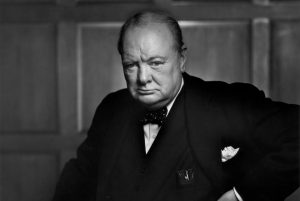
Years ago, while attending Oxford University, I decided to bug out and take a 600-mile bicycle ride into northern England. Along the way, I stopped at Blenheim Palace and a little cemetery in Bladen. There, a simple marker signifies the final resting place of Winston Churchill. History teaches us.
You would think that Churchill, arguably Great Britain’s greatest prime minister, who served and saved the Western World in WWII, faced Hitler alone until joined by the United States, which wrote 72 volumes of history, would have a towering grave marker. He does not.
This month, I am reminded of him, not just because the world is awash in conflict, America in distress at home, those of good heart distressed with each other, but because he almost died this month in 1943. He got pneumonia. One wonders what would have happened had he not recovered.
The magic of Churchill, having read many of his books, was not just his defense of liberty – later predicting the Cold War – but his clarity in seeing “the big things,” the need to fight for them.
He once wrote, “Courage is what it takes to stand up and speak; courage is also what it takes to sit down and listen.” Looking around – and in the mirror – I often think we might do with more of both.
Churchill could be terse, but carried whimsy with him. The mixture jostled around and spilled out, producing quiet or laughter. If Reagan, TR, and Lincoln had it, Churchill was a master.
Faced with failures, he never gave up. Early on, his British father was absorbed in politics, his American mother more in herself, so he built confidence and self-reliance early. Failing an entrance exam for military school twice, he passed the third time and became a courageous soldier.
In the 1930s, during his “wilderness years,” he was ignored and maligned. Not always right, he got back up when knocked down. “Success consists of going from failure to failure without loss of enthusiasm.”
That certainly characterized his life, which seems to have been composed of more failures, more falls and recoveries, no straight lines until he saved the Western World. A great distiller of truth and admirer of distilleries, he did mince words when direct talk was needed, but could be a diplomat.
Some of his lines are famous, others less. Many came to him, apparently in the moment during “Question Time.” Challenged by Lady Astor, a political opponent in Parliament, their back-and-forth became famous. When she said, “If you were my husband, I would poison your tea,” he responded, “Madame, if you were my wife, I’d drink it.”
Inspirationally, some favorite Churchill nuggets include: “Kites fly highest against the wind, not with it,” and “So you have enemies, good, it means you have stood for something some time in your life,” and “Solitary trees, if they grow at all, grow strong.” They speak to his life, battling against evil.
One of his gifts was to force political detractors to think – with quotes like, “An appeaser is one who feeds the crocodile, hoping it will eat him last,” “He has all the virtues I dislike, and none of the vices I admire,” and “When the Eagles are silent, the parrots begin to jabber.”
Today, the call for Churchillian leadership turns on truth saying – in a way that makes people listen. He was not always easy to deal with, but he reflected on the world and knew what “the big things” were.
My favorite quote is one that came toward the end, a giant truth. “All great things are simple, and many can be expressed in a single word: Freedom, Justice, Honor, Duty, Mercy, Hope.”
Today, many forget there are “great things,” timeless values distilled over ages, memorialized in traditions, and vital for the continuation of life as we know it. Churchill, himself, never forgot.
Two last thoughts.
First, while Churchill could be impatient, a great but grumpy – as his parrot apparently was – he entered all conversations, even with his opponents, on even ground. For all his faults, he began them with respect, suggesting this was the bedrock on which all conversations must be built.
Second, while many think of him as irreverently assertive, self-indulgent, too self-assured, and too ready to fight for his view of the right, he was also humble. His gravestone in that little Bladen cemetery told me a lot. If widely respected and rightly admired, he wanted no Westminster burial.
Maybe Churchill’s greatest lessons, after all, are the unspoken ones. That is what I thought on that day when I bicycled up and saw the humble grave of a great man. History teaches us, in many ways.
Robert Charles is a former Assistant Secretary of State under Colin Powell, former Reagan and Bush 41 White House staffer, Maine attorney, ten-year naval intelligence officer (USNR), and 25-year businessman. He wrote “Narcotics and Terrorism” (2003), “Eagles and Evergreens” (North Country Press, 2018), and “Cherish America: Stories of Courage, Character, and Kindness” (Tower Publishing, 2024). He is the National Spokesman for AMAC. Today, he is running to be Maine’s next Governor (please visit BobbyforMaine.com to learn more)!
