
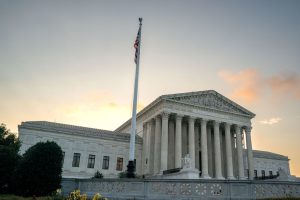
The dust has now settled following the Supreme Court’s decision in Trump v. Barbara to strike down President Trump’s executive order ending birthright citizenship for children born to parents unlawfully or temporarily present in the United States. The Court affirmed that any child born on U.S. soil is a citizen at birth under the Fourteenth Amendment’s Citizenship Clause.
Trump has since announced that he will petition the High Court for a rehearing of the case, utilizing a rule that allows such requests within 25 days of a ruling. However, the chances that the Court will grant this rare request are slim. Securing a rehearing requires a majority vote from the nine justices – a threshold that is historically nearly impossible to meet given that the Court has not agreed to rehear a decided case in roughly 60 years.
The Court undoubtedly deserves plenty of criticism for its damaging and legally dubious decision, as Justice Clarence Thomas made clear in his blistering 91-page dissent. That said, given the stakes of continuing to grant anyone who is born on American soil full citizenship rights, anyone who cares about American sovereignty and restoring the sanctity of American citizenship must now focus on where to go from here.
In 2023, mothers who were unauthorized immigrants or held only temporary legal status accounted for 320,000 births in the United States, representing an astonishing nine percent of all U.S. births. If the restrictions of President Trump’s executive order had been properly upheld, roughly 260,000 of those children would not have qualified for automatic citizenship.
That’s the scale of what the Court just locked in.
So where do we go from here? Justice Brett Kavanaugh, intentionally or not, may have provided something of an answer.
Though Kavanaugh sided against Trump’s executive order on statutory grounds, he did not endorse the majority’s sweeping constitutional interpretation of so-called birthright citizenship.
On this key constitutional question, the Court was actually split 5-4, not 6-3.
Kavanaugh argued that Trump’s executive order was invalid because it directly conflicted with 8 U.S.C. § 1401(a) – the section of the Immigration and Nationality Act in which Congress has already codified birthright citizenship – explicitly stating, “I respectfully disagree with the Court’s constitutional holding. In my view, the Executive Order does not violate the Fourteenth Amendment.”
Kavanaugh’s reasoning leaves the door open for the legislative branch to act by passing a statutory amendment to the Immigration and Nationality Act specifically excluding children born to illegal aliens, tourists, and temporary visa holders from automatic citizenship. Should such an amendment be passed and should that amendment be challenged before this Court, there is every reason to believe it would be upheld.
Such legislation would once again force the Supreme Court to rule on another fundamental question: do the nation’s elected representatives have the power to determine the boundaries of citizenship, or is that authority reserved forever for unelected judges?
Under Article I, Section 8 of the Constitution, the authority to “establish an uniform Rule of Naturalization” belongs exclusively to Congress.
Therefore, any decision to grant citizenship to the offspring of temporary or unlawful residents is a statutory privilege that elected representatives have the absolute authority to limit, condition, or revoke.
In his dissent, Justice Samuel Alito warned that birthright citizenship for children of temporary or unlawful residents is not a permanent constitutional mandate, stating, “The Fourteenth Amendment dictates who must be a citizen, but it does not address who may be a citizen by Act of Congress.”
By constitutionalizing what should have been a statutory question, Alito argued, the Court took a decision that rightfully belonged to the American people and handed it to itself.
His dissent laid bare the ultimate consequence of the Court’s ruling: it stripped the American people, acting through their elected lawmakers, of their sovereign right to define the boundaries of their own political community.
While the Fourteenth Amendment, as currently interpreted, stands as a nearly unassailable roadblock in ending birthright citizenship absent a new constitutional amendment, the Tenth Amendment may already contain a workaround.
Under the Tenth Amendment, states control their own vital records, not the federal government. While states cannot unilaterally redefine federal citizenship, they do possess the power to regulate how birth certificates are documented and issued.
By exercising this authority under the Tenth Amendment, reform-minded states could require strict documentation of parental domicile, proof of lawful presence, or sworn affidavits of residency before issuing a standard vital record.
Rather than withholding birth certificates entirely, which, of course, would trigger immediate federal injunctions, states could simply annotate the document to reflect the parents’ temporary or unlawful status.
Why would this matter?
First, it expands on a long-accepted practice: states already annotate the birth records of children born to foreign diplomats, who are excluded from birthright citizenship.
Second, it establishes a permanent paper trail for future federal review if the legal landscape ever changes.
Finally, it arms states with the precise data needed to deny local taxpayer-funded benefits reserved for American citizens or lawful residents, while providing concrete records for federal immigration enforcement actions.
In short, through determined administrative reform, states can strip some of the taxpayer-funded “birth tourism” incentives from illegal aliens and temporary visa holders looking to game our system.
Armed with clear records of parental residency, states can systematically restrict the flow of local, taxpayer-funded public benefits.
While federal welfare programs are subject to their own complex rules, states generally have more discretion over state-specific programs. By mandating that a household’s legal status be factored into eligibility equations, states can attempt to ensure that state-funded pre-K, local housing assistance, and state-subsidized healthcare are reserved for legal residents.
Similarly, public higher education can be safeguarded by requiring students to prove that at least one parent is a lawful, permanent resident in the state to qualify for in-state tuition or state-funded financial aid.
Beyond the social safety net, states possess the ultimate power to regulate their local marketplaces and dismantle the primary economic magnets driving unlawful residency.
By implementing mandatory statewide E-Verify and backing it with the threat of business license revocation, states can effectively dry up unauthorized employment.
State attorneys general and local municipalities can also deploy zoning laws, health codes, and commercial regulations to directly target and shut down the lucrative “birth tourism” industry.
The shadowy networks of “maternity hotels” and specialized concierge brokers that profit from facilitating pre-arranged citizenship-by-birth schemes can then be aggressively regulated out of existence at the state level.
Critics will inevitably point to the judicial defeat of California’s Proposition 187 as proof that states cannot act. But Prop 187 failed because it attempted to create a state-run immigration enforcement mechanism, which is a power reserved exclusively for the federal government.
The strategy outlined here focuses strictly on the Tenth Amendment administrative powers of vital record annotation, business licensing, and the fiscal preservation of state-exclusive benefits.
To be clear, many of these arguments operate in areas of constitutional uncertainty. The Supreme Court has never squarely ruled on several of the questions raised, and any attempt to test these boundaries would trigger immediate litigation.
But states do not need to apologize for testing the limits of their own authority. These are legal battles that need to be fought. Inaction is akin to surrender, and sovereignty is worth fighting for, even if the desired outcome is a longshot.
If the Supreme Court refuses to defend America’s sovereignty, and Congress fails in its duty to secure the value of citizenship by statute, then that responsibility ultimately falls to individual states, who have both the right and the duty to safeguard their own borders, budgets, and communities.
Adam Johnston is a senior contributor to The Federalist whose work has been featured in The Blaze and the Daily Caller. He is also the creator of the Substack publication “Conquest Theory” where he regularly writes about politics, history, philosophy, and technology. You can find him on X @adamkjohnston.
