
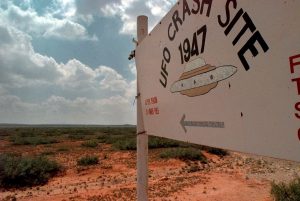
On June 24, 1997, the U.S. Air Force released a report attempting to explain one of the most enduring mysteries in American history: the alleged UFO crash near Roswell, New Mexico, in 1947. For half a century, speculation had swirled around what many believed was evidence of extraterrestrial visitation. The Air Force’s findings, however, pointed to a far more terrestrial explanation—one rooted in Cold War secrecy and military surveillance.
The Roswell incident began in early July 1947 when rancher William “Mac” Brazel discovered unusual debris scattered across his property near Roswell. The material included strips of foil, rubber, and lightweight rods, unlike anything he had seen before. After reporting the discovery to local authorities, officials from the nearby Roswell Army Air Field investigated the site. On July 8, the military issued a startling press release announcing that personnel had recovered a “flying disc.” Newspapers across the country quickly picked up the story, fueling public fascination with the possibility of alien spacecraft.
The excitement was short-lived. Within hours, military officials reversed course, stating that the debris was actually from a weather balloon. While the revised explanation seemed straightforward, many people remained skeptical. Over the following decades, rumors persisted that the government had concealed the recovery of an extraterrestrial craft and possibly even alien bodies. By the 1970s and 1980s, Roswell had become the centerpiece of countless books, documentaries, and conspiracy theories.
Seeking to address growing public interest, the U.S. Air Force conducted an extensive review of historical records. Its 1997 report concluded that the debris recovered near Roswell was not from an alien spacecraft but from a highly classified military project known as Project Mogul. Developed during the early years of the Cold War, Project Mogul used high-altitude balloons equipped with sensitive instruments to detect Soviet nuclear weapons tests. Because the program was top secret, military officials in 1947 could not publicly reveal its true purpose, contributing to confusion and suspicion.
The report also addressed claims about recovered alien bodies. According to Air Force investigators, many accounts likely stemmed from memories of military crash-test dummies and other aerospace experiments conducted in the region during the 1950s. Although these activities occurred years after the original Roswell incident, the passage of time may have blurred details in eyewitness recollections.
Despite the Air Force’s conclusions, the Roswell mystery remains a cultural phenomenon. For believers, unanswered questions continue to fuel speculation about extraterrestrial life and government cover-ups. For skeptics, the incident serves as a fascinating example of how secrecy, misinformation, and public imagination can combine to create a lasting legend.
Nearly 80 years after the debris was discovered in the New Mexico desert, Roswell continues to capture the public’s imagination, standing as one of the most famous and debated mysteries in modern American history.
