
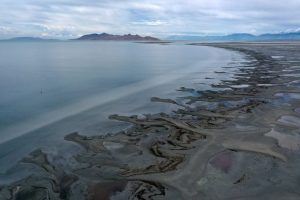
When President Donald Trump addressed the nation’s governors at a dinner last month, he raised an issue few national leaders have dared to confront directly: the drying of Utah’s Great Salt Lake.
Soon afterward, he doubled down on social media, writing, “Very important to save the Great Salt Lake in Utah. This is an Environmental hazard that must be worked on, IMMEDIATELY.” The lake’s long-documented decline – losing more than 60 percent of its surface area and 70 percent of its volume since a high point in the 1980s – is not merely a regional concern. It is a genuine environmental crisis that threatens the health, economy, and future of much of the Intermountain West.
The stakes are enormous. The Great Salt Lake began 2026 at one of its lowest levels on record. As the shoreline retreats, vast stretches of lakebed containing arsenic, mercury, and other toxic metals are exposed and can be lifted and carried by wind. If the lake continues shrinking, carcinogenic dust storms could threaten the health of more than two million Utah residents.
The ecological consequences would be just as severe. The lake supports one of North America’s most important migratory bird ecosystems, hosting millions of birds each year. If it continues to decline, wildlife habitat would collapse while Utah’s tourism, ski, mineral extraction, and real estate industries would face significant economic damage.
Utah Governor Spencer Cox confirmed after the dinner that he is drafting a proposal for Trump that could seek up to $1 billion in federal support. The details have not yet been made public, but the scale of the request raises an important question: how should conservatives approach a complex environmental problem like this?
Trump is right that conservatives should welcome the challenge with boldness. In fact, conservative governing principles may offer the lake its best hope. Liberals’ environmental policy in projects across the nation has relied on blank-check spending, sprawling bureaucracies, and little accountability that produces precious few results. Conservative stewardship by contrast offers practical solutions, measurable outcomes, and policies focused on results rather than rhetoric.
In the case of the Great Salt Lake, the need is simple: the lake must receive more water.
Trump and Utah can also learn from past environmental failures and delayed achievements. In California, the diversion of rivers feeding Owens Lake in the 20th century transformed a thriving marsh ecosystem into a dry alkali basin that became the largest source of hazardous dust pollution in North America. The remediation effort required billions of dollars and decades of work due to political leaders deflecting responsibility, encouraging a host of lawsuits, and wasting money on ineffective environmental contractors engaged in “disaster profiteering.”
The Great Salt Lake is more than ten times larger than Owens Lake. Waiting until the problem becomes irreversible would be far more expensive and dangerous.
So, what should conservatives do?
The first step is recognizing that saving the lake requires a strategy grounded in practical action. A serious plan should follow a three-tiered approach: prevent catastrophe, stabilize water levels, and ultimately restore the lake.
Prevention means stopping the worst-case scenarios before they unfold. One practical step would be constructing a network of berms or dikes to create shallow flooding systems that cover exposed lakebed and suppress toxic dust storms. A similar approach has already proven effective at Owens Lake, where targeted flooding dramatically reduced airborne pollutants.
In 2025, Utah House Speaker Mike Schultz proposed building berms that would allow limited water supplies to pool over exposed hotspots and form a protective salt crust. Projects like these will not restore the lake on their own, but they could provide a critical safeguard for millions of Utahns.
The next phase is stabilization – ensuring that the lake stops shrinking. That requires improving water flows from rivers that feed the lake while increasing conservation across the watershed.
Liberal critics often single out agriculture, which uses roughly 71 percent of Utah’s developed water supply. But farmers are not villains. Agriculture remains the backbone of rural Utah and a cornerstone of the state’s economy. Forcing farmers to surrender their water rights would abandon the principle of private property while creating a precedent more damaging than the environmental crisis we are trying to solve.
Instead, Utah has demonstrated that cooperation works better than coercion. Businesses and churches have voluntarily transferred water rights to help refill the lake. In 2023, The Church of Jesus Christ of Latter-day Saints donated more than 20,000 acre-feet, believed to be the largest permanent donation in state history. The business community has also raised hundreds of millions of dollars to modernize irrigation and conservation.
The state also took an extraordinary step in January by purchasing the bankrupt U.S. Magnesium plant and its water rights for $30 million. The acquisition will keep roughly 144,000 acre-feet of water flowing to the lake each year, one of the largest single boosts to the lake’s inflow.
These actions demonstrate a distinctly conservative solution. Instead of endless litigation or heavy-handed regulation, Utah secured results through voluntary cooperation and targeted investment.
But the lake needs more than 700,000 acre-feet of annual water inflow for the next handful of years to return to healthy levels. So, the state’s efforts are a good first step, but Trump’s federal partnership is paramount to finding a permanent solution.
The final restoration phases of a plan will require federal action to force multiply Utah’s efforts. Returning the lake to healthy levels will demand smarter water management across the basin, including wetland restoration, upstream conservation, and continued collaboration between government and the private sector.
Trump’s emphasis on bold innovation may also open new possibilities for the entire West. Underground desert aquifers are proving to harbor previously hidden water reserves of vast proportions. The U.S. Geological Survey estimates 900 million acre-feet of groundwater exist within aquifers in the Southwest alluvial basin alone.
Advances in horizontal drilling now make it possible to access previously unreachable water reserves, offering long-term opportunities to strengthen water security across multiple states in the region if the Federal government will incentivize private sector exploration.
This moment offers conservatives an opportunity to lead. Environmental stewardship was born in the conservative movement, most notably through the likes of President Teddy Roosevelt. Many of America’s most successful conservation efforts were guided by leaders who understood that protecting natural resources and preserving economic vitality are not mutually exclusive goals.
The Great Salt Lake does not need ideological lectures or another stack of federal reports. It needs leadership willing to measure success by the simple metric of whether the lake begins to rise again.
President Trump is right. The Great Salt Lake’s decline is a real environmental challenge. But it is also an opportunity to prove that disciplined, accountable, conservative governance can solve problems where the Left’s bureaucratic environmentalism too often fails.
W.J. Lee has served in the White House, NASA, on multiple campaigns, and in nearly all levels of government.
