
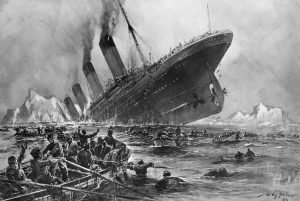
On April 15, 1912, the RMS Titanic—hailed as the most luxurious and technologically advanced ship of its time—slipped beneath the icy waters of the North Atlantic, marking one of the deadliest and most enduring maritime disasters in history. Just days earlier, on April 10, the massive British ocean liner had departed Southampton, England, on its maiden voyage to New York City, carrying more than 2,200 passengers and crew. It was widely considered “unsinkable,” a symbol of modern engineering and human ambition.
That confidence was shattered late on the night of April 14, when the Titanic struck an iceberg about 400 miles south of Newfoundland. The collision, though not immediately catastrophic in appearance, fatally damaged the ship’s hull, allowing water to flood multiple compartments. Over the next two and a half hours, the vessel slowly succumbed to the damage. By 2:20 a.m., it broke apart and disappeared beneath the surface.
What followed was a scene of chaos, confusion, and tragedy. Despite the ship’s grandeur, safety measures were tragically inadequate. There were not enough lifeboats for everyone on board—only about 20, far short of what was needed. As a result, more than 1,500 people lost their lives, many either trapped on the sinking ship or succumbing to the freezing ocean waters. Roughly 700 survived, with women and children making up the majority of those rescued.
The disaster exposed critical failures in both preparation and response. Lifeboats were often launched partially filled, communication about the severity of the situation was inconsistent, and emergency procedures were poorly executed. Nearby ships were slow to respond, and help did not arrive until hours after the Titanic had already sunk. Survivors were eventually rescued by the RMS Carpathia, which reached the scene in the early morning hours.
Beyond the immediate loss of life, the sinking of the Titanic sent shockwaves around the world. It challenged assumptions about technological progress and revealed the dangers of overconfidence. Public outrage led to sweeping changes in maritime safety, including stricter lifeboat requirements, improved emergency drills, and the establishment of the International Convention for the Safety of Life at Sea (SOLAS) in 1914.
More than a century later, the story of the Titanic continues to captivate the public imagination. It is remembered not only for its scale and tragedy, but also for the human stories it carries—of courage, sacrifice, and survival in the face of overwhelming odds. The sinking remains a powerful reminder that even the greatest achievements can be undone by unforeseen forces, and that vigilance and humility must accompany innovation.
