
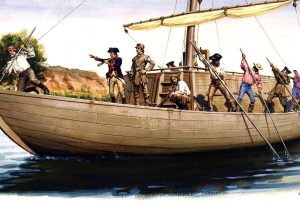
On September 23, 1806, after two and a half years traversing some of the most challenging terrain in North America, the Lewis and Clark Expedition triumphantly returned to St. Louis. Their homecoming marked the completion of the first recorded overland journey from the Mississippi River to the Pacific Ocean—and back.
Commissioned by President Thomas Jefferson and led by Meriwether Lewis and William Clark, the “Corps of Discovery” set out in May 1804 with about two dozen men. Their mission: to explore lands newly acquired in the Louisiana Purchase, map unknown territories, establish trade and diplomatic relations with Native American tribes, and find a practical route across the continent.
Along the way, the expedition endured hardships and surprises at nearly every turn. They navigated upriver through the wild Missouri, wintered with various tribes, crossed mountain ranges, and finally descended river systems like the Clearwater, Snake, and Columbia to reach the Pacific. Sacagawea, a Shoshone woman who served as guide and interpreter, played a key role, facilitating crucial interactions and helping the explorers procure horses.
Having reached the Pacific in November 1805, Lewis and Clark spent the winter there before beginning their return journey. Their path back was no less perilous or awe-inspiring. Rivers that had seemed manageable on the way west proved treacherous in reverse, and the harsh terrain, weather, and logistics continued to test endurance and resolve.
When the explorers finally reached St. Louis again on September 23, 1806, they brought with them not only personal tales of danger and discovery, but a trove of scientific, geographic, and ethnographic knowledge. They documented previously unknown species of plants and animals, sketched maps of the vast territories, and recorded detailed observations of the land, rivers, climate, and the diverse Native American nations they met along the way.
Beyond the immediate scientific and diplomatic achievements, the return of Lewis and Clark had lasting implications. The expedition strengthened U.S. claims to the Oregon Territory, encouraged subsequent migration and settlement into the American West, and expanded both the nation’s understanding of its new landscape and its idea of what the young republic might become.
Their journey was not without controversy or cost—particularly to Native Americans whose lives and lands would be forever changed by the waves of settlers that followed. Still, the expedition remains a defining moment in American history: a testament to courage, curiosity, and the transformative power of exploration.
