
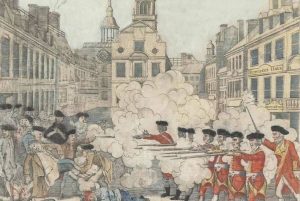
On March 5, 1770, a violent confrontation in Boston, Massachusetts, known today as the Boston Massacre, ignited outrage in the American colonies and helped accelerate the path toward the American Revolution. Against a backdrop of growing resentment toward British authority, what began as a tense street encounter quickly escalated into deadly gunfire, leaving five colonists dead and others wounded — and reverberating through colonial society as a symbol of British oppression.
Tensions in Boston had been simmering for years. In response to costly wars and the need to pay debts, the British Parliament imposed a series of taxes and regulations — including the unpopular Townshend Acts — on the American colonies without local representation. In 1768, thousands of British soldiers were stationed in Boston to enforce these laws and protect customs officials. But their presence only fanned the flames of local resentment, with colonists increasingly hostile to what they saw as an occupying force encroaching on their rights and livelihoods.
On that cold, snowy evening, a crowd began to harass a lone British sentry posted outside the Customs House on King Street. Taunts soon turned to thrown snowballs, oyster shells, and other objects, prompting reinforcements led by Captain Thomas Preston to intervene. In the confusion and chaos, a shot rang out — whether by accident or fear — and the British troops opened fire into the crowd. When the smoke cleared, five colonists lay dead or dying: Crispus Attucks, Patrick Carr, Samuel Gray, Samuel Maverick, and James Caldwell. Several others were wounded in the clash.
Among the slain, Crispus Attucks, of African and Native American descent, became a powerful symbol in later years. Many colonists came to regard him as the first martyr of the Revolution, representing the broad coalition of people who would fight for independence.
The immediate aftermath of the Boston Massacre played out in both the legal arena and public opinion. British soldiers were arrested and tried for murder; in a notable demonstration of colonial legal principles, future president John Adams defended the troops, securing acquittals for most. Two soldiers were convicted of manslaughter and punished by having their thumbs branded.
Public perception, however, was shaped more by propaganda than courtroom outcomes. Patriot leaders like Samuel Adams and engraver Paul Revere circulated dramatic depictions of the event, portraying British soldiers as cold-blooded killers. This imagery fueled outrage across the colonies, turning the Boston Massacre from a local riot into a powerful rallying cry against British rule.
In the years that followed, March 5 was commemorated in Boston as Massacre Day, serving as an annual reminder of British tyranny and colonial unity. Though the Revolution itself would not begin in earnest until 1775, the Boston Massacre remains one of the seminal flashpoints in the struggle for American independence — a moment when grievance and sacrifice helped galvanize an entire people toward revolution.
