
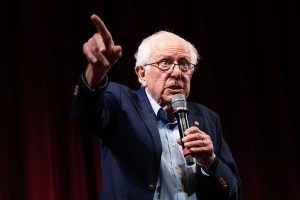
For progressive Democrats, it’s no longer enough to simply raise the tax rate on earned income. Now, they want the IRS to reach directly into accumulated private wealth to create a blatantly communist redistribution scheme.
Earlier this month, Vermont Senator Bernie Sanders and California Rep. Ro Khanna introduced the “Make Billionaires Pay Their Fair Share Act,” a bill that would impose a five percent annual tax on the wealth of America’s 938 billionaires.
The lawmakers say the bill would raise $4.4 trillion over the next decade. The federal government would then supposedly use that money to send $3,000 checks to people in households earning $150,000 or less, raise teacher pay to a $60,000 floor, and expand Medicare benefits. The money would also be used to massively expand government housing and subsidize childcare.
The proposal has no chance of ever seeing a vote in a Republican-controlled Congress. Even if Democrats were to win both the House and Senate this November, it’s unlikely that they could garner enough Democrat support to pass.
But as The Washington Post reported, Sanders and Khanna aren’t really interested in passing the bill anytime soon. Instead, they’re trying to shift the Overton Window ahead of the 2028 Democrat presidential primary and make support for a wealth tax a litmus test for candidates, much like Medicare-for-All was in 2020. In Bernie Sanders’s ideal world, “war on the wealthy” would become the party’s de facto campaign slogan two years from now.
While Sanders and Khanna present their plan as “making the rich pay their fair share,” a wealth tax would be something totally unprecedented in American history. A government that taxes income claims a share of what someone earns; a government that taxes wealth claims a recurring share of what someone owns, including assets whose value can rise or fall on paper without any realized gains.
The biggest problem lies in the mechanics of Sanders’s plan. A wealth tax sounds simple until the government tries to enforce it.
Unlike an income tax, a wealth tax requires Washington to value private companies, stock holdings, real estate, partnerships, and other assets every year. Those assets can swing sharply in value and often do not produce liquid cash, which creates strong incentives to hide assets, restructure ownership, move capital, or relocate wealth outside of the United States.
A wealth tax also distorts risk and reward. When an asset surges in value, the government can tax that paper gain even if the owner has not sold it or received cash. But if the asset later drops in value, the owner still absorbed the earlier tax hit, which means the state shares in the upside without suffering the downside in the same way.
Even the Post’s reporting notes that Sanders’s revenue estimate assumes only a 10 percent rate of “tax evasion/avoidance,” an optimistic premise for a tax aimed at the most mobile and best-advised individuals in the country.
Other wealthy democracies have already learned this lesson. The OECD found that net wealth taxes have often failed to achieve their redistributive aims and that countries repealed them because of efficiency costs, administrative burdens, and weak results.
That record matters because Europe already struggles with the kind of economic stagnation Americans should fear. In a 2025 report, the OECD said the European Union suffers from weak productivity growth and lags the United States in innovation and technology adoption. Countries that have wealth taxes, like Norway, have performed comparably worse than nations like Sweden without a wealth tax.
Wealth taxes also risk a political ratchet effect.
Once the government establishes the principle that private assets, not just income, form a standing tax base, future lawmakers gain a new template for pushing that logic down the wealth ladder to lower income brackets. Politicians rarely present a new tax as broad at the start. They sell it as narrow and targeted, and then inevitably expand it when the results fail to live up to the billing.
Critics of California’s proposed billionaire tax have raised that exact concern. The current measure targets only taxpayers and trusts with covered assets worth more than $1 billion, but its broader constitutional language creates the legal and political infrastructure for wider wealth taxation later on. Even far-left Governor Gavin Newsom has broken with his party on the policy, warning that it will drive companies out and threaten the state’s economy.
“This will be defeated,” Newsom said of the California proposal. “I’ll do what I have to do to protect the state.”
Wealth taxes do not just target the rich. They signal to all business owners, entrepreneurs, and investors that the government will punish success and view private wealth as a reservoir to tap whenever politicians need more revenue.
Moreover, the lessons of history prove that redistributionist schemes do not work. In pursuit of “combatting wealth inequality,” Sanders and Khanna are essentially proposing a watered-down version of the same bad idea that led to some of the most outrageous wealth inequality in world history in places like the Soviet Union, Venezuela, and Cuba.
Sanders wants to move American tax policy in that direction anyway. His bill and his failed ideas deserve nothing but mockery.
Sarah Katherine Sisk is a proud Hillsdale College alumna and a master’s student in economics at George Mason University. You can follow her on X @SKSisk76.
