
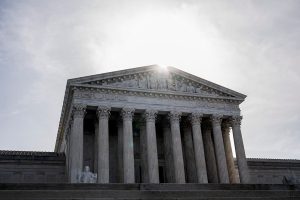
A Supreme Court decision that has largely flown under the radar could nonetheless prove to be a major victory for conservatives in the battle against left-wing lawfare and weaponized government in the years ahead.
On April 29, the Court handed down a unanimous ruling in First Choice Women’s Resource Center v. Davenport. At first glance, it appears to be largely technical in nature, but it could have significant downstream effects.
The case began in 2022 when then-New Jersey Attorney General Matthew Platkin, a Democrat, issued a “consumer alert,” warning about pregnancy resource centers. (The current Attorney General of New Jersey is Democrat Jennifer Davenport, hence why her name, not Platkin’s, is listed on the case.)
Sometimes called “crisis pregnancy centers,” these pro-life nonprofits offer free resources for pregnant moms and families, including counseling, medical care, diapers, and clothes. In 2024 alone, such centers provided nearly $500 million in services to one million clients.
Despite the heroic and charitable work of these pro-life organizations, Democrats have long targeted them for giving women the resources and support to choose life instead of abortion.
Accordingly, Platkin’s “Reproductive Rights Strike Force” accused “groups like First Choice of seeking to prevent people from accessing reproductive health care by providing false or misleading abortion information,” as Justice Neil Gorsuch wrote in the court’s opinion.
Platkin specifically demanded “28 categories of documents, including documents reflecting the names, phone numbers, addresses, and places of employment of all individuals who had made donations to First Choice by any means other than through one specific webpage.”
The case continued for several years as judges considered the technical legal question of whether the subpoenas were themselves injuries that allowed First Choice to sue. Eventually, the question ended up at the Supreme Court, where even left-wing justices Elena Kagan, Sonia Sotomayor, and Ketanji Brown Jackson sided with the crisis pregnancy center.
Technically, the Court’s decision only clears the way for First Choice’s lawsuit against New Jersey to move forward in federal court by ruling that the organization has a right to sue because it suffered an “actual or imminent” injury as a result of New Jersey’s subpoena. The ruling specifically held that the subpoena deterred donors from associating with First Choice, thus constituting injury; that New Jersey effectively restricted how First Choice may interact privately with its donors; and that “[a]n official demand for private donor information is enough… to discourage groups from expressing dissident views.”
One particularly shocking detail revealed in the case is that no First Choice donor had ever actually complained to state officials about being misled by the group’s operations, even though Platkin urged people to complain to consumer affairs.
The majority opinion also noted that nonprofits generally have a right to be protected from large fishing expeditions for private data absent legitimate concerns. This principle stretches back to the 1958 Supreme Court case NAACP v. Alabama, where officials in the segregated Southern state demanded membership rolls from the black civil rights advocacy group. In response to New Jersey’s suggestion that First Choice donor data would’ve been kept private, Gorsuch asks, “Would it have been an answer in NAACP v. Alabama if the State’s Attorney General promised to keep the NAACP’s membership rolls to himself?”
The Court reaffirmed this principle in 2021 in Bonta v. Americans for Prosperity Foundation, where California’s left-wing Attorney General Rob Bonta demanded private donor information from conservative groups.
Demands for information must pass the toughest bar of “strict scrutiny” when the requests could conflict with the First Amendment. “Demands for private donor information, we held, ‘chill’ protected First Amendment associational rights even when those demands contemplate disclosure only to government officials,” Gorsuch wrote.
Legal scholar Timothy Lee made a similar point in December in his preview of the case.
“Citizens don’t owe government an accounting of which lawful advocacy organizations they support any more than they owe government a list of what books they read, what newspapers they purchase, what news channels they watch or how they vote,” Lee wrote.
He had urged the Court to rule that “compulsory disclosure of donors has no place in a free society unless the government can demonstrate a truly compelling interest in disclosure.”
Still, some may have concerns that the latest ruling will make it more difficult for conservatives to hold accountable left-wing groups like donation processor ActBlue over complaints that it improperly accepted foreign donations. ActBlue is currently under investigation by the Department of Justice and several congressional committees.
However, this situation is different. In ActBlue’s case, there are documented complaints that the platform “may have allowed illegal donations to political campaigns to come through.”
“Congressional investigators also uncovered anomalies in ActBlue donations, such as donations being made in amounts the donor couldn’t afford and unusually frequent donations being made by elderly Americans,” according to an article on the Federalist Society website.
The Supreme Court’s ruling in First Choice does not handcuff prosecutors from opening investigations; rather, it requires them to have some proof of malfeasance to do so. In this case, Platkin’s office sought First Choice donor data without any evidence of wrongdoing with clear intentions of dissuading current and prospective donors from supporting First Choice.
Donors should feel secure that their private records are not going to be used against them by rogue Democrat prosecutors who are seeking to chill the free speech of pro-life and conservative groups. They also should feel confident that state authorities will properly investigate legitimate complaints.
While the First Choice ruling is indeed technical in nature, it draws a firmer constitutional line against the use of government power to intimidate political opponents under the guise of regulation. Going forward, activist officials will face a higher bar before prying into the internal operations of nonprofit groups, especially when core First Amendment rights are at stake.
If consistently applied, this precedent could mark the beginning of the end for one of the left’s most effective lawfare tactics.
Matt Lamb is an AMAC Newsline contributor and associate editor for The College Fix. He previously worked for Students for Life of America, Students for Life Action, and Turning Point USA. He previously interned for Open the Books. His writing has also appeared in the Washington Examiner, The Federalist, LifeSiteNews, Human Life Review, Headline USA, and other outlets. The opinions expressed are his own. Follow him @mattlamb22 on X.
