
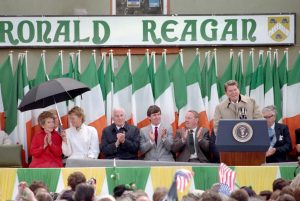
Photo Credit | Ronald Reagan Presidential Library & Museum
Ronald Reagan’s buoyancy, his amusement with the world in rough times, ability to see humor in the ordinary, and willingness to share what he saw – that inner lightness – was a beacon. We need more leaders who know how to laugh, take their job seriously, and themselves not so much.
Too often, people in leadership think the job is about being forceful, asserting authority, and taking command. Maybe in combat, but seldom in daily life. Today’s leaders too often resolve to listen, but fail to understand.
Reagan’s attitude – as the years pass – comes back to me, because at 21, 22, and 23, I worked in his White House, watched the man. Remembering him brings a smile. He cared about people, and they knew it. He was admired, even adored.
I can hear the cynics, critics, and surefooted doubters, and that is alright too. If you have never seen him, have not read his speeches, watched his press conferences, days at Normandy, Berlin, London, White House, and Whitehall, then doubt is natural.
But Reagan – like few presidents, governors, or CEOs in history or today – was an alloy, hard times young producing good cheer under pressure; hard work throughout his life grounding him; and vision that inspired him daily, got him up, as he tried to help others to see the future he saw, and work for it.
While I would not call Reagan “jolly,” I would call him whimsical, happy with life, and generous of heart, from the day he picked a lens cap in the Rose Garden grass, walking it back to Sam Donaldson’s cameraman, to how he told stories for kids.
Reagan was authentic, took nothing personally, lived to find those “better angels of our nature” – not just to inspire, but because he needed to find them for himself.
We know people who are fun to be around, naturally congenial, who speak truth to us but are aware of our feelings, who mean to lift us, not break us, who measure themselves not by where they have been but how they treat others.
That was Reagan. I recall so many self-deprecating one-liners. Going into surgery after the assassination attempt, he said, “Please tell me you’re all Republicans.” Coming out of anesthesia: “All in all, I’d rather be in Philadelphia,” an old W.C. Fields line.
Reagan was a mix of having lived through so much that was serious, the Depression, his father’s alcoholism, World War II, ups and downs of the 1950s and 1960s – and the rigmarole of Hollywood – that he took things in stride.
Trying to put my finger on what is missing, today, leaders take themselves as arbiters of everything. They have lost the ability to differentiate between serious and unimportant, what matters, and the nonsense, defaulting to self-righteousness.
Thinking of Reagan, his attitude lightened the whole enterprise of government, the process of sharing ideas, debating, and building support for them, modifying as needed, and sharing credit once done. People trusted him, a trust he kept.
As Saint Patrick’s Day arrives, four-leaf clovers everywhere, we think Irish. My mind goes to Reagan, his friendship with fellow Irishman, Democrat Tip O’Neil.
These two men – opposite ends of the spectrum, but both Americans first – did often break bread. One St. Patrick’s Day in the Rose Garden, Speaker Tip O’Neil was in the front row. Reagan decided to have some fun. It went like this…
“Folks, I don’t know if you all know, but Tip and I often have a meal, share confidences, what Irishmen do.” Reagan looked at O’Neil. “I hope you won’t mind, Tip, I thought I’d share one of yours today…” The tip did not move.
For background, the President and Speaker often duked it out over policy, taxes, and spending. Tip was congenial but a tough Speaker, a hard-bitten negotiator.
Reagan continued. “The other night, the Speaker shared with me his lifetime ambition…He would someday like to be Ambassador to Ireland…” Reagan paused, then the punchline: “Tip, how about tomorrow!” The place exploded.
After he left the White House, Reagan moved back to California. The last time I saw him was in the early 1990s. He was still crisp, smiling, and witty. On finishing a one-on-one visit, really just a “thank you” and look back, we stood in his doorframe.
I could not help saying “thank you” again. Noting his demeanor was positive, strength good, joy built in, I added. “You know, Sir, you look …fit as a fiddle,” I said. He never missed a beat. “Well, you know, I did play football…” he chortled. With that, we parted. Reagan’s buoyancy lifted a nation. He remains a beacon.
Robert Charles is a former Assistant Secretary of State under Colin Powell, former Reagan and Bush 41 White House staffer, Maine attorney, ten-year naval intelligence officer (USNR), and 25-year businessman. He wrote “Narcotics and Terrorism” (2003), “Eagles and Evergreens” (North Country Press, 2018), and “Cherish America: Stories of Courage, Character, and Kindness” (Tower Publishing, 2024). He is the National Spokesman for AMAC. Today, he is running to be Maine’s next Governor (please visit BobbyforMaine.com to learn more)!
