
This Sunday, 2.3 billion Christians around the world will celebrate the Resurrection of Jesus Christ following his crucifixion on Good Friday two thousand years ago. But what is often overlooked is that the story of Easter is not only a story of Christ overcoming sin and death – it is also a story of divine truth overcoming one of the earliest and most deliberate attempts to suppress it. From the very beginning, the Resurrection was met not just with doubt, but with a coordinated campaign to deny and dismiss its miraculous nature.
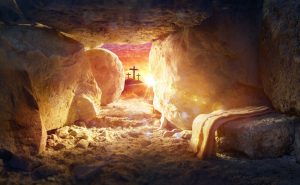
The Gospels do not dwell on the mechanics of the Resurrection itself. There is no eyewitness account of the stone being rolled away from the tomb, or of those first glorious moments when life returned to the human body of Christ. The Gospel of Matthew tells us only that an Angel of the Lord rolled back the stone and the guards fled in fear.
The guards then went to the city, where they reported what they had seen to the chief priests. But instead of rejoicing at this miracle – proof that Jesus was the Son of God – the authorities immediately hatched a plan to bury the truth of the Resurrection:
“And when they were assembled with the elders, and had taken counsel, they gave large money unto the soldiers, saying, ‘Say ye, His disciples came by night, and stole him away while he slept.’” (Matthew 28:12-13)
This was not confusion or misunderstanding. It was a deliberate attempt to erase the most significant moment in human history. It was one of the earliest recorded examples of organized deception – a coordinated effort to obscure the truth at the very moment it appeared.
The episode reveals something enduring about human nature and about how actual disinformation works. What began as an attempt to suppress the truth of the Resurrection became a model for future political warfare.
First, there were the words: a false narrative crafted to explain away what could not be denied. Second, there were the actions: the guards were paid and directed to repeat the claim. Third, there was organization: authorities ensured the story spread and held.
Together, these elements formed a complete system. The lie was not spontaneous, but carefully constructed. We see this pattern repeated again and again throughout history, not only when it comes to the Bible, but also other enduring truths.
Retired Professor of Formal Logic Ruprecht von Bültzingslöwen, who advised the German Chancellor in the 1980s, described this structure succinctly as “the three pillars of disinformation.”
Seen through this lens, the Gospel account is not only a theological narrative, but also a case study in how divine truth is challenged when it threatens worldly power. Professor von Bültzingslöwen, who helped expose Soviet disinformation campaigns, noted that “the scheme revealed in the Gospels was a skeleton of many combined operations launched by the Soviet Communist Party.”
In 2005, former KGB Colonel Oleg Gordievsky shared with me a Soviet Politburo protocol in which Yuri Andropov, former General Secretary of the Soviet Communist Party, citing militant atheist Yemelyan Yaroslavsky, argued that the authorities in Jerusalem had pioneered disinformation against the Apostles.
But the Gospel does not end with deception. Instead, as the Book of Acts and later New Testament works detail, every attempt to suppress the truth of Christ’s sacrifice only resulted in that truth spreading further and faster. Over the span of just a few hundred years, Christianity went from a few scared men hiding from the religious authorities following the state-sanctioned murder of their leader to the official religion of the Roman Empire.
The Apostles accomplished this feat through the power of the Holy Spirit, which guided them in how to counteract the world’s disinformation campaign. Instead of attempting to suppress opposing voices or impose belief through authority, they bore witness to Christ’s teachings and miracles. In a sense, they were pioneers of a belief in free speech that would later become a foundational principle of the U.S. Bill of Rights.
The Apostles spoke openly about what they had seen. They relied on testimony – on encounter, on experience, on truth repeated freely rather than enforced. Their message spread not through coercion, but through conviction. As New Testament scholar Professor Gordon Fee reflected in a 2001 interview, “the Apostles visibly trusted that the Holy Spirit would guard the truth and did not take matters into their own hands.”
This contrast reflects the heart of the Resurrection story.
On one side was a coordinated effort to shape perception, suppress reality, and protect authority through deception. On the other side were a few brave disciples willing to let truth stand on its own, even in the face of doubt, opposition, and risk.
The Apostles understood what they were up against. They knew the narrative being spread about them. Yet they chose not to mirror it. They did not construct counter-propaganda. They did not manipulate. They spoke—and allowed others to judge.
History proves which approach endures. The false story of a stolen body, though powerful in the moment, did not last. It required maintenance, reinforcement, and authority to sustain it. The truth, by contrast, moved outward – carried by witnesses, tested by time, and strengthened through scrutiny.
That pattern has repeated across the centuries. Systems built on manipulation and imposed narratives eventually fracture. Truth, when freely encountered, proves far more resilient.
The Resurrection story shows how quickly truth can be challenged and how deliberately it can be obscured. But it also shows that truth does not require force to survive. It requires only witnesses willing to speak it.
The example set on that first Easter morning remains as relevant now as it was then. In a world saturated with competing narratives, the temptation to control, distort, or overwhelm is constant. But the Gospel offers a different model – one grounded in humility, restraint, and confidence that truth does not need to be manufactured. It needs only to be told.
Ben Solis is the pen name of an international affairs journalist, historian, and researcher.
