
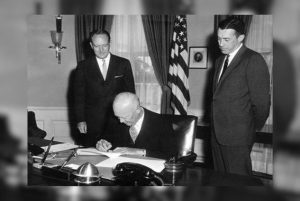
On May 6, 1960, President Dwight D. Eisenhower signed the Civil Rights Act of 1960 into law and issued a formal statement marking the occasion as a meaningful, if measured, advance in the ongoing struggle for equality in the United States. Coming at a time of mounting pressure from the civil rights movement, the legislation sought to strengthen earlier federal protections—particularly those established by the Civil Rights Act of 1957—while signaling a continued commitment by the federal government to address racial discrimination, especially in voting.
In his signing statement, Eisenhower described the new law as a “historic step forward in the field of civil rights,” emphasizing both its symbolic importance and its practical goals. Rather than introducing sweeping new guarantees, the Act focused on closing loopholes and reinforcing enforcement mechanisms that had proven insufficient in earlier efforts. The president underscored that the legislation was designed to ensure that constitutional rights—especially the right to vote—were more effectively protected, reflecting a growing recognition that legal equality required not just laws on paper, but meaningful federal oversight.
A central focus of the 1960 Act was voting rights, an issue that lay at the heart of the civil rights struggle. Across much of the American South, African Americans continued to face systemic barriers to voter registration, including intimidation, discriminatory practices, and bureaucratic obstacles. The law responded by authorizing federal inspection of local voter registration processes and imposing penalties on those who interfered with a citizen’s attempt to vote. In his remarks, Eisenhower highlighted the importance of these provisions, expressing hope that they would help make the Fifteenth Amendment—guaranteeing the right to vote regardless of race—fully effective in practice.
The president also pointed to other key aspects of the legislation, including expanded authority for federal investigations into acts of violence such as the bombing of schools and churches. These provisions were intended to deter acts of intimidation and lawlessness that had increasingly accompanied desegregation efforts. By strengthening the role of federal agencies, the Act represented a cautious but important shift toward greater federal involvement in civil rights enforcement.
Despite its significance, the Civil Rights Act of 1960 was widely seen as incremental rather than transformative. It reflected the political realities of the time, when strong resistance in Congress limited the scope of civil rights reforms. Still, Eisenhower’s statement conveyed a sense of forward momentum, framing the law as part of a broader national effort to uphold justice and equality under the Constitution.
In hindsight, the 1960 Act—and the president’s words upon signing it—served as a bridge between early civil rights legislation and the more sweeping reforms that would follow later in the decade. While it did not fully resolve the deep inequalities facing African Americans, it reinforced the principle that the federal government had both the authority and the responsibility to protect the rights of all its citizens.
