
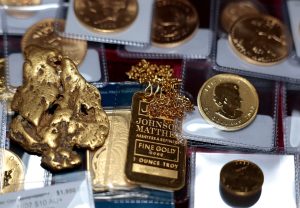
Although the United States has officially been off the gold standard since 1971, a growing number of states are following individual investors in buying up significant quantities of gold and other precious metals – perhaps signaling a broader shift in where governments park their funds in the years ahead.
Wyoming became the latest state to bet big on gold, buying more than $10 million worth in December after lawmakers required the state to add precious metals to its investment portfolio. About 72 smartphone-sized gold bars are now being stored in an old newspaper building on the outskirts of Casper.
While critics of the strategy worry about fluctuating prices, the value of gold has skyrocketed in recent years, rising from less than $2,000 an ounce as recently as March 2023 to more than $5,200 an ounce in February 2026. It now sits at around $4,600 an ounce – more than double the increase in the S&P 500 over the same period.
Utah has also moved to invest in gold, allocating up to 10 percent of its budget stabilization fund, about $140 million, in precious metals purchases in 2024. Lawmakers in West Virginia, Tennessee, and Georgia have pushed similar bills. Missouri, Texas, Florida, and Arkansas also passed laws last year that made it easier to use gold and silver as legal tender.
Texas has gone even further. Rather than simply allowing or encouraging precious metals holdings, the Lone Star State built its own bullion depository and sought to bring about $1 billion in bullion back under state control.
While these state-level moves alone likely won’t have much impact on the overall national economy, they do reflect growing distrust of Washington’s fiscal irresponsibility and the dollar’s long-term stability. The fact that states feel the need to invest in what has long been seen as the most secure asset is indicative of a population that has become increasingly uneasy about the country’s financial future.
That uneasiness is reflected in the general population as well. A survey of 2,000 U.S. adults ages 35 to 64 found that 38.6 percent had bought gold or silver as an investment in the previous 12 months, while 91.7 percent of those buyers said they were just as likely, or more likely, to buy again in the year ahead. Millennials aged 35 to 44 reported the highest buying rate at 47.5 percent.
Taken together, the state-level push and the consumer data suggest that skepticism toward fiat money now reaches well beyond lawmakers and traditional hard-money circles.
Supporters of the new gold and silver laws cite concerns about inflation, debt, and the long-term strength of the dollar. Wyoming State Sen. Bob Ide put it bluntly. “I can’t put a timeline on it, but there’s gonna be a sovereign-debt crisis,” Ide told The Wall Street Journal. “There’s no will to rein in spending.”
Buying gold, of course, does not eliminate a state’s reliance on the dollar – and the U.S. dollar, while not as valuable as it once was, remains the world’s reserve currency. But what gold can do is give states and individuals an asset that may hold value better than dollar-denominated assets if inflation rises or confidence in federal policy weakens. It is no cure-all, but it can hedge against some of the damage that short-sighted fiscal policy causes.
That is why gold still matters. A fiat system depends on restraint from the people running it. Gold imposes restraint from outside the political system. Congress cannot vote more gold into existence. The Federal Reserve cannot create it to relieve pressure from growing debt. Meanwhile, both Congress and the Federal Reserve have had no problem printing and spending money that America does not have, thus devaluing privately held paper money.
Gold, like any monetary system, is not perfect. But it gives the government less room to disguise the cost of its decisions.
For most of American history, the dollar was tied in one way or another to gold. Under that system, paper money was not simply worth whatever the government said it was worth. It was meant to be a redeemable claim on something tangible. The gold standard limited how far the government could expand money and credit before it had to make good on that promise.
The United States left the gold standard for domestic transactions in 1933 and ended international convertibility in 1971, completing the move to fiat money.
In 1933, President Franklin D. Roosevelt suspended domestic convertibility and even limited private gold ownership during the Great Depression. The administration wanted more room to fight bank failures and deflation.
The subsequent Bretton Woods System, which was established in 1944, pegged international currencies to the U.S. dollar. Critically, it also allowed foreign governments to redeem dollars for U.S. gold. But persistent U.S. deficits and mounting pressure on American gold reserves made that promise difficult to keep. In 1971, President Richard Nixon closed the gold window, ending foreign redemptions and completing the transition to a full fiat regime.
Both advocates and critics agree on one thing: the gold standard constrained the government. A few state purchases of gold will not restore sound monetary policy or shield the country from every poor fiscal decision in Washington. But the gold rush does signal that trust in the federal government’s stewardship of the dollar has weakened – and that more and more Americans want their wealth stored in something that politicians cannot debase.
Sarah Katherine Sisk is a proud Hillsdale College alumna and a master’s student in economics at George Mason University. You can follow her on X @SKSisk76.
